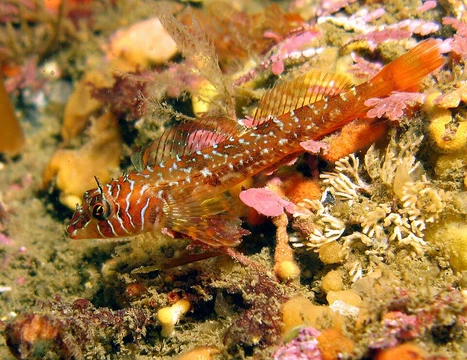
Squilla mantis
Commercially fished mantis shrimp of the Mediterranean and Eastern Atlantic.

Squilla mantis, also called the spot-tail mantis shrimp, pacchero, or canocchia, lives in shallow coastal waters of the Mediterranean Sea and the eastern Atlantic Ocean. It is the only mantis shrimp caught commercially in the Mediterranean, thanks to its abundance.
This species can reach 200 millimeters (about 8 inches) in length. It is a spearer type, meaning its front limbs are modified into long, spiked spears for capturing soft-bodied prey. Its body is generally dull brown, with two brown eye spots ringed in white at the base of the telson. Other mantis shrimp species, including smashers, are sometimes sold in the aquarium trade under the name *Squilla mantis*.
The spot-tail mantis shrimp is found all around the Mediterranean coast, and in the Atlantic from the Gulf of Cádiz south to Angola, as well as near the Canary Islands and Madeira. It was once recorded from Galicia, the Bay of Biscay, and the British Isles, but no longer appears there. It is most common on sandy or muddy bottoms near river outflows, where the substrate is good for burrowing. In the Mediterranean, the Nile, Po, Ebro, and Rhône rivers create such conditions. These shrimp are usually found down to 150 meters deep, with the highest densities between 50 and 60 meters, though they have been recorded as deep as 367 meters.
*S. mantis* digs burrows in muddy or sandy bottoms near the coast. It stays in its burrow during the day and emerges at night to hunt, and in winter to mate. Its feeding is strongly tied to nighttime, and captive individuals often refuse food during the day. Adults are very sedentary. The alpheid shrimp *Athanas amazone* often lives in these burrows, despite being similar in size to other shrimp that *S. mantis* eats. The relationship between the two species is unknown, though a similar case has been reported for *Athanas squillophilus* in the burrows of *Oratosquilla oratoria* in Japan.
Spot-tail mantis shrimp are opportunistic predators and scavengers, eating whatever is locally available. Common food includes crabs, decapods, bivalves, squid, polychaetes, benthic fish, and algae. They have been seen following fishing boats to feed on dead animals. They also show cannibalism, with remains of their own kind found in their digestive tracts. They have been recorded eating the egg masses of common cuttlefish.
Reproduction happens over winter and spring. In the Ligurian Sea, gonad maturity peaks in April; in the Adriatic Sea, it peaks between February and March. Females attach their eggs to their front legs using a sticky secretion from cement glands in their sternums. They then spend spring and early summer incubating the eggs, staying in their burrows and not feeding. Eggs hatch between late spring and late summer. The larvae, called alima, are planktonic and remain in the water column through summer and early autumn, with the highest numbers in August, though some persist into November. After ten molts in the water, the larvae settle on the seafloor and grow to adult size over the rest of the year. Females usually spawn in their second year. While some individuals may live into a third year, most only spawn once.
*S. mantis* is the only native stomatopod fished commercially in the Mediterranean. Over 7,000 tons are caught each year, 85% of that from Italian shores of the Adriatic Sea. Spain is the next most important fishing area, with smaller fisheries in France, Israel, and Egypt. In Catalonia, most of the catch comes from around the Ebro River delta, where the densest local populations live; it is called "galera" there. Outside the Mediterranean, it is eaten in Andalusia in the Gulf of Cádiz. Spot-tail mantis shrimp are usually caught as valued bycatch in multi-species trawling targeting sole and bivalves. Dedicated fishing uses trammel nets and gillnets. Catches are highest in winter, when adults are mating, and lowest in spring and early summer, when females stay in their burrows. Because the fishery is mostly bycatch, it is not specifically regulated.
- Type
- Spearer
- Distribution
- Mediterranean Sea and Eastern Atlantic from Gulf of Cádiz to Angola, including Canary Islands and Madeira
- Commercial importance
- Only commercially fished mantis shrimp in the Mediterranean
Quick Facts
- Taxon
- Squilla mantis
Facts from the source article.
Lore & Background
Squilla mantis is a spearer-type mantis shrimp, using spiked, elongated forelimbs to capture soft-bodied prey. It digs burrows in sandy and muddy bottoms near coastlines, remaining in its burrow during the day and emerging at night to hunt and in winter to mate. Its feeding activity is strongly linked to night, and captive specimens refuse food during the day. Adults are strongly sedentary. The species is found around the entire coast of the Mediterranean and in the Atlantic from the Gulf of Cádiz to Angola, as well as around the Canary Islands and Madeira. It has historically been recorded from Galicia, the Bay of Biscay, and the British Isles, but is not known to occur there any more. It is particularly abundant on sandy and muddy bottoms with significant river runoff, such as the outflows of the Nile, Po, Ebro, and Rhône. Reproduction occurs over winter and spring, with gonad maturity peaking in April in the Ligurian Sea and between February and March in the Adriatic Sea. Females attach eggs to their anterior legs using a sticky secretion and incubate them through spring and early summer without leaving their burrows or feeding. The planktonic larvae, called alima, remain in the water column over summer and early autumn, settling on the sea bottom after ten molts. Most S. mantis spawn only once, typically within their second year.
Reader's Guide
Its abundance in shallow coastal areas with muddy or sandy bottoms, particularly near river outflows, has made it a valued by-catch in multi-species trawling for sole and bivalves, as well as a target for trammel nets and gillnets. Catches peak in winter during mating and drop in spring and early summer when females remain in burrows. The fishery is not specifically regulated, as it consists chiefly of bycatch. Ecologically, S. mantis is an opportunistic predator and scavenger, feeding on crustaceans, mollusks, polychaetes, benthic fishes, and algae, and has been observed following fishing boats to feed on dead animals. It also displays cannibalism and feeds on cuttlefish egg masses. The species hosts the alpheid shrimp Athanas amazone in its burrows, a relationship that remains unknown. Its life cycle, with a single spawning event for most individuals and a planktonic larval stage, shapes its population dynamics and fishery patterns. The species is also sometimes sold in the aquarium trade under the name Squilla mantis, though other species may be included.
Did You Know?
- It has two brown eye spots circled in white at the base of the telson, giving it the common name spot-tail mantis shrimp.
- The alpheid shrimp Athanas amazone often lives in the burrows of S. mantis, despite being similar in size to prey the mantis shrimp feeds on.
- Females attach their eggs to their anterior legs using a sticky secretion and do not leave their burrows or feed during incubation.
More in Aquatic Invertebrates 1-24
Spotted an error? Know more?
This is a living reference — every entry is fact-audited, and reader corrections feed straight into our audit queue. Suggest an edit · See this site's audit record