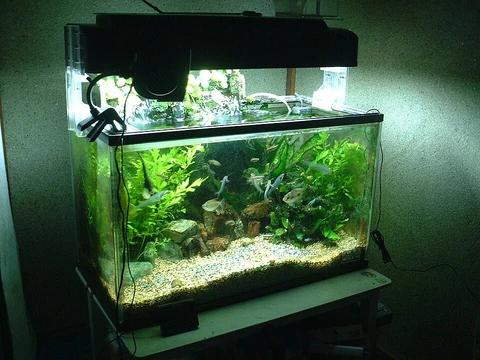
Freshwater ecosystem
Freshwater ecosystems host 41% of known fish species.

Freshwater ecosystems are the parts of Earth’s aquatic environments where the water has low salt content. They include all the living communities found in lakes, ponds, rivers, streams, springs, bogs, and wetlands. Unlike marine ecosystems, which are much saltier, these habitats are shaped by factors like temperature, how far light reaches, available nutrients, and the types of plants present. There are three main categories: lentic systems (still or slow-moving water, such as pools, ponds, and lakes), lotic systems (faster-moving water like creeks and rivers), and wetlands (areas where the soil is soaked or flooded for at least part of the year). These ecosystems are home to 41% of all known fish species on the planet.
Over time, freshwater ecosystems have changed a lot, which has affected their features. Early efforts to study and track them were driven by risks to human health, like cholera outbreaks from sewage pollution. At first, monitoring focused on chemical signs, then bacteria, and later algae, fungi, and protozoa. A newer approach involves counting different groups of organisms—such as macroinvertebrates, aquatic plants, and fish—and measuring the stream conditions linked to them.
The main threats to freshwater biodiversity are overexploitation, water pollution, changes in water flow, destruction or damage of habitats, and the arrival of invasive species. Climate change adds more pressure: water temperatures have already risen by about 1 °C, and there have been major drops in ice cover, causing further stress on these ecosystems. Between 1970 and 2014, the populations of freshwater vertebrates dropped by 83%, a decline that outpaces losses in marine or land environments. The causes include a rapidly shifting climate, online wildlife trade and invasive species, infectious diseases, toxic algae blooms, hydropower dams that fragment half the world’s rivers, emerging contaminants like hormones, engineered nanomaterials, microplastic pollution, light and noise interference, saltier coastal freshwaters from rising sea levels, and falling calcium levels that harm some freshwater organisms. These threats can add up or even amplify each other.
Invasive plants and animals are a major problem, often outcompeting native species and changing water conditions.
- Percentage of world fish species
- 41%
- Temperature increase
- about 1 °C
- Freshwater vertebrate decline 1970 2014
- 83%
- North american freshwater extinctions si
- over 123 species
- North american freshwater fish extinctio
- 877 times higher than background extinction rates
Lore & Background
Freshwater ecosystems have undergone substantial transformations over time, which has impacted various characteristics of the ecosystems. Original attempts to understand and monitor freshwater ecosystems were spurred on by threats to human health (for example cholera outbreaks due to sewage contamination). Early monitoring focused on chemical indicators, then bacteria, and finally algae, fungi and protozoa. A new type of monitoring involves quantifying differing groups of organisms (macroinvertebrates, macrophytes and fish) and measuring the stream conditions associated with them.
Threats to freshwater biodiversity include overexploitation, water pollution, flow modification, destruction or degradation of habitat, and invasion by exotic species. Climate change is putting further pressure on these ecosystems because water temperatures have already increased by about 1 °C, and there have been significant declines in ice coverage which have caused subsequent ecosystem stresses. The World Wide Fund for Nature's Living Planet Index noted an 83% decline in the populations of freshwater vertebrates between 1970 and 2014, outpacing contemporaneous declines in marine or terrestrial systems.
Invasive plants and animals are a major issue to freshwater ecosystems, in many cases outcompeting native species and altering water conditions. Introduced species are especially devastating to ecosystems that are home to endangered species. An example of this being the Asian carp competing with the paddlefish in the Mississippi river. Common causes of invasive species in freshwater ecosystems include aquarium releases, introduction for sport fishing, and introduction for use as a food fish.
Reader's Guide
Freshwater ecosystems are notable for containing 41% of the world's known fish species despite covering a small fraction of Earth's surface. Their biodiversity faces severe threats: over 123 freshwater fauna species have gone extinct in North America since 1900, with 48.5% of mussels, 22.8% of gastropods, 32.7% of crayfishes, 25.9% of amphibians, and 21.2% of fish either endangered or threatened. Extinction rates for freshwater animals are projected to be around five times greater than for land animals, comparable to rainforest communities. Current biomonitoring techniques focus on community structure, using macroinvertebrates and algae because of their diverse taxonomy, ease of collection, and sensitivity to stressors. Reference sites are used to define idealized ecosystem health, either spatially by selecting minimally impacted sites or temporally by using preserved indicators such as diatom valves, macrophyte pollen, insect chitin, and fish scales. Climate change exacerbates other stressors by increasing water temperatures and reducing ice coverage, causing ripple effects on substrate composition, oxygen concentration, and biology. Given the dire state of freshwater biodiversity, a team of scientists and practitioners drafted an Emergency Action plan to try and restore freshwater biodiversity.
Did You Know?
- Water temperatures in freshwater ecosystems have already increased by about 1 °C.
- Freshwater vertebrate populations declined by 83% between 1970 and 2014.
The Three Pillars of Freshwater Life
Freshwater ecosystems represent a distinct branch of Earth's aquatic world, defined by their low salinity in contrast to the salt-heavy marine realm. These habitats span an extraordinary range of waterbodies—from still lakes and quiet ponds to rushing rivers and narrow creeks, from spring-fed pools to waterlogged bogs and marshy wetlands. Scientists classify these environments along multiple axes, including water temperature, how deeply light penetrates, nutrient availability, and the character of surrounding vegetation.
The field organizes freshwater habitats into three fundamental categories. Lentic systems encompass slow or standing water such as pools, ponds, and lakes. Lotic systems capture the energy of faster-moving water found in streams, creeks, and rivers. Wetlands occupy a middle ground, where soil remains saturated or periodically flooded, creating a semi-aquatic zone. Together, these three types harbor 41 percent of all known fish species on the planet, underscoring how biologically concentrated these environments are. The scientific discipline dedicated to studying them is limnology, with freshwater biology serving as a key subfield exploring the living communities within these waters.
A Biodiversity Collapse in Plain Sight
The scale of freshwater biodiversity loss is staggering and accelerating. The World Wide Fund for Nature's Living Planet Index documented an 83 percent decline in freshwater vertebrate populations between 1970 and 2014, a rate of collapse that outpaces losses in both marine and terrestrial systems. In North America alone, more than 123 freshwater fauna species have gone extinct since 1900. The remaining populations face dire odds: an estimated 48.5 percent of mussels, 32.7 percent of crayfishes, 25.9 percent of amphibians, and 21.2 percent of fish are now classified as endangered or threatened.
The extinction math is particularly alarming. Even under conservative estimates, freshwater fish extinction rates in North America run 877 times higher than the natural background rate of one species per three million years. Projected extinction rates for freshwater animals overall are roughly five times greater than those for land animals, placing them on par with the losses seen in tropical rainforest communities. Recognizing the severity, a global team of scientists and practitioners has drafted an Emergency Action Plan aimed at halting and reversing the trajectory of freshwater biodiversity loss.
A Web of Compounding Threats
Freshwater ecosystems face a layered assault from multiple directions simultaneously. Five broad categories of pressure dominate: overexploitation of resources, water pollution, alteration of natural flow patterns, destruction or degradation of habitat, and the introduction of exotic species. Climate change compounds every one of these, with water temperatures already rising by approximately one degree Celsius and significant losses in ice coverage triggering cascading ecosystem stresses.
Hydropower development has fragmented roughly half the world's rivers, while chemical stresses such as acidification, eutrophication, and contamination from copper and pesticides degrade water quality. Emerging contaminants including hormones, engineered nanomaterials, and microplastics add further complexity, alongside light and noise interference and rising salinity in coastal freshwaters from sea level rise. Invasive species pose a particularly acute danger, with introduced organisms like Asian carp outcompeting native paddlefish in the Mississippi River. These invasions often originate from aquarium releases, sport fishing introductions, or stocking for food. Crucially, these threats do not act in isolation; their additive and potentially synergistic interactions multiply the damage far beyond what any single stressor would cause alone.
Reading the Water: Science of Monitoring and Recovery
Understanding freshwater health has evolved dramatically over time. Early monitoring efforts were driven by public health crises such as cholera outbreaks linked to sewage contamination. The scientific toolkit progressed from simple chemical indicators to tracking bacteria, then to observing algae, fungi, and protozoa. Modern programs now quantify entire communities of macroinvertebrates, macrophytes, and fish, measuring the stream conditions these organisms depend on.
Biomonitoring programs focus heavily on community structure, with macroinvertebrates serving as a particularly valuable indicator group due to their taxonomic diversity, ease of collection, and sensitivity to a wide range of environmental stressors. Algal communities, often tracked through diatoms, offer another powerful lens because of their rapid growth rates, which allow them to reflect swift changes in water conditions. Functional indicators such as biochemical oxygen demand, sediment oxygen demand, and dissolved oxygen levels supplement these biological measures.
Defining what healthy looks like relies on reference sites chosen for minimal human disturbance, or on temporal indicators like preserved diatom valves. Experimental studies further probe how stressors alter organism behavior, growth, reproduction, and mortality, though researchers caution that single-species controlled results may not fully capture the complexity of natural multi-species communities.
Frequently Asked Questions
Who is Freshwater ecosystem?
Freshwater ecosystem is the umbrella term for every low-salt aquatic habitat on Earth, spanning lakes, ponds, rivers, streams, springs, bogs, and wetlands. It is defined by its minimal dissolved-salt content, which sets it apart from the far saltier marine world.
What are Freshwater ecosystem's powers/role?
It shelters 41% of all known fish species, making it the single most important aquatic habitat for vertebrate diversity. Its living communities are governed by temperature, how deep sunlight penetrates, nutrient levels, and the particular plant species rooted in the water.
Why is Freshwater ecosystem important?
Although it occupies only a small slice of the planet's surface, it sustains nearly half of all described fish species and a vast web of invertebrate and plant life. Its health is further threatened by a roughly 1 °C warming trend that reshapes which organisms can survive in each body of water.
What are Freshwater ecosystem's three main forms?
The canon sorts it into lentic systems (still or slow-moving water such as ponds and lakes), lotic systems (faster-flowing water like creeks and rivers), and wetlands (saturated transition zones between land and open water). Each form supports a distinct mix of plants, invertebrates, and fish.
More in Aquarium and Aquatic Plants, Part 3 1-24
Spotted an error? Know more?
Reader corrections go straight into our review queue. Suggest an edit · How this site is sourced