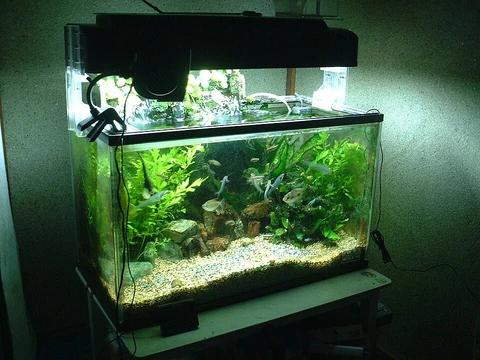
Aponogeton abyssinicus
Amphibious African plant with variable leaves and violet or white flowers.

Aponogeton abyssinicus is an amphibious plant from east and central Africa, occurring from Ethiopia down to Malawi and Zaire. Its root stock is a tuber or oblong structure, reaching up to 2.5 cm in diameter. Underwater leaves start out strap-shaped, up to 12 cm long and 6 mm wide, then become lanceolate to obovate, up to 8.5 cm long and 2.6 cm wide, with petioles up to 10 cm. The blade is thin and slightly translucent, with a narrowing or decurrent base and an acute or obtuse tip. Adult floating leaves have petioles up to 50 cm long; the blade is linear to ovoid, rarely heart-shaped, up to 16 cm long and 5 cm wide, but usually much smaller. Emerged leaves resemble floating ones but are slightly leathery and have shorter petioles.
The peduncle grows up to 45 cm, is angled, dark red to green, slightly hairy underwater and nearly smooth above, and is not swollen beneath the inflorescence. The spathe is 1.0–1.6 cm long and falls off early. The inflorescence has two spikes, each 1.5–5 cm long, with flowers arranged all around. Flowers have two tepals, colored violet or white; six stamens (absent in apomictic plants); and three carpels (up to seven in apomictic plants). Fruits reach up to 7 by 2.75 mm, containing (4–) 7–10 seeds, each 1–2 by 0.75 mm, with a double seed coat.
The species name *abyssinicus* comes from Latin, meaning "Abyssinian" or "Ethiopian," referencing its presence there.
Ecologically, it lives in shallow, usually temporary waters up to 2,700 meters elevation. White-flowering plants (more commonly violet) were collected in Tanzania’s Selous Game Reserve, where only a few grew at the edges of a permanent water body in shallow depth, sometimes fully emerged on moist ground.
In cultivation, *A. abyssinicus* is rarely imported but can be kept in an aquarium. Soft water, nutrient-rich loose substrate, and temperatures of 24–28 °C are recommended. In the tank, the white-flowering form forms a rosette about 15 cm wide and 10 cm tall, with light green leaves, suiting the foreground. Floating leaves, which rarely appear in aquariums, should be removed to keep later leaves short-petioled. Emersed or semi-aquatic growth is possible with high humidity, and best results come from shallow water. Propagation is only sexual, via very tiny seeds. While seeds usually germinate well, raising the young plants is extremely difficult and labor-intensive.
Quick Facts
- Genus
- Aponogeton
- Species
- abyssinicus
Facts from the source article.
Lore & Background
The specific epithet, abyssinicus, is derived from Latin and means 'Abyssinian' or 'Ethiopian', referring to the plant's occurrence there. Aponogeton abyssinicus populates shallow, usually temporary waters up to an altitude of 2,700 metres. White-flowering plants (usually violet-flowering) were collected by the author in the Selous Game Reserve, Tanzania, where very few specimens were located only on the edges of a permanent water in shallow depth, occasionally also completely emersed in a moist substrate.
The plant's root stock is tuberous or oblong, up to 2.5 cm in diameter. Submersed leaves are initially strap-shaped, up to 12 cm long and 6 mm wide, continuing lanceolate to obovate, up to 8.5 cm long, 2.6 cm wide and up to 10 cm long petiolate. The blade is thin and slightly transparent, with a narrowing or decurrent base and acute or obtuse apex. Adult floating leaves are up to 50 cm long petiolate, with a blade linear to ovoid, rarely cordate, up to 16 cm long and 5 cm wide, usually considerably smaller. Emersed leaves are shaped like the floating leaves, slightly leathery and shorter petiolate.
The peduncle is up to 45 cm long, angled, dark red to green coloration, slightly pubescent underwater, almost glabrous above water, not swollen under the inflorescence. The spathe is 1.0–1.6 cm long and caducous. The inflorescence features two 1.5–5-cm long spikes with omni-lateral flowers; 2 tepals, violet or white coloration; 6 stamens (none in apomictic plants); 3 carpels (up to 7 in apomictic plants). The fruit is up to 7 x 2.75 mm, with (4-) 7-10 seeds, sized 1-2 x 0.75 mm, double testa.
Reader's Guide
Aponogeton abyssinicus is a rarely imported plant, the maintenance of which is entirely possible in an aquarium. For cultivation, preferably soft water as well as nutrient-rich and loose substrate is recommended. The best water temperature is 24–28 °C (75–82 °F). In the aquarium, the white-flowering form of A. abyssinicus forms a 15 cm wide and 10 cm tall rosette consisting of light green leaves, so that it may be considered for the foreground. The floating leaves, which only rarely form in aquariums, should be removed so that the later leaves will again remain short petiolate. An emersed or semi-aquatic keeping is possible under conditions of high humidity. Best cultivation results are achieved in shallow water. Propagation can occur only sexually through the very tiny seeds. Though they mostly germinate well, the rearing of the young plant is, in fact, extremely difficult and requires a lot of effort. Its significance lies in its adaptability to aquarium conditions despite its rarity in trade, and its unique leaf polymorphism that allows it to serve as a foreground plant when floating leaves are managed.
Did You Know?
- The specific epithet abyssinicus means 'Abyssinian' or 'Ethiopian' in Latin.
- The plant can grow at altitudes up to 2,700 metres.
- Propagation is only possible sexually through very tiny seeds, and rearing young plants is extremely difficult.
Frequently Asked Questions
What is Aponogeton abyssinicus?
It is an amphibious aquatic plant native to the freshwater systems of east and central Africa. Unlike purely submerged species, it can produce both underwater foliage and floating leaves at the water's surface.
Where is Aponogeton abyssinicus found in the wild?
Its natural range stretches from Ethiopia southward through regions including Malawi and Zaire. It typically inhabits rivers, lakes, and other freshwater bodies across this broad African corridor.
How do the leaves of Aponogeton abyssinicus change as the plant matures?
Young submerged leaves begin as narrow, strap-like blades and gradually broaden into lanceolate or obovate shapes with a thin, slightly translucent texture. Once the plant reaches the surface, it sends up much longer petioles bearing linear to ovoid floating leaves.
What do Aponogeton abyssinicus flowers look like?
The blooms appear on a compact spike roughly 1.5 to 5 cm long, supported by a peduncle that can reach about 45 cm. Individual flowers are small and come in either violet or white.
How large does Aponogeton abyssinicus get in an aquarium?
The tuber at its base can swell to about 2.5 cm across, while floating leaf blades may extend to roughly 16 cm in length. Petioles of the surface leaves can stretch up to 50 cm, making it a fairly substantial plant for medium-to-large tanks.
More in Aquarium and Aquatic Plants, Part 3 1-24
Spotted an error? Know more?
Reader corrections go straight into our review queue. Suggest an edit · How this site is sourced