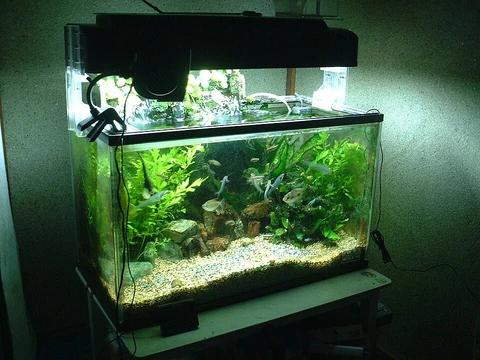
Ceratophyllum demersum
A cosmopolitan, free-floating aquatic plant popular in aquaria.

Ceratophyllum demersum, known as hornwort or coontail, is a flowering aquatic plant that lives fully submerged and free-floating. It is found on every continent except Antarctica, making it cosmopolitan. The plant is both a popular choice for aquariums and a troublesome invasive weed in New Zealand. Scientists have sequenced its genome to better understand the evolution of flowering plants.
The genus name *Ceratophyllum* comes from Greek words for "horn" and "leaf," referring to the antler-like leaves. This is mirrored in German (*Hornblatt*) and Dutch (*hoornblad*). In English, "hornwort" is common, but because that name also applies to unrelated Anthocerotophytes, "coontail" is sometimes used instead. Other names include hornweed, morassweed, cornifle, and hornleaf.
The plant has stems 1–3 meters long, with many side shoots that give it a bushy look. Leaves grow in whorls of six to twelve, each 8–40 mm long, simple or forked into two to eight thread-like segments with spiny teeth; they are stiff and brittle. It is monoecious, with separate male and female flowers on the same plant. The small flowers, about 2 mm long, have eight or more greenish-brown petals and appear in leaf axils. The fruit is a small nut 4–5 mm long, usually with three spines (two basal and one apical) that can be 1–12 mm long. Varieties with very short basal spines are called *Ceratophyllum demersum* var. *apiculatum*, and those lacking basal spines are var. *inerme*. The plant forms turions—buds that sink to the bottom in winter and grow into new plants in spring.
Rigid coontail can be confused with soft coontail (*Ceratophyllum submersum*), especially when young. A key difference is that its leaves fork only once or twice, not three or four times, and they are more roughly toothed.
*C. demersum* grows in lakes, ponds, and slow-moving streams with summer water temperatures of 15–30 °C and rich nutrients. In North America, it occurs across the US and Canada except Newfoundland. In Europe, it reaches 66° north in Norway. It is also reported in China, Siberia (at 66° north), Burkina Faso, the Volta River in Ghana, Vietnam, and New Zealand (where it was introduced). It prefers still or very slow water.
In Tasmania, Australia, it is a declared weed under the Tasmanian Weed Management Act 1999, and New Zealand classifies it as an unwanted organism.
Quick Facts
- Genus
- Ceratophyllum
- Species
- demersum
Facts from the source article.
Lore & Background
The genus name Ceratophyllum is latinized from Greek κέρας kéras (combining κέρατ- kerat-), meaning 'horn, antler', and φύλλον phúllon, meaning 'leaf', in allusion to the resemblance of the leaves to antlers. This name is mirrored in German and Dutch common names, Hornblatt and hoornblad respectively. In English, the plant is most commonly called hornwort, a name shared with the unrelated Anthocerotophytes; for this reason, the name coontail (or coon's tail) is sometimes preferred. Other common names include hornweed, morassweed, cornifle, and hornleaf.
Ceratophyllum demersum has stems that reach lengths of 1–3 m with numerous side shoots, making a single specimen appear as a large, bushy mass. The leaves are produced in whorls of six to twelve, each leaf 8–40 mm long, simple or forked into two to eight thread-like segments edged with spiny teeth; they are stiff and brittle. It is monoecious, with separate male and female flowers produced on the same plant. The flowers are small, 2 mm long, with eight or more greenish-brown petals, produced in the leaf axils. The fruit is a small nut 4–5 mm long, usually with three spines, two basal and one apical, 1–12 mm long. Plants with very short basal nut spines are sometimes distinguished as Ceratophyllum demersum var. apiculatum, and those with no basal spines as Ceratophyllum demersum var. inerme. It can form turions: buds that sink to the bottom of the water and stay there during the winter before forming new plants in spring.
Rigid coontails can be easily confused with soft coontails (Ceratophyllum submersum), especially when there is young growth with less stiff leaves. A key feature to look out for is the number of times a leaf is branched: the leaves are only forked once or twice, rather than three to four times in soft coontails. They are also rather more roughly toothed.
Reader's Guide
Ceratophyllum demersum is often used as a floating freshwater plant in both coldwater and tropical aquaria. Though without roots, it may attach itself to the substrate or objects in the aquarium. Its fluffy, filamentous, bright-green leaves provide excellent cover for newly hatched fish. It is propagated by cuttings. This plant appears to drop all its leaves when exposed to products designed to kill snails; the stems can recover relatively quickly, growing new leaves within a few weeks.
It is frequently used as a model organism for studies of plant physiology. One reason is that it allows studies on shoot effects without influence of a root, which often makes interpretation of nutrition and toxicity experiments difficult in terrestrial plants. As it is free floating and therefore does not require a solid substrate, it has been used successfully in the biological life support systems 'Aquarack/CEBAS' and 'Omegahab' on space flights. Coontail plants or the epiphytes they support have been shown to degrade the herbicide atrazine.
Ecologically, C. demersum has allelopathic qualities as it excretes substances that inhibit the growth of phytoplankton and cyanobacteria. Its dense growth can outcompete other underwater vegetation, leading to loss of biodiversity. In New Zealand, it has caused problems with hydroelectric power plants. It is a declared weed under the Tasmanian Weed Management Act 1999 in Tasmania, Australia, and is classed as an unwanted organism in New Zealand.
Did You Know?
- Ceratophyllum demersum is native to all continents except Antarctica.
- Its leaves are produced in whorls of six to twelve and are forked once or twice.
- It can form turions that sink to the bottom during winter and form new plants in spring.
- It has been used in biological life support systems on space flights.
More in Aquarium and Aquatic Plants, Part 3 1-24
Spotted an error? Know more?
Reader corrections go straight into our review queue. Suggest an edit · How this site is sourced