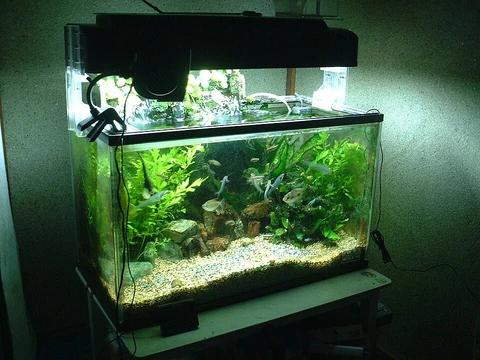
Cabomba
A fan-leaved aquatic genus popular in aquariums and invasive in Australia.

Cabomba is a genus of perennial, aquatic herbs with rhizomes, belonging to the family Cabombaceae. These plants are native to tropical and subtropical parts of the Americas. They have submerged leaves that are divided and fan-shaped, which is why they are commonly called fanwort. Aquarium hobbyists value them for their looks and their ability to add oxygen to fish tanks. One species, *Cabomba caroliniana*, is considered a national weed in Australia, where it escaped from aquariums and clogged up waterways.
The plants have short, brown rhizomes and delicate, branched roots that grow from the lower stem nodes. The stems are long, cylindrical, flexible, and either branched or unbranched, measuring 2–4 mm wide and reaching up to 4 m in length. They produce both submerged and floating leaves, though floating leaves are few and may be absent. The submerged leaves are split into three to seven parts that branch in a dichotomous or trichotomous pattern. The floating leaves are not showy.
The flowers are solitary, hermaphrodite, and held above the water on stalks. They are scentless, actinomorphic, and come in white, yellow, or purple. They are usually trimerous, but can be di- or tetramerous. The oval-shaped petals are about 2.0 cm across when fully open. Unlike the sepals, the petals have two yellow, ear-shaped nectaries at the base, and may have purplish edges. The flowers are protogynous: they are female on the first day and male on the second and following days. Pollination happens above the water, mainly by flies and other small flying insects.
Chromosome counts for the genus include 2n = 26, 39, 52, 78, and 104.
The genus was first published by Jean Baptiste Christophore Fusée Aublet in 1775, with the type species being *Cabomba aquatica*.
There are six living species: *Cabomba aquatica* (fanwort), *Cabomba caroliniana* (green cabomba), *Cabomba furcata* (red cabomba), *Cabomba haynesii*, *Cabomba palaeformis*, and *Cabomba schwartzii*. There are also four fossil species: *Cabomba gracilis*, *Cabomba grandis*, *Cabomba inermis*, and *Cabomba pitonii*. It is thought that *Cabomba haynesii* might be a hybrid of *Cabomba palaeformis* and *Cabomba furcata*.
The name *Cabomba* may come from an aboriginal name for the plant in Guyana. The genus is native to tropical and subtropical America, with its center of diversity in Brazil.
Quick Facts
- Taxon
- Cabomba
- Type Species
- Cabomba aquatica Aublet / Cabomba
Facts from the source article.
Lore & Background
Cabomba was published by Jean Baptiste Christophore Fusée Aublet in 1775, with the type species Cabomba aquatica. The generic name may be derived from an aboriginal name of the plant in Guyana. The genus consists of six extant species and four fossil species. It has been speculated that Cabomba haynesii may be a result of a hybridisation event involving Cabomba palaeformis and Cabomba furcata.
Vegetatively, Cabomba are perennial, rhizomatous herbs with short, brown rhizomes. The roots are delicate, brown to white, and branched, formed on the lower nodes of the stems. The stems are long, cylindrical, flexible, delicate, branched or unbranched, 2–4 mm wide, and up to 4 m long. Both floating and submerged leaves are present, but only few floating leaves are produced, and they may be absent entirely. The submerged leaves are divided into 3–7 dichotomously or trichotomously branched parts, giving a fan shape that leads to the vernacular name fanwort.
Generatively, the solitary, hermaphrodite, pedicellate, chasmogamous, scentless, actinomorphic flowers are white, yellow, or purple, trimerous or rarely di- and tetramerous, and extend beyond the water surface. The petals are oval-shaped, about 2.0 cm across when fully developed, with two yellow ear-shaped nectaries at the base, and may have purplish edges. Flowers are protogynous, having primarily female structures on the first day and switching to male on the second and subsequent days. Pollination occurs above the waterline, with principal pollinators being flies and other small flying insects.
Reader's Guide
Cabomba species are popular aquarium plants. Cabomba caroliniana is easily cultivated and tolerant of various substrates and temperatures, though in dimly lit conditions the leaves grow small and the internodes elongate. By contrast, Cabomba furcata is considered difficult to cultivate, requiring soft, acid water and high light intensity. Use in the aquarium trade has led to some species being introduced to other parts of the world, such as Australia, where Cabomba caroliniana is a nationally declared weed. Having arrived in 1967, it spread rapidly in waterways and out-competed native plants, threatening water supplies, especially along the eastern side of the continent. In Australia, Cabomba caroliniana has been targeted by both chemical and biological control. Herbicide treatment is effective yet damages remaining aquatic flora and fauna. The cabomba weevil (Hydrotimetes natans) is introduced as a means of biological control; they consume the plant's tips and inflict significant harm when present in large quantities, with larvae burrowing within the stems and causing substantial damage due to tissue necrosis. Likewise, Cabomba furcata has become invasive in Kerala, India, the Kalutara district of Sri Lanka, Chini Lake, Malaysia, and Taiwan, leading to a decline of water quality and biodiversity.
Did You Know?
- Cabomba caroliniana is a nationally declared weed in Australia, where it has choked waterways after escaping from aquaria.
- The cabomba weevil (Hydrotimetes natans) is used as a biological control agent against Cabomba caroliniana in Australia.
- Cabomba flowers are protogynous, with female structures on the first day and male structures on the second and subsequent days.
More in Aquarium and Aquatic Plants, Part 3 1-24
Spotted an error? Know more?
Reader corrections go straight into our review queue. Suggest an edit · How this site is sourced