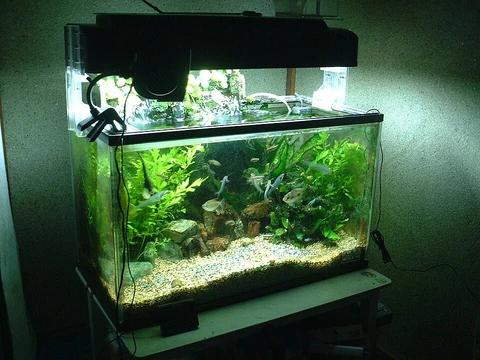
Cabomba furcata
A rhizomatous aquatic herb used as an aquarium plant.

Cabomba furcata, called red cabomba or forked fanwort, is a perennial aquatic herb that spreads by rhizomes. It belongs to the family Cabombaceae and is originally from tropical America. The plant is commonly kept in aquariums.
This herb produces both submerged and floating leaves. The submerged leaves are mostly arranged in whorls, are dark purple, and branch into two or three forks. Its flowers are bisexual and purple, measuring 5–10 mm long and 6–12 mm wide, with stalks 2–5.5 cm long. The plant has a chromosome number of 2n = 52, and its chloroplast genome spans 160,271 base pairs.
The species was formally described by Josef August Schultes and Julius Hermann Schultes in 1830. A lectotype specimen, collected by Leandro do Sacramento in 1821, was designated in 1991 by Marian Ørgaard. The name *furcata* means “forked.”
In the wild, red cabomba grows in freshwater lagoons, ponds, streams, lakes, and floodplains. As an aquarium plant, it typically needs added carbon dioxide, strong light, and regular fertilizer to thrive.
Outside its native range, *Cabomba furcata* has become invasive in Kerala, India; the Kalutara district of Sri Lanka; Chini Lake, Malaysia; and Taiwan. It spreads through stem fragments, blocking light from reaching the water’s surface. This suffocates water bodies, harming native aquatic plants and freshwater fish both economically and ecologically. The plant also consumes large amounts of oxygen, which lowers biodiversity and water quality.
Quick Facts
- Genus
- Cabomba
- Species
- furcata
Facts from the source article.
Lore & Background
Cabomba furcata was published by Josef August Schultes and Julius Hermann Schultes in 1830. The lectotype specimen, collected by Leandro do Sacramento in 1821, was designated in 1991 by Marian Ørgaard. The specific epithet furcata means forked, referring to the branched leaf structure. The plant produces both submerged and floating leaves; the submerged leaves are mostly whorled, dark purple, and dichotomously or trichotomously branched. Its bisexual flowers are purple, 5–10 mm long and 6–12 mm wide, with pedicels 2–5.5 cm long. The chromosome count is 2n = 52, and the chloroplast genome is 160271 bp long.
Reader's Guide
Cabomba furcata is used as an aquarium plant, but its cultivation requires specific conditions: carbon dioxide addition is usually necessary, mostly because this plant requires high light and regular fertilization for optimal growth. In the wild, it occurs in freshwater lagoons, ponds, streams, lakes, and floodplains. However, it has been reported as an invasive species in Kerala, India; the Kalutara district of Sri Lanka; Chini Lake, Malaysia; and Taiwan. Its active stem propagation prevents light from penetrating the water surface, suffocating water bodies and economically and ecologically hindering the growth of native aquatic plants and freshwater fish. Red cabomba requires a huge quantity of oxygen, resulting in decline of biodiversity and water quality.
Did You Know?
- Cabomba furcata has a chromosome count of 2n = 52.
- It has been reported as invasive in Kerala, India, and in the Kalutara district of Sri Lanka.
More in Aquarium and Aquatic Plants, Part 3 1-24
Spotted an error? Know more?
Reader corrections go straight into our review queue. Suggest an edit · How this site is sourced