Bolbitis heudelotii
An aquatic fern native to African rivers and streams.

Bolbitis heudelotii, commonly called the African water fern, creeping fern, or Congo fern, is a submerged aquatic plant belonging to the polypody family. It is found across subtropical and tropical Africa, ranging from Ethiopia west to Senegal and south to northern South Africa. The species is named after Jean-Pierre Heudelot (1802–1837), a botanical explorer of West Africa.
This fern grows underwater in rivers and streams, attaching itself to rocks or wood via fine, threadlike rootlets that emerge from its rhizomes. Its leaves are dark green, pinnate, and measure 15–40 cm in length and 15–25 cm in width. In its natural habitat, the water is fast-moving, clean, low in hardness, and slightly acidic, with sandy or rocky bottoms.
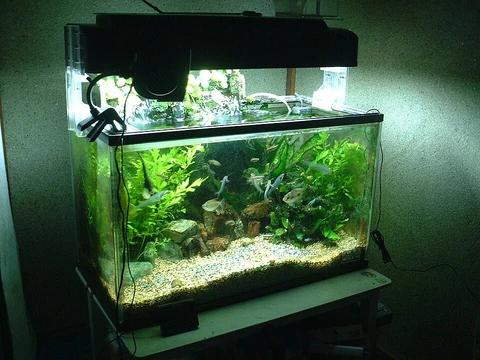
In aquariums, *B. heudelotii* thrives in temperatures between 20–28 °C and prefers moderately acidic to neutral water (pH 5.0–7.0). It tolerates a wide range of light levels but does best in flowing water. The plant is often used as a midground specimen in tropical freshwater tanks. It is best secured to a piece of wood rather than planted directly in the substrate, as it seems intolerant of crowding and fish waste. Additional CO₂ can boost its growth, and it prefers a somewhat shady position. Propagation is achieved by dividing the rhizome or taking cuttings, though the plant grows slowly.
Quick Facts
- Genus
- Bolbitis
- Species
- heudelotii
Facts from the source article.
Lore & Background
Bolbitis heudelotii was named for the botanical explorer of West Africa Jean-Pierre Heudelot (1802–1837). It is an aquatic polypody fern that grows submerged in rivers and streams, attached to rocks or wood by threadlike rootlets extending from its rhizomes. Its dark green, pinnate leaves reach 15–40 cm in length and 15–25 cm in breadth. In its native habitat, the water is fast-moving over sandy or rocky bottoms, very clean, not very hard, and slightly acidic. The roots cling to rocks and sandy beds.
Reader's Guide
In the aquarium, Bolbitis heudelotii requires water temperatures of 20–28 °C and moderately acidic to neutral water with a pH range of 5.0–7.0, but tolerates a wide range of light levels. It does best in flowing water. This species is often used as a midground specimen plant in tropical freshwater aquaria. Propagation is from divisions and cuttings from the rhizome. It seems to be intolerant to being crowded and to fish excreta. It is best grown secured to a piece of wood rather than planted directly in the substrate. Additional CO2 seems to boost growth, and it grows best in a rather shady position. Propagation is by division of the rhizome. It is a slow-growing plant.
Did You Know?
- Bolbitis heudelotii is named for botanical explorer Jean-Pierre Heudelot (1802–1837).
- It is native to subtropical and tropical Africa, from Ethiopia west to Senegal and down to northern South Africa.
- Its leaves are dark green, pinnate, and 15–40 cm long.
- It grows best secured to wood rather than planted in substrate.
More in Aquarium and Aquatic Plants, Part 3 1-24
Spotted an error? Know more?
Reader corrections go straight into our review queue. Suggest an edit · How this site is sourced