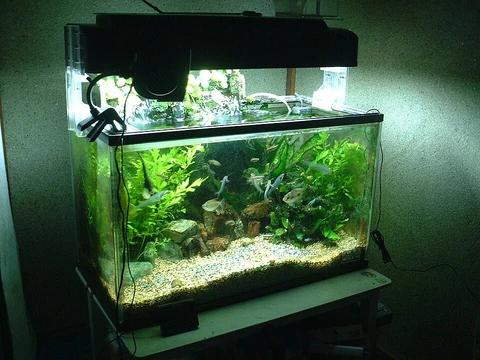
Bolbitis heteroclita
An aquatic fern native to Asia and Melanesia, used in aquariums.

Bolbitis heteroclita is a species of aquatic fern that grows naturally across Southeast Asia, Melanesia, and parts of northeastern South Asia, southern East Asia, and Micronesia—specifically the islands of Pohnpei and Kosrae. People often grow it as a decorative plant in aquariums and garden ponds.
This fern is native to subtropical and tropical regions including Assam in India, Bangladesh, Nepal, Bhutan, southern China (including Hainan), Taiwan, the Ryukyu Islands of Japan, Myanmar, Thailand, Vietnam, Malaysia, Indonesia, the Philippines, Papua New Guinea, the Solomon Islands, and the two Micronesian islands mentioned above.
In cultivation, it is fairly common as an ornamental for planted tanks and ponds. Along with *Bolbitis heudelotii*, it is one of two *Bolbitis* species popular in freshwater aquariums. However, these ferns can be tricky for beginners. They sometimes prove unexpectedly sensitive, needing a gentle water current and soft, acidic water with a pH between 6.0 and 7.0, though local water conditions may allow some variation. Because they are adapted to a semi-submerged, riparian lifestyle rather than full submersion, keeping them underwater long-term can be stressful. It works best to tie or attach their roots to driftwood or rocks, placing them just a few inches below the water surface. Their leaves should float at or just above the waterline, where they can reach fresh air while the fine, hair-like roots stay saturated.
Adding carbon dioxide can boost the health of aquarium plants, especially epiphytes like ferns, and many online guides show how to do it. But for the average hobbyist, this may seem difficult or out of reach at first. Fortunately, it is not necessary. More important are weekly water changes of 25 to 75 percent of the tank volume, depending on the number of fish and other animals. Clean water helps ferns by stirring the water column and washing their broad leaves, preventing algae, mulm, and detritus from blocking sunlight and hindering photosynthesis, which can cause the plant to decline.
On the other hand, this species grows easily as a terrestrial or immersed potted plant in ponds. Its fronds, at a certain size, are notable for looking like poison ivy leaves. Some nurseries and growers still sell it under its former name, *Bolbitis asiatica*.
Quick Facts
- Genus
- Bolbitis
- Species
- heteroclita
Facts from the source article.
Lore & Background
Bolbitis heteroclita is native to subtropical and tropical regions across Asia, Melanesia, and Micronesia, including locations such as Assam (India), Bangladesh, Nepal, Bhutan, southern China, Taiwan, the Ryukyu Islands, Myanmar, Thailand, Vietnam, Malaysia, Indonesia, the Philippines, Papua New Guinea, the Solomon Islands, and the Micronesian islands of Pohnpei and Kosrae. It is one of two species of Bolbitis popular for use as freshwater aquarium plants, the other being Bolbitis heudelotii. Despite their relative popularity, these plants are not suitable for most novice aquarists, as they can be unexpectedly sensitive. The species is also remarkable for the resemblance of its fronds of a certain size to poison ivy leaves. Some plant nurseries and growers sell this under the former name Bolbitis asiatica.
Reader's Guide
Bolbitis heteroclita is fairly commonly cultivated and sold as an ornamental plant for planted aquariums and garden ponds. It requires minimal water flow with a gentle current, and soft, acidic water is preferred, ideally between pH 6.0 and 7.0, though exceptions may exist based on local water qualities. As these ferns are more adapted to a riparian, semi-submerged growth habit rather than fully aquatic and submerged, maintaining them fully underwater long-term may be taxing. It is best to cultivate them with roots tied or attached to driftwood or rocks, only a few inches beneath the water's surface, with leaves floating just at and above the waterline. The addition of carbon dioxide can greatly improve health but is not a requirement. Weekly water changes of 25 to 75% of total aquarium volume are vital, depending on bioload and fish count, as clean water boosts health and prevents algae and detritus buildup. This species is easy to grow as a terrestrial or immersed potted plant in ponds.
Did You Know?
- Bolbitis heteroclita is native to regions including Assam (India), Bangladesh, Nepal, Bhutan, southern China, Taiwan, the Ryukyu Islands, and Micronesia.
- It is one of two Bolbitis species popular for freshwater aquariums, the other being Bolbitis heudelotii.
- The fronds of a certain size resemble poison ivy leaves.
- Some nurseries sell this plant under the former name Bolbitis asiatica.
More in Aquarium and Aquatic Plants, Part 3 1-24
Spotted an error? Know more?
Reader corrections go straight into our review queue. Suggest an edit · How this site is sourced