Azolla filiculoides
A fast-growing floating fern with nitrogen-fixing symbiosis.

Azolla filiculoides, commonly known as water fern, is a species of aquatic fern native to warm temperate and tropical regions of the Americas. It is notable for its very fast growth, ability to form dense floating mats, and its ancient symbiosis with the nitrogen-fixing cyanobacterium Anabaena azollae, which allows it to contribute nitrogen to its own metabolism.
Quick Facts
- Genus
- Azolla
- Species
- filiculoides
Facts from the source article.
Lore & Background
Azolla filiculoides is a floating aquatic fern, with each individual plant 1–2 cm across, green tinged pink, orange, or red at the edges. It branches freely and breaks into smaller sections as it grows. It is not tolerant of cold temperatures; in temperate regions it largely dies back in winter, surviving by means of submerged buds. The species harbors the diazotrophic organism Anabaena azollae in specialized leaf pockets, an ancient symbiosis that allows the cyanobacterium to fix nitrogen from the air and contribute to the fern's metabolism.
Fossil records from as recent as the last interglacials are known from several locations in Europe. About 50 million years ago, a species similar to A. filiculoides may have played a pivotal role in cooling the planet in what is known as the Azolla event. A. filiculoides was one of the first two fern species with a reference genome published.
The only sure method of distinguishing this species from A. cristata (long incorrectly known as A. caroliniana) is to examine the trichomes on the upper surfaces of the leaves: trichomes are unicellular in A. filiculoides but septate (two-celled) in A. cristata.
Reader's Guide
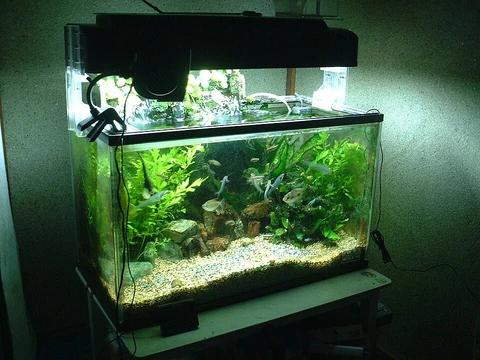
Azolla filiculoides has been introduced to many regions of the Old World, grown for its nitrogen-fixing ability, which may be used to enhance the growth rate of crops grown in water, such as rice, or by removal from lakes for use as green manure. It is frequently cultivated in aquariums and ponds, where it can become easily dominant over other species. The species was first recorded in Europe in the 1870s–1880s, possibly accidentally transported in ballast water, with fry, or directly as an ornamental or aquarium plant. It was introduced into Asia from East Germany in 1977 as an alternative to the cold-susceptible native strain of A. pinnata, used as a green manure in the rice industry. A. filiculoides has also been spread around the world as a research model plant for the study of Azolla–Anabaena symbiosis. In areas of introduction, it is capable of rapid growth, especially in eutrophic ecosystems, and outcompetes native aquatic plants. The dense mat causes lack of light penetration and an anaerobic environment due to detritus decomposition, leading to a drastic reduction of water quality, aquatic biodiversity, and ecosystem function.
Did You Know?
- It harbors the nitrogen-fixing cyanobacterium Anabaena azollae in specialized leaf pockets.
- The only sure way to distinguish it from A. cristata is by examining leaf trichomes: unicellular in A. filiculoides, septate in A. cristata.
More in Aquarium and Aquatic Plants, Part 3 1-24
Spotted an error? Know more?
Reader corrections go straight into our review queue. Suggest an edit · How this site is sourced