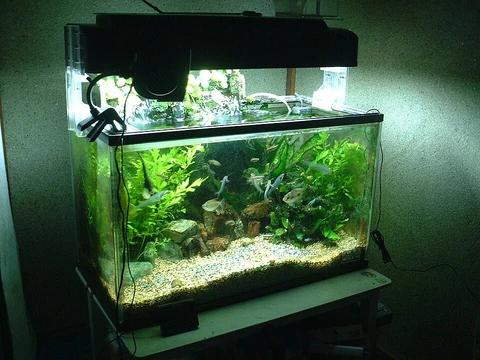
Aponogeton ulvaceus
A submerged Madagascar plant with translucent leaves and yellow flower spikes.

Aponogeton ulvaceus is a submerged aquatic plant in the Aponogetonaceae family, distributed throughout central and northern Madagascar. It is notable for its large, slightly translucent leaves with wavy margins and its ability to produce up to forty leaves from a single bulb in good conditions.
Quick Facts
- Genus
- Aponogeton
- Species
- ulvaceus
Facts from the source article.
Lore & Background
Aponogeton ulvaceus has a small cone-shaped, slightly hairy rhizome about 30 mm in diameter. The leaf blades are pale green, becoming reddish under intense light, with a base that tapers gradually and a wavy margin on petioles of equal length. No floating leaves are formed. The yellow flowers are produced on one or two, and sometimes more, erect spikes. In the wild, the plant is permanently submerged and grows in both still and moving waters, as well as sunny and partially shaded environments. The leaves may easily reach a length of more than 12 inches on average, and a single bulb can produce up to forty leaves. The plant comes in various varieties, some of which need a latent period during which the root does not produce leaves to flourish. Many hybrids of this species are sold in the aquarium trade, and the true form is probably quite rare.
Reader's Guide
Aponogeton ulvaceus will tolerate most water conditions but thrives in slightly alkaline water (pH 6.5-7.5) and a temperature of around 22 to 28 °C, though some survive cooler temperatures. Additional CO2 produces more luxuriant growth. It likes a bright position but will grow in partial shade. In an aquarium it makes a very good specimen plant. The recommended tank size is 10 gallons. Its most popular biological filter is the under-gravel filter. A fine brush is used to pollinate the flowers; in sand or very fine gravel compost, seeds germinate in about one to two weeks. Fish substrates with additional nutrients can lessen the need for liquid fertilisers for bulb plants with nutritional deficiencies. Fertiliser tablets or capsules can be placed near the roots. Sprouted aponogeton blooms should be fully buried in the substrate; non-sprouted bulbs should have their narrower end kept out. Pruning stems regularly helps keep plants healthy and minimises rot. 10W LED floodlights are the minimum recommended lights for 10-gallon tanks, with as little as 6 hours of light per day. Higher lighting means more growth and more frequent pruning. In nano tanks, a liquid carbon additive may be needed. Bulbs should be spaced 2 or 3 inches apart. The leaves are attractive to snails, which can do significant damage. Some plants may go dormant in winter and can be kept at a lower temperature for several months; others keep growing.
Did You Know?
- A single bulb may produce up to forty leaves in good conditions.
- The leaves are slightly translucent and can exceed 50 cm in length.
- Aponogeton ulvaceus is distributed throughout central and northern Madagascar.
More in Aquarium and Aquatic Plants, Part 3 1-24
Spotted an error? Know more?
Reader corrections go straight into our review queue. Suggest an edit · How this site is sourced