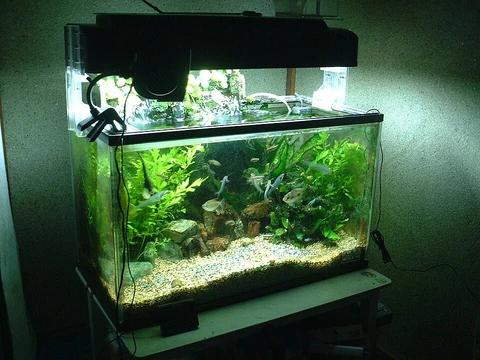
Aponogeton crispus
A robust, non-floating-leaved aponogeton from seasonal waters of South Asia.

Aponogeton crispus, commonly called the crinkled aponogeton or ruffled sword plant, belongs to the family Aponogetonaceae. This aquatic plant grows seasonally submerged, with a round rhizome that reaches 2–3 cm in diameter, sometimes up to 5 cm. Its leaves are light green to olive green-brown, measuring 20–35 cm long and up to 6 cm wide, with wavy edges and a petiole that can extend 45 cm. Wild specimens typically have longer, narrower leaves than cultivated varieties. No floating leaves develop. The flower stem rises up to 80 cm tall, bearing an apical white to pink spike-like raceme up to 18 cm long. Each small flower has a 2 mm perianth and six stamens, emits a scent, and the flowering spike lasts one to two weeks. Seeds are elliptical, 5–6 mm long and 2 mm wide. Many plants sold in the aquarium trade are hybrids, often sterile; the genuine plant never produces floating leaves. In Sri Lanka, it is protected and banned from export under Section 24 (1) of the Forest Ordinance.
Native to India, Bangladesh, and Sri Lanka, A. crispus grows in seasonal ponds, becoming dormant during the dry season, and occurs naturally in both still and running waters.
It is widely cultivated as an aquarium plant, considered the easiest and most robust aponogeton. It needs a mineral-rich substrate with carbon dioxide available as carbonic acid, and prefers moderate to bright overhead lighting. It tolerates a broad temperature range of about 15–32°C and does best in an established aquarium with a nutrient-rich environment. Under good conditions, it produces many leaves and often flowers. A dormant period is not normally required in aquariums, but it may lose larger leaves; if so, it can be rested in cooler water for about two months, often grown in removable pots. This species eventually needs dry storage during dormancy, signaled by gradual leaf die-off. Propagation is by seed or careful rhizome division. Seeds have two prolongations that curve and anchor into marshy ground to form initial roots. Flowers can be pollinated with a soft brush, and seeds sown in a propagator at room temperature take several weeks to germinate. Once leaves and roots appear, they can be potted in peat-based compost and covered with water.
Quick Facts
- Genus
- Aponogeton
- Species
- crispus
Facts from the source article.
Lore & Background
Aponogeton crispus is a seasonally submerged aquatic plant with a round rhizome 2–3 cm in diameter, occasionally reaching 5 cm. Its leaves are light green to olive green-brown, 20–35 cm long and 6 cm broad, with wavy margins and petioles up to 45 cm; wild plants tend to have longer, narrower leaves than cultivated varieties. No floating leaves are formed. The flowers appear on an erect stem up to 80 cm tall, bearing a white to pink spike-like raceme up to 18 cm long; each small flower has a 2 mm perianth and six stamens, is scented, and the spike lasts 1–2 weeks. Seeds are elliptical, 5–6 mm long and 2 mm in diameter.
The plant is native to India, Bangladesh, and Sri Lanka, typically growing in seasonal ponds and becoming dormant in the dry season. It occurs in both still and running waters. In Sri Lanka, it is a protected species banned from exportation under Section 24 (1) of the Forest Ordinance. Many aquarium specimens are hybrids and often sterile; the genuine plant never produces floating leaves.
Reader's Guide
Aponogeton crispus is widely cultivated as an aquarium plant and is considered the easiest and most robust of the aponogetons. It requires a mineral-rich substrate with readily available carbon dioxide in the form of carbonic acid. It prefers moderate to bright lighting from above and tolerates a wide temperature range of about 15–32 °C. It does best in an established aquarium due to its need for a nutrient-rich environment; under these conditions it forms a mass of leaves and often flowers. It does not normally require a dormant period in aquariums but may lose larger leaves and can be rested in cooler water for about two months, so it is often grown in removable pots. A. crispus is one of the aponogetons that eventually need dry storage during dormancy, recognized by gradual leaf loss. Propagation is by seed or by carefully splitting the rhizome. Seeds have two prolongations that curve and stick into marshy ground to form initial roots. Flowers can be pollinated with a soft brush; seeds sown in a propagator at room temperature take several weeks to germinate. When leaves and roots appear, they can be potted in peat-based compost and covered with water.
Did You Know?
- The genuine Aponogeton crispus never forms floating leaves.
- Many plants sold as A. crispus in the aquarium trade are actually sterile hybrids.
- It is a protected plant in Sri Lanka, banned from export under the Forest Ordinance.
More in Aquarium and Aquatic Plants, Part 3 1-24
Spotted an error? Know more?
Reader corrections go straight into our review queue. Suggest an edit · How this site is sourced