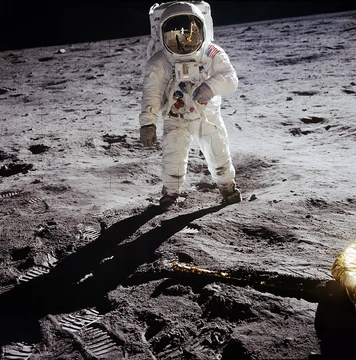
Buzz Aldrin
Second human to walk on the Moon.
Last updated

NASA · via Wikipedia: Buzz Aldrin · Public domain
Edwin Eugene Aldrin Jr., who later legally changed his first name to Buzz, was born at Mountainside Hospital in Glen Ridge, New Jersey, on January 20, 1930.[1] During the Apollo 11 mission in 1969, Aldrin followed Neil Armstrong and became the next person to step onto the lunar surface.[2] Aldrin's doctorate in astronautics was awarded by the Massachusetts Institute of Technology, where he completed a thesis on orbital rendezvous techniques.[3]
Key facts and history
Aldrin flew on Gemini 12 in November 1966, performing three spacewalks totaling 5.5 hours.[2] Aldrin spent one hour and 33 minutes on the lunar surface during the Apollo 11 EVA.[4] While flying F-86 Sabres in the Korean War, Aldrin completed 66 combat missions and was credited with destroying two MiG-15 aircraft.[5] As the first astronaut to hold a doctoral degree, Aldrin was called "Dr. Rendezvous" by his fellow astronauts because of his expertise in orbital mechanics.[6]
What the cited sources add
The West Point Association of Graduates Distinguished Graduate Award notes that Aldrin's doctoral thesis developed techniques crucial to the Gemini and Apollo programs.[3] The NASA Space Science Data Coordinated Archive records that Gemini 12's primary propulsion system anomaly prevented planned orbit-raising maneuvers.[7] A Space.com article states that Aldrin legally adopted the nickname "Buzz" in 1988.[2] The same article reports that Aldrin was awarded the Presidential Medal of Freedom after Apollo 11.[2]
A NASA mission overview states that approximately 650 million people watched Armstrong's initial steps on the lunar surface on July 20, 1969.[4] The same archive records that during his second extravehicular activity, Aldrin operated a torque wrench while secured by a tether to the spacecraft.[7]
References
- Wikipedia, "Buzz Aldrin" (CC BY-SA 4.0), which cites: Kaulessar, "The Place Where There's Buzz", The Montclair Times, September 22, 2016, p. A5; Hansen 2005, p. 348–349; Grier 2016, p. 87–88; Hansen 2005, p. 348–349; Redd, "Buzz Aldrin & Apollo 11", Space.com, June 23, 2012; Nelson 2009, p. 50; Hansen 2005, p. 348–349; Chaikin 2007, p. 585; "Scouting and Space Exploration", Boy Scouts of America (we also read that source) en.wikipedia.org
- Redd, "Buzz Aldrin & Apollo 11", Space.com, June 23, 2012. facts only, no text reused. space.com
- "2000 Distinguished Graduate Award", West Point Association of Graduates, May 17, 2000. facts only, no text reused. westpointaog.org
- Loff, "Apollo 11 Mission Overview", NASA, December 21, 2017. facts only, no text reused. nasa.gov
- Wikipedia, "Buzz Aldrin" (CC BY-SA 4.0), which cites: Aldrin Abraham 2009, p. 36; Grier 2016, p. 87–88 (original not read by us) en.wikipedia.org
- Wikipedia, "Buzz Aldrin" (CC BY-SA 4.0), which cites: Burgess 2013, p. 285; Burgess 2013, p. 285; Burgess 2013, p. 285; "14 New Astronauts Introduced at Press Conference", NASA, October 30, 1963; Chaikin 2007, p. 585; Bostick, "Jerry C. Bostick Oral History", NASA Johnson Space Center Oral History Project, February 23, 2000; Roger Ressmeyer, "Buzz Aldrin plans the next giant leap", NBC News, July 15, 1999; Collins 2001, p. 314; Grier 2016, p. 87–88; Burgess 2013, p. 285; Collins 2001, p. 314 (we also read that source) en.wikipedia.org
- "Gemini 12", NASA Space Science Data Coordinated Archive. facts only, no text reused. nssdc.gsfc.nasa.gov
Each numbered sentence above was checked against the source it cites before publication. Sentences citing Wikipedia adapt text from the English Wikipedia article Buzz Aldrin (contributors), used under CC BY-SA 4.0; this entry is available under the same licence. Other sources were used for facts only; no text or images are copied from them.
More in Apollo 11
Sources
Compiled from Wikipedia and the sources listed below. Text from Wikipedia is available under CC BY-SA 4.0; this entry is adapted from it.
- Wikipedia: Buzz Aldrin (CC BY-SA 4.0).
Spotted an error? Know more?
Reader corrections go straight into our review queue. Suggest an edit · How this site is sourced