Julian Scheer
NASA public affairs chief who put a TV camera on the Moon.
Last updated
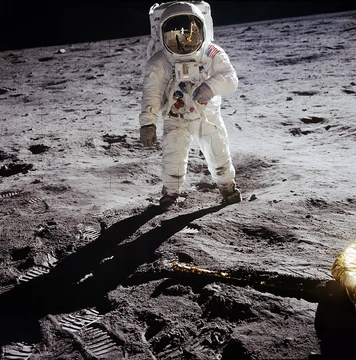
Julian Weisel Scheer was born in Richmond, Virginia, on January 26, 1926, and died on September 1, 2001, from a heart attack while riding a tractor at his farm in Catlett, Virginia.[1][2] Scheer's most notable achievement was his successful push for a television camera on the Lunar Module Eagle, which enabled a global audience to view the Moon landing.[3][4]
Key facts and history
Scheer served in the United States Merchant Marine during World War II at age 17, then graduated from the University of North Carolina at Chapel Hill in 1950 with a journalism degree.[1][5] He worked as a journalist at The Charlotte News, covering sports and Hurricane Hazel in 1954.[4] After visiting Cape Canaveral in 1956, he wrote a series of articles on missile launches on his own time.[4] He co-wrote the bestseller "First into Outer Space" with NASA engineer Theodore J. Gordon after the space race began.[6]
In 1962, NASA administrator James Webb asked Scheer to develop a media coordination plan, and he became assistant administrator for public affairs in early 1963.[3][7] He clashed with public affairs officer Shorty Powers, who leaked a flight plan to a journalist for whiskey, and accepted Powers's resignation.[8] On February 22, 1971, Scheer departed NASA to serve as campaign manager for Terry Sanford's bid for the presidency in 1972, a campaign that did not succeed.[4]
References
- Wikipedia, "Julian Scheer" (CC BY-SA 4.0), which cites: Covey, "NASA – The Chroniclers", NASA; Hilliard, "From Richmond to Chapel Hill ... from Charlotte to the Moon", A View to Hugh, February 20, 2014; "Julian Scheer, 75, a Leader in Selling the Space Program", The New York Times, September 5, 2001; Hilliard, "From Richmond to Chapel Hill ... from Charlotte to the Moon", A View to Hugh, February 20, 2014 (original not read by us) en.wikipedia.org
- Wikipedia, "Julian Scheer" (CC BY-SA 4.0), which cites: "Julian Scheer, 75, a Leader in Selling the Space Program", The New York Times, September 5, 2001; Zielinski, "Julian Scheer, NASA Publicist And N.Va. Conservationist, Dies", The Washington Post, September 4, 2001 (original not read by us) en.wikipedia.org
- Wikipedia, "Julian Scheer" (CC BY-SA 4.0), which cites: Zielinski, "Julian Scheer, NASA Publicist And N.Va. Conservationist, Dies", The Washington Post, September 4, 2001 (original not read by us) en.wikipedia.org
- Wikipedia, "Julian Scheer" (CC BY-SA 4.0), which cites: Hilliard, "From Richmond to Chapel Hill ... from Charlotte to the Moon", A View to Hugh, February 20, 2014 (original not read by us) en.wikipedia.org
- Wikipedia, "Julian Scheer" (CC BY-SA 4.0), which cites: Covey, "NASA – The Chroniclers", NASA; Hilliard, "From Richmond to Chapel Hill ... from Charlotte to the Moon", A View to Hugh, February 20, 2014; Zielinski, "Julian Scheer, NASA Publicist And N.Va. Conservationist, Dies", The Washington Post, September 4, 2001 (original not read by us) en.wikipedia.org
- Wikipedia, "Julian Scheer" (CC BY-SA 4.0), which cites: Hilliard, "From Richmond to Chapel Hill ... from Charlotte to the Moon", A View to Hugh, February 20, 2014; Scheer, "Tweetsie: The Blue Ridge Stemwinder", 1991 (we also read that source) en.wikipedia.org
- Wikipedia, "Julian Scheer" (CC BY-SA 4.0), which cites: Zielinski, "Julian Scheer, NASA Publicist And N.Va. Conservationist, Dies", The Washington Post, September 4, 2001; Makemson 2009, p. 90–92; Makemson 2009, p. 90–92 (original not read by us) en.wikipedia.org
- Wikipedia, "Julian Scheer" (CC BY-SA 4.0), which cites: Makemson 2009, p. 90–92; Makemson 2009, p. 90–92; Hilliard, "From Richmond to Chapel Hill ... from Charlotte to the Moon", A View to Hugh, February 20, 2014 (original not read by us) en.wikipedia.org
Each numbered sentence above was checked against the source it cites before publication. Sentences citing Wikipedia adapt text from the English Wikipedia article Julian Scheer (contributors), used under CC BY-SA 4.0; this entry is available under the same licence. Other sources were used for facts only; no text or images are copied from them.
More in Apollo 11
Test yourself
Three questions drawn from this entry’s sources. Pick an answer to check it.
Answers checked against the source article
Sources
Compiled from Wikipedia and the sources listed below. Text from Wikipedia is available under CC BY-SA 4.0; this entry is adapted from it.
- Wikipedia: Julian Scheer (CC BY-SA 4.0).
Spotted an error? Know more?
Reader corrections go straight into our review queue. Suggest an edit · How this site is sourced