Bird nest
A bird nest is the spot for egg incubation and rearing young.

A bird nest is any place where a bird lays eggs, warms them until they hatch, and raises its young. While most people picture a woven cup of grass, like the one made by an American robin, or a hanging pouch built by a Montezuma oropendola, that image is far too narrow. In reality, a nest can be a simple hollow scraped in sand, a hole left by a broken branch, a tunnel dug in the ground, a cavity carved into a tree, a huge mound of rotting vegetation and soil, a ledge formed from dried saliva, or a mud dome with a tunnel entrance. Some birds, such as magpies, have even been seen building nests out of anti-bird spikes, sometimes using up to 1,500 of them to create a protective dome that ironically keeps other birds away while shielding their own chicks. The smallest nests belong to certain hummingbirds, whose tiny cups measure just 2 cm across and 2–3 cm high. At the other extreme, the mound nests of the dusky scrubfowl can be over 11 m wide and nearly 5 m tall. The study of bird nests is called caliology or nidology.
Not every bird builds a nest. Some species, like common murres and razorbills, lay their eggs directly on narrow rocky ledges. These eggs are sharply pointed at one end so they roll in a circle when bumped, preventing them from falling off the cliff. Because the eggs are so exposed, parent birds rarely leave them alone. King penguins and emperor penguins also skip nests, instead tucking their eggs and chicks between their feet and a fold of skin on their belly. This lets them move while incubating, though only emperor penguins regularly do so. They breed during the harsh Antarctic winter, and their mobility allows them to huddle together in huge groups, sharing body heat. In the center of these tight clusters, temperatures can be 10 °C warmer than the outside air, which is essential for survival. Other species, such as the ashy storm-petrel and Eurasian eagle-owl, lay eggs in rock crevices or gaps between boulders without adding any nesting material. Potoos place their single egg on a broken stump or in a shallow depression on a branch, often where a branch has died and fallen off. Brood parasites, including cowbirds, honeyguides, and many cuckoos, lay their eggs in the active nests of other birds, leaving the foster parents to raise their young.
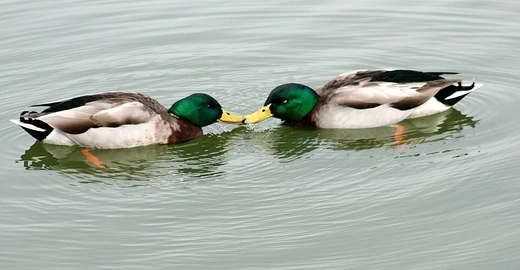
The simplest nest is the scrape: a shallow hollow in soil or vegetation, with a rim just deep enough to stop eggs from rolling away. It may be lined with bits of plant, small stones, shell fragments, or feathers, which help camouflage the eggs, provide some insulation, and keep them from sinking into mud or sand if the nest gets flooded. Ostriches, many ducks, most shorebirds, terns, some falcons, pheasants, quail, partridges, bustards, and sandgrouse all use scrape nests. Because these nests are on the ground and often in the open, the eggs, chicks, and brooding adults are more exposed to predators and weather than birds in more sheltered nests.
Most birds build a fresh nest each year, though some refurbish old ones. The large eyries of some eagles are platform nests used and repaired for several years. Eurasian coots also reuse nesting sites, especially in urban areas like Amsterdam’s canals, where nests made from plastic waste have built up in layers over decades. Because plastic doesn’t decompose, these layers can be dated using expiration dates on food packaging found inside. In most nest-building species, the female does most or all of the construction; in others, both partners help. Sometimes the male builds the nest and the female lines it. In some polygynous species, the male does most or all of the building, and the nest may be part of a courtship display, as in weaver birds. Females in these species may choose mates based on their ability to pick good nest sites and build high-quality nests. In some species, young from previous broods may also help the adults.
- field
- Ornithology
- known_for
- Site where birds lay and incubate eggs and raise young
- types
- Scrape, cup, platform, burrow, mound, dome, hanging, crevice
- smallest_nest
- Some hummingbird nests, 2 cm across and 2–3 cm high
- largest_nest
- Dusky scrubfowl mounds over 11 m in diameter and nearly 5 m tall
Lore & Background
Not all bird species build nests. Some auks, including common murre, thick-billed murre and razorbill, lay eggs directly onto narrow rocky ledges. Their eggs are dramatically pointed at one end so they roll in a circle when disturbed, critical for survival as there are no nests to prevent rolling off cliffs. King penguins and emperor penguins tuck eggs and chicks between their feet and folds of skin on their lower bellies, allowing mobility; emperor penguins breed during the harshest Antarctic winter and form huge huddled masses to share body heat, with temperatures in the centre of tight groups up to 10 °C above ambient air.
Reader's Guide
Bird nests are diverse in form and function, ranging from simple scrapes in soil to elaborate woven structures and massive mounds. The simplest nest is the scrape, a shallow depression in soil or vegetation, sometimes lined with bits of vegetation, small stones, shell fragments or feathers. These materials help camouflage eggs, provide insulation, and prevent eggs from sinking into muddy or sandy soil. Eggs and young in scrape nests are more exposed to predators and elements; most ground-nesting species have precocial young that quickly leave the nest upon hatching. In cool climates, scrape depth is critical for egg survival, with lined nests reducing heat loss by up to 25%. In warm climates, scrapes are shallower and lined with non-vegetative material to allow convective cooling. Some species, such as magpies, have been observed building nests using anti-bird spikes, with some nests containing up to 1,500 metal spikes, forming a protective dome that deters predators. The study of nests, caliology or nidology, reveals how nest architecture is influenced by local topography and abiotic factors.
Did You Know?
- Some magpie nests contain up to 1,500 anti-bird spikes, used to form a protective dome.
- The smallest bird nests are made by some hummingbirds, measuring just 2 cm across and 2–3 cm high.
- Dusky scrubfowl nest mounds can exceed 11 m in diameter and stand nearly 5 m tall.
- Emperor penguins do not build nests; they tuck eggs between their feet and skin folds and form huddled masses to share body heat.
More in Animal Behavior 1-23
Spotted an error? Know more?
This is a living reference — every entry is fact-audited, and reader corrections feed straight into our audit queue. Suggest an edit · See this site's audit record