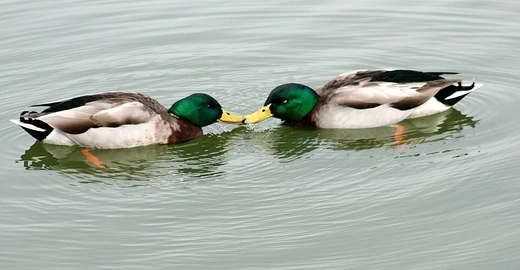
Sociality
Sociality describes how animals form cooperative groups.

Sociality is the degree to which individuals in an animal population tend to associate in social groups and form cooperative societies. This tendency, known as gregariousness, is a survival response to evolutionary pressures. For instance, a mother wasp that remains near her larvae reduces the risk of parasites consuming them, a behavior biologists believe was selected for by such pressures in the family Vespidae. The most fundamental characteristic of animal sociality is parental investment—any expenditure of resources, such as time or energy, to benefit one’s offspring. This investment, however, reduces a parent’s capacity for future reproduction or aid to other kin. An animal that cares for its young but shows no other social traits is termed subsocial. The highest degree of sociality is eusociality, characterized by overlapping adult generations, reproductive division of labor, cooperative care of young, and often a biological caste system. Social animals tend to possess higher cognitive abilities; for example, social predators like spotted hyenas and lions outperform non-social predators such as leopards and tigers in problem-solving requiring innovation. Animals that associate beyond courtship but lack eusociality are presocial. Entomologist Charles D. Michener, building on Suzanne Batra’s earlier work, classified presociality into subsocial, communal, and semisocial categories. Subsocial taxa, common among winged insects, involve parents caring for young for some period. Solitary-but-social animals, like mouse lemurs and orangutans, forage alone but share sleeping sites, with female home ranges overlapping while males’ do not. Parasociality encompasses communal, quasisocial, and semisocial groups, all exhibiting parental investment and cooperative dwelling. In communal groups, adults cohabit but rear their own young; quasisocial groups share brood care; semisocial groups add a reproductive caste system. Eusociality extends this with overlapping adult generations, where older generations also help rear the newest offspring.
- field
- Sociobiology, Ethology
- key_concept
- Degree of social association in animal populations
- highest_degree
- Eusociality
- subcategories
- Subsocial, Presocial, Parasocial, Eusocial
- notable_classification_contributors
- Charles D. Michener, Suzanne Batra, E. O. Wilson
Lore & Background
Sociality is a survival response to evolutionary pressures, such as predation and parasitism. For instance, a mother wasp remaining near her larvae reduces the likelihood of parasites consuming them, a behavior selected for in wasps of the family Vespidae. This illustrates the most fundamental characteristic of animal sociality: parental investment, which is any expenditure of resources—time, energy, or social capital—to benefit offspring. Such investment reduces a parent's ability to invest in future reproduction or aid to kin. An animal that cares for its young but shows no other social traits is termed subsocial. The highest recognized degree of sociality is eusociality, defined by overlapping adult generations, reproductive division of labor, cooperative care of young, and often a biological caste system. Social animals tend to possess relatively high cognitive ability; social mammal predators like spotted hyenas and lions outperform non-social predators such as leopards and tigers at innovative problem-solving. Solitary animals, like the jaguar, associate only for courtship and mating. Taxa showing sociality beyond this but lacking full eusociality are called presocial. Entomologist Charles D. Michener developed a classification system for presociality in 1969, building on Suzanne Batra’s earlier coining of eusocial and quasisocial. Subsociality, where parents care for young for some period, is widespread among winged insects and has evolved independently many times. Solitary-but-social animals forage separately but may share nests or sleeping sites, with overlapping female home ranges but not male ones; this is common among nocturnal strepsirrhine primates and tarsiers. Parasociality groups communal, quasisocial, and semisocial animals, all exhibiting parental investment and cooperative dwelling. Communal adults cohabit but rear their own young; quasisocial animals share brood care; semisocial populations add a reproductive caste system. Eusociality extends this with overlapping adult generations.
Reader's Guide
Sociality describes the tendency of animals to form social groups and cooperative societies, a survival response shaped by evolutionary pressures. For instance, in wasps of the family Vespidae, mothers staying near their larvae reduce the risk of parasitism, a behavior that biologists believe was selected by such pressures. This illustrates the fundamental characteristic of animal sociality: parental investment, defined as any expenditure of resources—time, energy, or social capital—to benefit offspring, which reduces a parent’s capacity for future reproduction. Animals that care for young but lack other social traits are termed subsocial. The highest degree of sociality is eusociality, characterized by overlapping adult generations, reproductive division of labor, cooperative care of young, and, in refined cases, a biological caste system. Social animals often display higher cognitive abilities; for example, social mammal predators like spotted hyenas and lions outperform non-social predators such as leopards and tigers in problem-solving requiring innovation. The classification of presociality, developed by entomologist Charles D. Michener in 1969, builds on earlier work by Suzanne Batra, who coined terms like eusocial and quasisocial in 1966. Michener’s system includes subsocial, communal, and semisocial categories, primarily applied to insects. Subsociality, where parents care for young for some period, is widespread among winged insects and has evolved independently many times. Solitary-but-social animals forage alone but share nesting sites, as seen in mouse lemurs, lorises, and orangutans. Parasociality groups communal, quasisocial, and semisocial taxa, all exhibiting parental investment and cooperative dwelling. Eusociality extends beyond parasociality by including overlapping adult generations.
Did You Know?
- Sociality is a survival response to evolutionary pressures, such as parasites selecting for maternal care in wasps of the family Vespidae.
- Eusociality has arisen among some crustaceans, such as Synalpheus regalis snapping shrimp that rely on fortress defense.
Frequently Asked Questions
Who is Sociality?
Sociality is the core concept in sociobiology and ethology that measures how strongly individuals within an animal population cluster into cooperative groups. It spans a full spectrum, from basic parental care all the way up to the most complex forms of collective living.
What are Sociality's powers/role?
At its foundation, Sociality tracks parental investment—any resource an animal expends to help its offspring survive. This single trait drives the entire hierarchy of group behavior, from a mother wasp guarding her larvae against parasites to full cooperative colonies.
How does Sociality's story end?
The narrative reaches its climax at eusociality, the highest degree of social association where individuals build highly organized, cooperative societies. Beneath that peak sit the intermediate subcategories of subsocial, presocial, and parasocial arrangements.
Why is Sociality important?
Sociality is a survival response forged by evolutionary pressures, meaning animals that grouped and cooperated gained a reproductive edge over solitary ones. Grasping this concept helps explain everything from wasp brood defense to the most intricate insect colonies.
Who helped map Sociality's classification?
Charles D. Michener, Suzanne Batra, and E. O. Wilson are the notable contributors who developed the formal classification system for degrees of sociality. Their work gave researchers a shared vocabulary for comparing social structures across species.
More in Animal Behavior 1-23
Spotted an error? Know more?
This is a living reference — every entry is fact-audited, and reader corrections feed straight into our audit queue. Suggest an edit · See this site's audit record