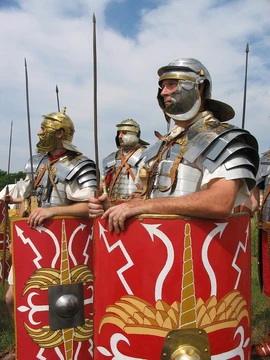
Lorica hamata
Roman mail armor used from the Republic through the late Empire.
Lorica hamata was a form of mail armor used by ancient Roman soldiers. It was likely adopted from Celtic peoples during conflicts in the 3rd century BC. The armor remained in continuous use by legionaries and was favored by centurions for its coverage and low maintenance.
Quick Facts
- Origin
- Celtic
- First documented use
- Roman conquest of Hispania
- Ring inside diameter
- about 5 mm / 0.197 in
- Ring outside diameter
- about 7 mm / 0.276 in
- Number of rings
- 35,000 to 40,000
- Weight
- around 11 kg / 24.3 lb
- Estimated production time
- two months
Facts from the source article.
Usage
Modern historians believe mail armor was invented by the Celts, with the idea possibly reaching Rome during conflicts in the 3rd century BC. Lorica hamata was used by both legionary and auxilia troops, with its first documented use during the Roman conquest of Hispania. Several versions existed for different duties such as skirmishers, cavalry, and spearmen. It remained in constant use by legionaries and was the preferred armor of centurions due to greater coverage and lower maintenance. Constant friction kept the rings free of rust. Only the richest soldiers could afford it. Depictions of emperors wearing lorica hamata or lorica squamata were rare in the early empire but more common later. During the 1st century AD it was supplemented by lorica segmentata, but was reintroduced as sole standard-issue armor by the 4th century, though still common among legionaries in the 2nd century.
Forging
Lorica hamata was mostly manufactured from bronze or iron, made from alternating rows of rings and rows of riveted rings. Rings were made by punching holes in iron sheets, while riveted rings were made from wires with ends butted together, producing flexible and strong armor. Each ring had an inside diameter of about 5 mm and an outside diameter of about 7 mm, with 35,000 to 40,000 rings in the armor. It was cut like a Greek cuirass made of linen, with leather pteruges underneath.
The armor contained flaps running from mid-back to the front of the torso, connected to the main armor through hooks of brass or iron attached to studs riveted through the flap ends. During the Republican period the armor was sleeveless but protected shoulders through shoulder pieces. In the Imperial period it gained sleeves, and by the 3rd century those sleeves extended to the elbows. A standard lorica hamata weighed around 11 kg, varying with design and materials.
Despite being difficult to forge, with good maintenance it could last several decades. The comfort came at the cost of some protection, and the weight placed concentrated strain on the wearer's shoulders, though the armor still protected well. Estimated production time was two months, even with continual slave labor at state-run armories.
More in Ancient Roman Legionary Equipment
Spotted an error? Know more?
Reader corrections go straight into our review queue. Suggest an edit · How this site is sourced