Plumbata
Lead-weighted throwing dart used by Roman infantry.
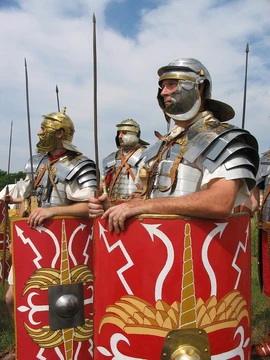
The plumbata, also known as the martiobarbulus, was a lead-weighted throwing dart used by infantry to strike enemies at a distance before close combat. Roman soldiers in some legions carried these darts inside their shields, providing them with a ranged weapon comparable to arrows. The weapon consisted of a lead-weighted head attached to a wooden shaft with fletching for effective long-distance throwing.
Quick Facts
- Earliest known users
- Ancient Greeks from about 500 BC
- Primary users
- Late Roman and Eastern Roman armies
- Archaeological find location
- Wroxeter
Facts from the source article.
History
The earliest known use of these darts dates to around 500 BC with the Ancient Greeks, but they are most famously associated with the late Roman and Eastern Roman armies. The oldest and most detailed written account describes them in use around 300 AD, though the text itself was written between 390 and 450 AD. A second source from the late 300s, the anonymous work De rebus bellicis, mentions a spiked version called plumbata tribolata, which has not been found by archaeologists.
This same treatise is the only one to include a drawing of a plumbata, showing a short arrow with a weight on its shaft. While only later copies of that manuscript survive, the image matches actual remains. A third source is the Strategicon, written by the Byzantine emperor Maurice in the late 500s, which refers to the martzobarboulon, a Greek corruption of the Latin martiobarbulum. The word plumbata comes from plumbum, meaning lead, so it translates to "lead-weighted darts."
Martiobarbuli, spelled mattiobarbuli in Latin, likely comes from Martio-barbuli, or "little barbs of Mars," where barb means a barbed head and Mars is the god of war. Archaeology provides a clearer picture: a find from Wroxeter was identified as a plumbata head, and a reconstruction shows a fletched dart with an iron head weighted by lead, matching Vegetius’s description. War darts continued to be used in Europe during the later Middle Ages.
More in Ancient Roman Legionary Equipment
Spotted an error? Know more?
Reader corrections go straight into our review queue. Suggest an edit · How this site is sourced