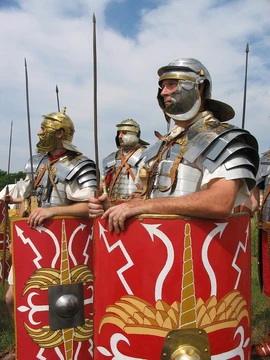
Lorica segmentata
Segmented plate armour of the Roman legionary.
The lorica segmentata, also known as lorica lamminata or banded armour, is a type of personal armour used by soldiers of the Roman army. It consists of metal strips fashioned into overlapping or interlocking circular bands, fastened internally and held in place on the body with leather straps. This torso armour has come to be viewed as symbolic of the Roman legions in popular culture.
Quick Facts
- Period of use
- Approximately beginning of the 1st century AD until at least the mid part of the 3rd century AD
- Earliest confirmed use
- Before 9 AD (Battle of the Teutoburg Forest)
- Latest known use
- 4th century (depicted on Arch of Constantine, 315)
- Main types and periods
- Dangstetten-Kalkriese-Vindonissa (9 BC–43 AD)
- Corbridge-Carnuntum (69–100)
- Newstead (164–180)
Facts from the source article.
Etymology
The Roman name is unknown, though it certainly included the word lorica. Some scholars propose lorica lamminata, based on the Roman term lamina for sheets of metal, but no firm evidence supports any theory.
History
The technology behind the lorica segmentata was old by the time it entered Roman service. The Dendra panoply from the 15th century BC used a similar technique of overlapping curved plates. Laminated armour was also employed by the Parthians and possibly by Dacians, Scythians, or Sarmatians before Roman adoption. Some 4th-century BC finds from the steppe combine limb armour of this type with scale armour.
The manica armguard may have been worn by gladiators before military use. The exact adoption date is unknown; possibilities include after Crassus' defeat at Carrhae in 53 BC or after the Revolt of Julius Sacrovir and Julius Florus in 21 AD. Excavations at Kalkriese confirm soldiers at the Battle of the Teutoburg Forest in 9 AD wore it, so it must have been in use before that year. Around the mid-3rd century it fell out of favor, though it remained in use during the Late Roman Empire.
Soldiers wearing it appear on the Arch of Constantine (315), though these depictions may come from an earlier monument by Marcus Aurelius. The latest known use was in the 4th century. The armour evolved through overlapping types: Dangstetten-Kalkriese-Vindonissa (9 BC–43 AD), Corbridge-Carnuntum (69–100), and Newstead (164–180). A possible fourth type, with segmented armour joined to scale shoulder defenses, is known from a single damaged statue from Alba Iulia in Romania, used from about 14 BC perhaps into the early 4th century. The lorica segmentata was geographically widespread, but the mail lorica hamata may have been more common at all times.
Construction
The plates were made by overlapping ferrous plates riveted to leather straps; the animal source and tanning method are unknown. Plates consisted of soft iron on the inside and rolled mild steel on the outside, case-hardened by packing organic matter around them and heating in a forge to transfer carbon into the metal surface. The strips were arranged horizontally, overlapping downward, surrounding the torso in two halves fastened at front and back.
Additional strips, shoulder guards, breastplates, and backplates protected the upper body and shoulders. The armour could be stored compactly by separating into four sections that collapsed on themselves. Fittings such as buckles, lobate hinges, hinged straps, tie-hooks, and tie-rings were made of brass. In later variants from around 75–80 AD, fastenings were simplified: bronze hinges were replaced by simple rivets, belt fastenings used small hooks, and the lowest two girdle plates were replaced by one broad plate.
The component parts moved in synchronization, making the armour more flexible. The Kalkriese type lasted 55 years, the Corbridge type 70 years, and the Newstead type 90 years.
Usage
It is unclear who used this armour. On monuments, auxilia are generally shown wearing mail and carrying oval shields, while Roman depictions such as Trajan's Column often show legionaries in lorica segmentata, leading to the supposition it was exclusive to legionaries and praetorians. However, some historians consider Trajan's Column inaccurate and stylized, advising it be interpreted as impressions rather than accurate representations. Parts of lorica segmentata found at auxiliary stations suggest auxilia used it, though these finds could reflect a small number of stationed legionaries.
The Adamclisi Tropaeum does not depict lorica segmentata at all, showing both legionaries and auxilia in lorica squamata; some experts consider this monument more accurate. It may have been used rarely, perhaps only for set-piece battles and parades, with Trajan's Column figures seen as highly stereotyped to distinguish troop types. Whether it was used only in the west is debated; all archaeological finds come from 16 western Roman Empire countries, none from the east.
More in Ancient Roman Legionary Equipment
Spotted an error? Know more?
Reader corrections go straight into our review queue. Suggest an edit · How this site is sourced