Howard J. Brewington
American visual comet discoverer and former SDSS telescope operator.

Howard J. Brewington was born on December 3, 1952, in South Carolina. He is an American astronomer known for discovering comets and for his later work as a professional telescope operator for the Sloan Digital Sky Survey.
Brewington began as an amateur astronomer, visually discovering or co-discovering five comets by manually sweeping the night sky with reflecting telescopes he built himself. He hand-ground and polished the 8-inch and 16-inch primary mirrors for these instruments. He found his first comet in 1989 while living in South Carolina. To increase his chances of finding more, he and his first wife, Trudy Bland-Brewington, moved to southern New Mexico in the fall of 1990. There, they built a comet-hunting observatory on a mountain ridge east of Cloudcroft. This move paid off: from 1991 to 1996, he made four more visual discoveries. Two of these New Mexico comets—97P/Metcalf-Brewington and 154P/Brewington—have short-period orbits of about ten years.
In 1992, NASA-funded robotic telescopes began finding comets as part of their Near-Earth Object survey. Brewington predicted this would end visual comet discoveries, writing about it in his article “The Future Of Comet Hunting,” published in the summer 1995 issue of *CCD Astronomy* magazine. He confirmed this prediction in a follow-up article, “The Last Visual Comet Hunters,” published in *Sky & Telescope* magazine in November 2015.
With few prospects left for visual comet hunters, Brewington stopped hunting in 1999. He moved back to South Carolina and enrolled at the University of South Carolina in Columbia, graduating with honors in the summer of 2002. By the end of that year, he was hired as a 2.5-meter telescope operator through the Astronomy Department of New Mexico State University. From 2002 to 2015, he worked at Apache Point Observatory in Sunspot, New Mexico, as part of the Sloan Digital Sky Survey. During Sloan projects SDSS-I through SDSS-IV, he collected imaging and spectral data for programs including First-Phase Operations, Sloan Legacy Survey, SEGUE, Sloan Supernova Survey, APOGEE, BOSS, MARVELS, SEGUE-2, APOGEE-2, eBOSS, and MaNGA.
Now retired from New Mexico State University, Brewington lives in Bastrop, Texas, with his second wife, Maria (also known as Maya) Hamby-Brewington. He is a member of the Austin Astronomical Society and often attends national star parties.
- Born
- December 3, 1952
- Birthplace
- South Carolina
- Comets discovered
- 5
- First comet discovery
- 1989
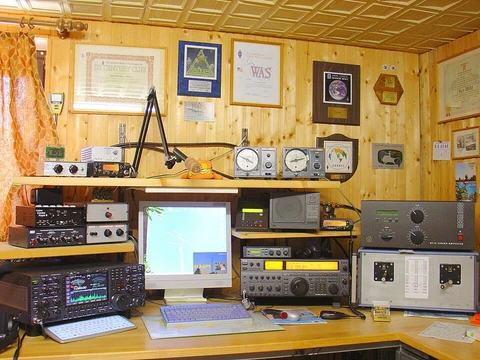
- Amateur radio license
- Amateur Extra Class
- Call sign
- KJ5NJ
- Awards
- Asteroid (5799) named 'Brewington' (1995); Leslie C. Peltier Award (2020)
Lore & Background
Brewington began as an amateur astronomer, hand-grinding and polishing the mirrors for his 8-inch and 16-inch reflecting telescopes, which he designed specifically for comet hunting. He discovered his first comet from South Carolina in 1989. To improve his chances of further discoveries, he and his first wife, Trudy Bland-Brewington, moved to southern New Mexico in fall 1990 and built a comet-hunting observatory on a mountain ridge east of Cloudcroft. From 1991 to 1996, the relocation yielded four more visual discoveries, including two short-period comets: 97P/Metcalf-Brewington and 154P/Brewington, each with orbits of about ten years.
In 1992, NASA-funded robotic telescopes began finding comets as part of the Near-Earth Object survey. Brewington predicted the end of visual comet discoveries in his article 'The Future Of Comet Hunting,' published in the summer 1995 issue of CCD Astronomy magazine. A follow-up article, 'The Last Visual Comet Hunters,' appeared in Sky & Telescope magazine in November 2015, confirming his prediction. He stopped comet hunting in 1999, moved back to South Carolina, and enrolled at the University of South Carolina in Columbia, graduating with honors in summer 2002.
Brewington was then hired as a 2.5-meter telescope operator through the Astronomy Department of New Mexico State University, working at Apache Point Observatory in Sunspot, New Mexico, from 2002 to 2015 as part of the Sloan Digital Sky Survey. During SDSS-I through SDSS-IV, he collected imaging and/or spectral data for projects including First-Phase Operations, Sloan Legacy Survey, SEGUE, Sloan Supernova Survey, APOGEE, BOSS, MARVELS, SEGUE-2, APOGEE-2, eBOSS, and MaNGA. Now retired from NMSU, he lives in Bastrop, Texas, with his second wife, Maria (Maya) Hamby-Brewington, and is a member of the Austin Astronomical Society. His most recent astronomical pastime is finding and imaging micrometeorites, having found hundreds of these sub-millimeter particles. He also holds an Amateur Extra Class amateur radio license with call sign KJ5NJ.
Reader's Guide
Brewington's significance lies in his role as one of the last successful visual comet hunters, a practice that effectively ended with the rise of NASA-funded robotic surveys. His five visual discoveries, made with home-built telescopes, represent a traditional approach to astronomy that was rapidly supplanted by automated systems. His 1995 article in CCD Astronomy magazine accurately predicted this shift, and his 2015 follow-up in Sky & Telescope confirmed it. After his comet-hunting career, Brewington transitioned to professional astronomy, operating the 2.5-meter telescope for the Sloan Digital Sky Survey over 13 years, contributing to major projects like SDSS-I through SDSS-IV, including the Sloan Legacy Survey, SEGUE, APOGEE, BOSS, and others. His legacy includes the naming of asteroid (5799) Brewington in his honor in 1995 and the 2020 Leslie C. Peltier Award from the Astronomical League for his comet discoveries and contributions to observational astronomy. His later work finding micrometeorites continues his observational tradition. Brewington's career bridges the era of visual amateur discovery and modern robotic, data-intensive astronomy.
Did You Know?
- Brewington hand-ground and polished the primary mirrors for his 8-inch and 16-inch reflecting telescopes.
- He discovered or co-discovered five comets, including two short-period comets: 97P/Metcalf-Brewington and 154P/Brewington.
- He predicted the end of visual comet discoveries in a 1995 article in CCD Astronomy magazine.
More in Amateur Radio People 1-24
Spotted an error? Know more?
Reader corrections go straight into our review queue. Suggest an edit · How this site is sourced