Leo Beranek
Acoustician, MIT professor, and founder of BBN Technologies.

Leo Leroy Beranek was an American acoustician, former MIT professor, and a founder and former president of Bolt, Beranek and Newman (now BBN Technologies). He authored the classic textbook *Acoustics* and its updated version *Acoustics: Sound Fields and Transducers*, and was an expert in the design and evaluation of concert halls and opera houses. He also held an amateur radio license, which he earned after being inspired by a fellow student's amateur radio setup.
Quick Facts
- Birth Name
- Leo Leroy Beranek
- Birth Date
- 1914-09-15
- Birth Place
- Solon, Iowa, US
- Death Date
- 2016-10-10
- Death Place
- Westwood, Massachusetts, US
- Fields
- Acoustics / Electrical engineering
- Workplaces
- Bolt, Beranek and Newman / Massachusetts Institute of Technology (MIT)
- Education
- Cornell College (Mount Vernon, Iowa) / Harvard University
- Doctoral Advisor
- Frederick Vinton Hunt
- Doctoral Students
- Kenneth N. Stevens / James L. Flanagan
- Known For
- Acoustics (1954, 1986) / Acoustics: Sound Fields and Transducers (2012) / Music, Acoustics, and Architecture (1962, 2004)
Facts from the source article.
Lore & Background
Beranek's early life was shaped by rural Iowa and the sudden death of his mother in January 1926, which forced his father to sell the farm. He learned radio repair through a correspondence course and apprenticed with an older repairman, eventually buying a Model T automobile. He also played trap drums in a dance band and excelled in a typing class. During the Great Depression, he saved $500 from his earnings, withdrew $400 to pay college tuition in advance, and lost the remaining $100 when his bank failed the next day. He worked as a field hand in the summers of 1932 and 1933 to earn tuition.
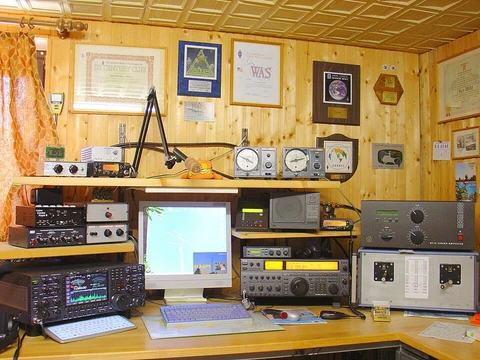
In fall 1933, after a friend showed him an amateur radio setup, Beranek studied Morse Code and earned his own amateur radio license. He bought an early disc sound recorder to record students for a speech class, his first hands-on acoustics experience. He dropped out of college in early 1934 to work full-time at Collins Radio Company in Cedar Rapids, Iowa, where he studied German in his spare time. A chance encounter in August 1935 with Glenn Browning, whose car had a flat tire, led Browning to encourage Beranek to apply to Harvard University, which he had thought financially out of reach.
During World War II, Beranek managed Harvard's electro-acoustics laboratory, designing communications and noise reduction systems for aircraft and building the first anechoic chamber. In 1945, he improved the Hush-A-Phone, a cup that fit over a telephone mouthpiece to prevent overhearing. AT&T threatened users with service termination, leading to the case Hush-A-Phone v. United States, which AT&T lost and which established a precedent that eventually helped break up AT&T's monopoly.
Reader's Guide
Beranek's significance lies in his foundational contributions to acoustics and his role in shaping modern telecommunications and concert hall design. His 1954 textbook *Acoustics* became a standard reference in the field, and he revised it in 1986 and again in 2012 at age 98 with Tim Mellow. His 1962 book *Music, Acoustics, and Architecture*, based on analysis of 55 concert halls, was expanded in 2004 to cover 100 halls. He participated in the design of numerous concert halls and opera houses worldwide. As a founder and president of Bolt, Beranek and Newman (BBN), he helped establish a company that became a major research and development organization. His involvement with the Hush-A-Phone case contributed to legal challenges against AT&T's monopoly. He also led Boston Broadcasters, Inc., which took control of television station WCVB-TV after a court battle. Beranek served as chairman of the board of the Boston Symphony Orchestra from 1983 to 1986 and remained a Life Trustee; the Beranek Room at Symphony Hall is named after him. The Leo and Gabriella Beranek Scholarship in Architectural Acoustics and Noise Control was established in 2016 to support graduate study in those fields.
Did You Know?
- Beranek earned his amateur radio license after a fellow student showed him an amateur radio setup.
- He built the first anechoic chamber during World War II, which later inspired John Cage's philosophy of silence.
- He lost $100 when his bank failed the day after he withdrew $400 to pay college tuition.
- At age 98, he collaborated with Tim Mellow to produce an updated version of his classic textbook *Acoustics*.
More in Amateur Radio People 1-24
Spotted an error? Know more?
Reader corrections go straight into our review queue. Suggest an edit · How this site is sourced