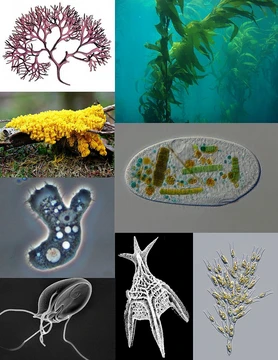
Paramecium
Unicellular ciliates used as model organisms in biology.

Paramecium (pronounced PARR-ə-MEE-s(ee-)əm or -see-əm; the plural "paramecia" is used only as a common name) is a genus of single-celled, eukaryotic ciliates. These organisms thrive in freshwater, brackish, and ocean environments, and are especially common in stagnant ponds and basins. Because certain species are easy to grow in culture and can be readily induced to undergo conjugation and cell division, they have become standard tools in classrooms and laboratories for studying biological processes. They are frequently used as model organisms for the ciliate group and have been called the "lab rats" of the phylum Ciliophora.
Historically, paramecia were among the first ciliates seen by microscopists in the late 1600s. The Dutch protozoology pioneer Antonie van Leeuwenhoek likely encountered them, and they were clearly described by his contemporary Christiaan Huygens in a 1678 letter. The earliest known illustration of a Paramecium species appeared anonymously in the Philosophical Transactions of the Royal Society in 1703. In 1718, French mathematics teacher and microscopist Louis Joblot described and illustrated a microscopic "fish" he found in an infusion of oak bark in water, naming it "Chausson" (slipper); the term "slipper animalcule" remained a common nickname for Paramecium through the 1700s and 1800s. The name "Paramecium," from the Greek παραμήκης (paramēkēs, meaning "oblong"), was coined in 1752 by English microscopist John Hill for animalcules with no visible limbs or tails and an irregularly oblong shape. In 1773, O. F. Müller, the first to place the genus in the Linnaean system, adopted the name but changed the spelling to Paramæcium. Johann Hermann altered it again in 1783 to Paramœcium. C. G. Ehrenberg, in a major 1838 study of infusoria, restored Hill's original spelling, which most researchers have since followed.
Paramecium species range from 0.06 mm to 0.3 mm in length. Their cells are typically ovoid, elongate, or shaped like a foot or cigar. The cell body is enclosed by a stiff but elastic pellicle, composed of an outer plasma membrane, a layer of flattened membrane-bound sacs called alveoli, and an inner epiplasm. The pellicle is not smooth; it has hexagonal or rectangular depressions, each perforated by a central opening through which a single cilium projects. Between the alveolar sacs, most species have closely spaced, spindle-shaped trichocysts—explosive organelles that discharge thin, non-toxic filaments, often used for defense. An anal pore (cytoproct) is usually located on the ventral surface in the posterior half of the cell. All species have a deep oral groove running from the anterior to the midpoint, lined with inconspicuous cilia that beat continuously to draw food into the cell. Paramecia are primarily heterotrophic, feeding on bacteria and other small organisms; a few species are mixotrophs, obtaining some nutrients from endosymbiotic algae (chlorella) carried in their cytoplasm. Osmoregulation is managed by contractile vacuoles, which actively expel water to offset fluid absorbed by osmosis; the number of vacuoles varies by species.
For movement, a Paramecium propels itself with whip-like motions of its cilia, arranged in tightly spaced rows around the body. Each cilium's beat has two phases: a fast, stiff "effective stroke" followed by a slow "recovery stroke," during which the cilium curls loosely to one side and sweeps forward counter-clockwise. The densely packed cilia move in coordinated waves across the "ciliary carpet," an effect sometimes compared to wind blowing across a field of grain. The organism spirals through the water as it moves. When it encounters an obstacle, it reverses the effective stroke of its cilia and swims backward briefly before resuming forward progress—a behavior called the avoidance reaction. If it hits the same object again, it repeats this process until it gets past. Calculations show that a Paramecium uses more than half its energy just to propel itself through water, and this ciliary method of locomotion is less than 1% efficient—though this is close to the maximum theoretical efficiency for an organism with cilia as short as those of Paramecium.
To gather food, Paramecium feeds on microorganisms like bacteria, algae, and yeasts. It uses ciliary movements to sweep prey and some water through the oral groove (vestibulum) and into the cell. Food then passes from the cilia-lined oral groove into a narrower buccal cavity (gullet), then through a small opening called the cytostome (cell mouth) into the cell interior. Once inside, food is collected into food vacuoles, which periodically close off and are released into the cytoplasm. These vacuoles circulate through the cell body via cyclosis (cytoplasmic streaming). As a food vacuole moves along, enzymes from the cytoplasm enter it to digest the contents.
- field
- Microbiology, Protozoology
- known_for
- Model organism for ciliate biology; first ciliates observed by microscopists in the late 17th century; used in studies of conjugation, binary fission, and learning
Lore & Background
Paramecium are among the earliest ciliates documented by microscopists, with observations dating to the late 1600s. The Dutch pioneer Antonie van Leeuwenhoek likely knew them, and Christiaan Huygens described them clearly in 1678. The first known illustration of a Paramecium species appeared anonymously in a 1703 scientific journal. In 1718, Louis Joblot described and illustrated a “slipper animalcule” from an oak bark infusion, a term used colloquially for Paramecium through the 1800s. The name *Paramecium*, from Greek for “oblong,” was coined in 1752 by John Hill for animalcules of irregular oblong shape without visible limbs. O. F. Müller placed the genus in Linnaean taxonomy in 1773, altering the spelling to *Paramæcium*; Johann Hermann changed it again in 1783. C. G. Ehrenberg restored Hill’s original spelling in 1838, which most researchers follow. Species range from 0.06 mm to 0.3 mm long, with ovoid, elongate, foot- or cigar-shaped cells. The body is enclosed by a pellicle composed of an outer membrane, a layer of flattened sacs called alveoli, and an inner epiplasm. The pellicle has hexagonal or rectangular depressions, each with a central opening for a single cilium. Most species possess spindle-shaped trichocysts between alveolar sacs, explosive organelles that discharge non-toxic filaments, often for defense. An anal pore lies on the ventral surface in the posterior half. A deep oral groove runs from the anterior to the cell’s midpoint, lined with cilia that beat continuously to draw in food. Paramecia are primarily heterotrophic, feeding on bacteria and other small organisms; a few mixotrophic species gain nutrients from endosymbiotic chlorella algae. Contractile vacuoles regulate osmoregulation by expelling water absorbed via osmosis, with numbers varying by species.
Reader's Guide
Paramecium species have served as key model organisms for understanding ciliate biology, including cell structure, movement, feeding, and reproduction. Their ciliary locomotion, involving coordinated effective and recovery strokes, has been studied for efficiency, calculated to be less than 1% but close to the theoretical maximum for short cilia. The genus has contributed to knowledge of endosymbiosis, as some species harbor green algae or bacterial endosymbionts like kappa particles. The genome of Paramecium tetraurelia has been sequenced, revealing evidence for three whole-genome duplications, and its genetic code uses only UGA as a stop codon, with UAG and UAA coding for glutamic acid. Their ease of cultivation and dual nuclear apparatus make them invaluable for studying asexual reproduction via binary fission and sexual phenomena like conjugation and autogamy.
Did You Know?
- Some Paramecium species harbor endosymbiotic green algae, deriving nutrients and protection from predators.
- In Paramecium, the codons UAG and UAA code for glutamic acid instead of acting as stop codons.
Frequently Asked Questions
What is Paramecium?
Paramecium is a genus of single-celled, eukaryotic ciliates that thrive in freshwater, brackish, and marine waters. They are most commonly encountered in still ponds and stagnant basins, where their abundance makes them easy to spot under a basic microscope.
Why do people call Paramecium the 'white rat' of Ciliophora?
The nickname reflects how universally these ciliates are used as a teaching and research test subject. Because particular species are simple to culture and can be coaxed into conjugation or binary fission on demand, they have become the default experimental organism for studying ciliate biology.
What biological processes can Paramecium demonstrate in a lab?
Researchers routinely use Paramecium to observe conjugation, binary fission, and even rudimentary forms of learning in a single cell. Their ease of handling and predictable reproductive cycles make them ideal for classroom demonstrations of protist life cycles.
Where do I find Paramecium in the wild?
They are most abundant in stagnant freshwater bodies such as ponds, ditches, and nutrient-rich basins, though some species tolerate brackish and even marine conditions. A quiet backyard pond in summer is one of the most reliable places to collect a sample.
How long has Paramecium been part of biology education?
Ciliates were among the first protists examined by microscopists in the late 1600s, and Paramecium has remained a staple of microbiology and protozoology curricula ever since. Its long track record as a model organism spans well over three centuries of scientific inquiry.
More in Algae And Protists 1-24
Spotted an error? Know more?
This is a living reference — every entry is fact-audited, and reader corrections feed straight into our audit queue. Suggest an edit · See this site's audit record