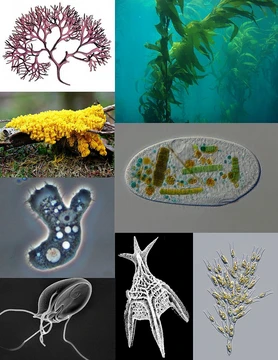
Flagellate
Organisms with whip-like flagella for motion and feeding.

A flagellate is a cell or organism possessing one or more whip-like appendages known as flagella. The term describes a particular level of biological organization and a means of motion found in both prokaryotes and eukaryotes, but it does not imply any specific evolutionary relationship or taxonomic classification. In eukaryotes, flagella are supported internally by a characteristic arrangement of microtubules: nine fused pairs surrounding two central singlets, all arising from a basal body. These appendages are generally used for propulsion, but in some flagellates they also create a current that directs food into a specialized mouth-like structure called a cytostome. Flagellates are major consumers of bacteria and other protists in aquatic ecosystems, playing a key role in consuming primary and secondary production. Many parasites of human health or economic importance, such as *Naegleria*, *Trichomonas*, and *Plasmodium*, are flagellates during at least one stage of their life cycle. In older classification systems, flagellated protozoa were grouped together as Flagellata (or Mastigophora), sometimes divided into autotrophic Phytoflagellata and heterotrophic Zooflagellata, and occasionally grouped with amoeboid organisms in Sarcomastigophora. The autotrophic flagellates were classified similarly to botanical algae groups, while colourless flagellates were artificially divided into groups such as Protomastigineae, Pantostomatineae, and Distomatineae. These older groups are now known to be highly polyphyletic. In modern classifications, principal flagellated taxa are placed across diverse eukaryotic groups including Archaeplastida, Stramenopiles, Alveolata, Rhizaria, Amoebozoa, Opisthokonta, and Excavata, which also contain non-flagellated forms. Although the taxonomic group Flagellata has been abandoned, the term remains in use to describe a level of organization and as an ecological functional group.
- definition
- Cell or organism with one or more flagella
- occurrence
- Eukaryotes, some prokaryotes
- ecological role
- Major consumers in aquatic ecosystems
- human relevance
- Includes parasites such as Naegleria, Trichomonas, Plasmodium
- flagella structure
- Eukaryotic flagella have nine fused pairs surrounding two central singlets, arising from a basal body
Lore & Background
Flagellates are cells or organisms possessing one or more whip-like appendages known as flagella. The term describes a particular level of biological organization and a means of motion found across many prokaryotes and eukaryotes, though it does not imply a specific evolutionary relationship or taxonomic classification. In eukaryotes, the flagellum is supported internally by microtubules arranged in a distinctive pattern: nine fused pairs surrounding two central singlets, all arising from a basal body. These appendages are primarily used for propulsion, but in some species they also generate water currents to direct food particles toward a specialized mouth-like structure called a cytostome. Typically, one or more flagella are positioned near the anterior of the cell, with one often pointing forward and another trailing behind. Flagellates are ecologically significant as major consumers of primary and secondary production in aquatic ecosystems, feeding on bacteria and other protists. Many parasites affecting human health or economy, such as *Naegleria*, *Trichomonas*, and *Plasmodium*, are flagellated during at least one stage of their life cycle. In older classification systems, flagellated protozoa were grouped together as Flagellata (or Mastigophora), sometimes divided into autotrophic Phytoflagellata and heterotrophic Zooflagellata. However, these groups are now recognized as highly polyphyletic, and modern classifications distribute flagellated taxa across diverse eukaryotic lineages, including Archaeplastida, Stramenopiles, Alveolata, Rhizaria, Amoebozoa, Opisthokonta, and Excavata. Despite the abandonment of Flagellata as a formal taxonomic group, the term remains useful for describing a level of organization and an ecological functional group.
Reader's Guide
The term 'flagellate' remains in use as a description of a level of organization and as an ecological functional group, even though the taxonomic group Flagellata was abandoned. In older classifications, flagellated protozoa were grouped in Flagellata (Mastigophora), sometimes divided into Phytoflagellata (mostly autotrophic) and Zooflagellata (heterotrophic). These groups are now known to be highly polyphyletic. Modern classifications place principal flagellated taxa in groups such as Archaeplastida, Stramenopiles, Alveolata, Rhizaria, Amoebozoa, Opisthokonta, and Excavata, which also include non-flagellated forms. The amoeboflagellates and helioflagellates represent peculiar types of organization combining flagella with pseudopods or heliozoan structures.
Did You Know?
- Flowering plants do not produce flagellate cells, but ferns, mosses, green algae, and some gymnosperms do.
- Most fungi do not produce cells with flagella, but the primitive fungal chytrids do.
- Many parasites that affect human health or economy are flagellates in at least one stage of their life cycle, such as Naegleria, Trichomonas, and Plasmodium.
- The term 'flagellate' does not imply any specific relationship or classification of the organisms that possess flagella.
Frequently Asked Questions
What is a flagellate in the Algae And Protists 1-24 entry?
A flagellate is any single cell or organism that propels itself using one or more whip-like tails called flagella. The label spans a broad swath of life, from certain prokaryotes to many eukaryotic protists, and it describes a locomotion strategy rather than a single evolutionary lineage.
What ecological role do flagellates fill in aquatic ecosystems?
Flagellates serve as major consumers of both primary and secondary production in water bodies, preying on bacteria and other protists. By linking microbial producers to higher trophic levels, they are a critical link in the aquatic food web.
Does the term 'flagellate' imply a single taxonomic group?
No. The word is purely functional, describing how an organism moves rather than where it sits on the tree of life. Flagellated cells appear across multiple kingdoms and phyla, so the label carries no implication of shared ancestry.
How do flagellates connect to human health and economy?
Several parasites that cause disease or economic loss are flagellates at some stage of their life cycle. Notable examples include Naegleria, Trichomonas, and Plasmodium, all of which can produce serious illness in humans.
What is the internal structure of a eukaryotic flagellum?
A eukaryotic flagellum contains nine fused microtubule pairs arranged around a central pair of singlets, a pattern often summarized as the 9+2 arrangement. It is anchored to the cell by a basal body, which also serves as the site where the flagellum assembles.
More in Algae And Protists 1-24
Spotted an error? Know more?
This is a living reference — every entry is fact-audited, and reader corrections feed straight into our audit queue. Suggest an edit · See this site's audit record