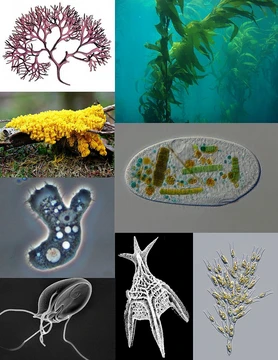
Foraminifera
Single-celled protists with intricate shells, key to Earth's history.

Foraminifera are single-celled organisms, members of a phylum or class of Rhizarian protists, characterized by streaming granular ectoplasm used for catching food and other functions, and commonly an external shell called a test. The name derives from Latin, meaning "hole bearers," a reference to the perforations in the partitions between chambers in their shells. These tests, which can have one or multiple chambers and sometimes become highly elaborate, are typically composed of calcium carbonate or agglutinated sediment particles. The most primitive tests are believed to be made of chitin, found in some simple genera and notably in *Textularia*. Most foraminifera are marine, with the majority living on or within seafloor sediment as part of the macrobenthos, meiobenthos, or microbenthos; a smaller number are planktonic, floating at various depths and belonging to the suborder Globigerinina. Fewer species inhabit freshwater or brackish conditions, and a very small number of nonaquatic soil species have been identified through molecular analysis of small subunit ribosomal DNA. Over 50,000 species are recognized, comprising both living forms (6,700–10,000) and fossils (40,000). They are usually less than 1 mm in size, though the largest species can reach up to 20 cm. The earliest known reference to foraminifera comes from Herodotus in the 5th century BCE, who noted them as making up the rock of the Great Pyramid of Giza, now recognized as the genus *Nummulites*. Robert Hooke illustrated a foraminifera in his 1665 book *Micrographia*, and Antonie van Leeuwenhoek described them as minute cockles in 1700. Alcide d'Orbigny named the group foraminifères in 1826, interpreting their pseudopodia as tentacles. The protozoan nature of foraminifera was first recognized by Dujardin in 1835. Modern classification, based on test wall microstructure and molecular systematics, largely follows the groupings established by Tappan and Loeblich in 1964.
- field
- Protistology, Micropaleontology
- known_for
- Granuloreticulose pseudopodia; calcareous or agglutinated tests; use in biostratigraphy
- size_range
- Usually less than 1 mm; largest up to 20 cm
- earliest_reference
- Herodotus, 5th century BCE (noted in Great Pyramid of Giza)
Quick Facts
- Taxon
- Foraminifera
Facts from the source article.
Lore & Background
Foraminifera, meaning "hole bearers" in Latin and informally called "forams," are single-celled protists belonging to the phylum or class of Rhizaria. They are characterized by streaming granular ectoplasm used for feeding and other functions, and most possess an external shell known as a test. Tests can be composed of various materials, with chitinous tests—found in simple genera like *Textularia*—considered the most primitive. The majority of foraminifera are marine, with most living on or within seafloor sediment as benthic organisms, where different-sized species contribute to the macrobenthos, meiobenthos, and microbenthos. A smaller number, belonging to the suborder Globigerinina, are planktonic, floating in the water column at various depths. Fewer species are known from freshwater or brackish conditions, and a very small number of nonaquatic soil species have been identified through molecular analysis of small subunit ribosomal DNA. Foraminifera typically produce a test with one or multiple chambers, some highly elaborate, commonly made of calcium carbonate or agglutinated sediment particles. Over 50,000 species are recognized, including both living (6,700–10,000) and fossil (40,000) forms. They are usually less than 1 mm in size, though the largest species can reach up to 20 cm. The term "foraminifera" is used as both singular and plural in modern scientific English.
Reader's Guide
Foraminifera are significant as index fossils for dating and correlating sedimentary rocks, and as indicators of past environments. Their tests, composed of calcium carbonate or agglutinated particles, preserve in marine sediments, providing a continuous record of climate and ocean conditions. Foraminifera are closely related to Cercozoa and Radiolaria within the Rhizaria. Their pseudopodia are unique in being granuloreticulose, used for locomotion, feeding, and test construction. The group includes both benthic and planktonic forms, with planktonic species belonging to the suborder Globigerinina.
Did You Know?
- The name 'Foraminifera' means 'hole-bearers' in Latin, referring to the holes in the septa of their shells.
- Some foraminifera lack tests entirely.
- The largest foraminifera species can reach up to 20 cm in size.
Frequently Asked Questions
Who is Foraminifera?
Foraminifera is a single-celled protist in the Rhizarian group, instantly recognizable by its granular streaming ectoplasm and its often ornate external shell, called a test. In the Algae And Protists series, this entry spotlights one of the most architecturally creative microorganisms on Earth.
What are Foraminifera's powers or role?
Foraminifera extends thread-like granuloreticulose pseudopodia to forage and explore, while simultaneously secreting or cementing a shell from calcium carbonate or sediment grains. That dual capacity to move and build gives it a niche no other protist quite matches.
How does Foraminifera's story end?
Living individuals are tiny and short-lived, but their calcium-carbonate tests fossilize readily on the seafloor, stacking into rock layers that survive for millions of years. So the organism's 'ending' is really an ongoing geological record that scientists still read today.
Why is Foraminifera important?
Because their tests are abundant, morphologically diverse, and evolve quickly, Foraminifera fossils anchor biostratigraphy for dating sedimentary rock and paleoclimatology for reconstructing ancient ocean temperatures. No other single-celled group has shaped how we read Earth's deep past so heavily.
How big is Foraminifera, and when was it first noticed?
Most specimens measure under one millimeter, though a few species reach roughly twenty centimeters, making them among the largest single cells known. The earliest recorded sighting of their shells traces back to Herodotus in the fifth century BCE, who noted them embedded in the limestone blocks of the Great Pyramid of Giza.
More in Algae And Protists 1-24
Spotted an error? Know more?
This is a living reference — every entry is fact-audited, and reader corrections feed straight into our audit queue. Suggest an edit · See this site's audit record