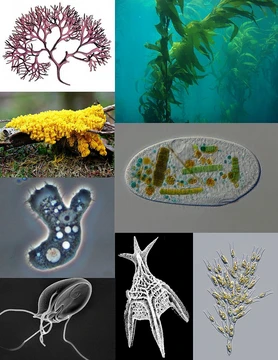
Amoebozoa
A major group of amoeboid protists with lobose pseudopods.

Amoebozoa is a large group of protists, with roughly 2,400 known species. These organisms are characterized by their blunt, finger-like pseudopods and mitochondria that have branching, tubular cristae. Older classification systems typically placed Amoebozoa as a phylum within the kingdoms Protista or Protozoa. Today, the International Society of Protistologists treats it as an unranked supergroup within Eukaryota. Genetic evidence confirms that Amoebozoa is a single, natural lineage (monophyletic). Phylogenetic studies show it is the sister group to Opisthokonta, the clade that includes fungi, animals, and about 300 species of single-celled eukaryotes. Because of this close relationship, Amoebozoa and Opisthokonta are sometimes combined into a higher taxon called Amorphea.
This group includes many well-known amoebae, such as *Amoeba*, *Chaos*, *Entamoeba*, and *Pelomyxa*. Species can be either naked or covered by a shell (testate), and some cells have flagella. Free-living forms are common in saltwater, freshwater, soil, moss, and leaf litter. Others live as parasites or symbionts, and a few cause disease in humans and other organisms. Although most amoebozoans are single-celled, the group also contains several types of slime molds. These have a multicellular stage: either a macroscopic plasmodium formed by repeated cell division without separation, or, in cellular slime molds, an aggregate of individual cells.
Size varies enormously. Some species are only 10–20 μm across, while others are among the largest protozoa. *Amoeba proteus*, which can reach 800 μm, is a common model organism in classrooms and labs. Multinucleate species like *Chaos* and *Pelomyxa* can be several millimeters long. Some multicellular slime molds, such as *Fuligo septica* (the “dog vomit” slime mold), can cover several square meters.
**Morphology**
Despite the group’s diversity, many members share common features. The cell is typically divided into a granular inner endoplasm and a clear outer ectoplasm. During movement, the endoplasm flows forward while the ectoplasm moves backward along the cell’s exterior. Many amoebozoans have a clear front and back and can move in a monopodial form, using the whole cell as a single pseudopod. Large pseudopods may produce smaller, temporary projections called subpseudopodia, used for locomotion or feeding. A cell can also extend several indeterminate pseudopods, through which the entire cell contents flow in the direction of travel. The cell mass pours into the leading pseudopod, and the others retract unless the organism changes course.
Most amoebozoans are naked (like *Amoeba* and *Chaos*) or covered with a loose coat of tiny scales (like *Cochliopodium* and *Korotnevella*). Members of the order Arcellinida, however, build rigid shells (tests) with a single opening for pseudopods. These tests can be secreted from organic material (as in *Arcella*) or assembled from collected particles cemented together (as in *Difflugia*).
The primary feeding method is phagocytosis: the cell surrounds food particles with pseudopods, seals them into vacuoles, and digests them. Some species have a posterior bulb called a uroid, which may collect waste and periodically detach. When food is scarce, most can form cysts, which can be carried through the air to new environments. In slime molds, these structures are called spores and are produced on stalked fruiting bodies (sporangia). Mixotrophic species that host symbiotic *Chlorella* algae inside their cytoplasm occur in Arcellinida and *Mayorella*.
Most Amoebozoa lack flagella and do not form microtubule-supported structures except during mitosis. Flagella do appear in the Archamoebae, and many slime molds produce biflagellate gametes. The flagellum is anchored by a cone of microtubules, hinting at a close relationship with opisthokonts. Mitochondria typically have branching tubular cristae, but Archamoebae, which live in low-oxygen habitats, have lost their mitochondria.
**Classification**
Molecular genetics places Amoebozoa as a sister group to animals and fungi, diverging after that lineage split from other eukaryotes. Strong similarities between Amoebozoa and Opisthokonta suggest they form a distinct clade. Thomas Cavalier-Smith proposed the name Unikonta for this branch, based on the idea of a common ancestor with a single emergent flagellum rooted in one basal body. While the close relationship is well supported, the uniciliate ancestor hypothesis is now considered unlikely. In the 2012 Revised Classification of Eukaryotes, Adl et al. proposed the name Amorphea for this clade.
- classification_rank
- Phylum or unranked supergroup
- sister_group
- Opisthokonta (includes fungi and animals)
- higher_taxon
- Amorphea (sometimes grouped with Opisthokonta)
- key_features
- Lobose pseudopods, tubular mitochondrial cristae, phagocytosis
- habitat
- Salt and freshwater, soil, moss, leaf litter; some parasitic or symbiotic
Quick Facts
- Taxon
- Amoebozoa
- Subdivision
- Tubulinea / Discosea / Evosea / Cutosea / Conosa / Variosea / Eumycetozoa / Archamoebea
Facts from the source article.
Lore & Background
Molecular genetic analysis supports Amoebozoa as a monophyletic clade, and modern studies identify it as the sister group to Opisthokonta. Amoebozoa and Opisthokonta are sometimes grouped together in a high-level taxon named Amorphea. Within Amoebozoa, two subphyla are recognized: Lobosa (non-flagellated amoebae with blunt, lobose pseudopods) and Conosa (amoeboid and flagellated cells with pointed or branching subpseudopodia, including Archamoebae and Mycetozoan slime molds). The well-known species Amoeba proteus, which may reach 800 μm in length, is often studied in schools and laboratories as a representative cell or model organism, partly because of its convenient size. Multinucleate amoebae like Chaos and Pelomyxa may be several millimetres in length, and some multicellular amoebozoa, such as the "dog vomit" slime mold Fuligo septica, can cover an area of several square meters.
Reader's Guide
Amoebozoa holds significant importance in evolutionary biology as the sister group to Opisthokonta, the clade that includes fungi and animals. This relationship, supported by molecular genetic analysis, places Amoebozoa at a key branching point in the eukaryotic tree of life. The group's diversity in form—from unicellular amoebae to multicellular slime molds—provides insight into the evolution of multicellularity and cellular organization. Many species, such as Amoeba proteus, serve as model organisms in education and research due to their convenient size and representative cellular features. The presence of both free-living and parasitic species, including some that cause disease in humans and other organisms, underscores their ecological and medical relevance. The ongoing refinement of their taxonomy, including the division into Lobosa and Conosa and the proposal of the clade Amorphea, reflects active scientific debate and the dynamic nature of protist classification.
Did You Know?
- Amoebozoa contains about 2,400 described species.
- The well-known species Amoeba proteus may reach 800 μm in length.
- Multinucleate amoebae like Chaos and Pelomyxa may be several millimetres in length.
- The "dog vomit" slime mold Fuligo septica can cover an area of several square meters.
- Among the Archamoebae, which are adapted to anoxic or microaerophilic habitats, mitochondria have been lost.
Frequently Asked Questions
Who is Amoebozoa?
Amoebozoa is a major lineage of amoeboid protists defined by their blunt, fingerlike lobose pseudopods and tubular mitochondrial cristae. It encompasses well-known genera such as Amoeba, Chaos, Entamoeba, and Pelomyxa.
What are Amoebozoa's powers/role?
Members of this group feed by phagocytosis, extending their flexible lobose pseudopods to engulf food particles. They lack a rigid cell wall, giving them the shape-shifting, gliding movement fans associate with classic amoebae.
Where does Amoebozoa live?
Amoebozoa inhabit saltwater, freshwater, soil, moss, and leaf litter, while some species have shifted to parasitic or symbiotic lifestyles rather than living freely in those environments.
How does Amoebozoa fit into the bigger cast?
Traditional taxonomy ranks it as a phylum within Protista or Protozoa, whereas the International Society of Protistologists treats it as an unranked supergroup under Eukaryota. Its closest living relatives form the sister group Opisthokonta (fungi and animals), and both lineages are sometimes lumped together under the broader clade Amorphea.
Why is Amoebozoa important?
It is one of the most recognizable branches of the protist world and includes organisms that have shaped our understanding of cell motility, phagocytosis, and parasitism. Its close evolutionary tie to Opisthokonta also makes it central to studying the deep origins of multicellular life.
More in Algae And Protists 1-24
Spotted an error? Know more?
This is a living reference — every entry is fact-audited, and reader corrections feed straight into our audit queue. Suggest an edit · See this site's audit record