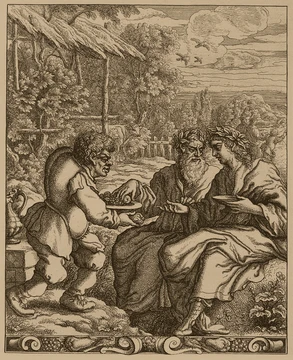
The Ass and his Masters
A discontented ass finds each new master worse than the last.
The Ass and his Masters is a fable numbered 179 in the Perry Index and also known as The ass and the gardener and Jupiter and the ass. It is included among Aesop's Fables and appears only in Greek sources from classical times.
Quick Facts
- Perry index number
- 179
- Alternative titles
- The ass and the gardener, Jupiter and the ass
Facts from the source article.
The fable
In this ancient Greek fable, an ass works for a gardener but complains to the king of the gods about not getting enough food, so he asks for a new master. He is sent to a potter, but soon begs for another change because the loads are too heavy. Next, he goes to a tanner and then regrets leaving his first employer. When slavery was widespread, the story was used to reflect the discontent of slaves.
During the Renaissance, two Neo-Latin poets helped spread the tale. Gabriele Faerno called his version Asinus dominus mutans, with the lesson that swapping masters only makes things worse. Hieronymus Osius titled his Asinus et olitor, noting that constant dissatisfaction always leads to a wish for change. Jean de la Fontaine later included it in his Fables as L'ane et ses maitres, adding that providence has better things to do than heed those who are never satisfied.
In Britain, the fable was usually called The ass and Jupiter, appearing in works by John Ogilby, Samuel Croxall, Thomas Bewick, and Brooke Boothby. The Dutch painter Dirck Stoop also created an etching of the fable under that title in 1655.
Change is never for the better
Laurentius Abstemius offered a different take on this fable in his collection. His ass, weary of the cold and a diet of nothing but straw, yearns for winter to end. But when spring arrives, the workload is so heavy that he wishes for summer, then autumn, as each season piles on fresh burdens. Finally, his last request is for winter to return, so he can rest where his complaining first began.
Phaedrus, who had been a slave before gaining his freedom, never wrote down the tale of the discontented ass. However, a similar lesson closes his version of The Frogs Who Desired a King. There, the people of Athens complain about their new leader, and Aesop tells them the fable, advising them to endure their current trouble for fear of something worse. Several quite unrelated stories share this same moral, keeping elements of the original plot: a sequence of three changes, each more unpleasant than the last, ending with a plea to keep the final state.
An early Tudor collection of jokes recounts an old classical anecdote. In it, an elderly woman prays for the tyrant Dionysius I of Syracuse to stay healthy. When he asks why, she gives her reason. This story had already appeared in Thomas Aquinas’s work on ruling princes, where he used it to discuss the problems with resisting a tyrant.
A bit earlier in the Middle Ages, Odo of Cheriton made a similar point using a monastery setting. His humorous tale involves monks who pray for their abbot to die. The first abbot gave them three dishes at meals, but not enough to fill them. After his death, the next abbot allows only two dishes, and after he dies, a third abbot permits just one.
One monk then prays for this last abbot to live a long time, fearing that a successor might leave them with nothing to eat at all.
More in Aesop's Fables
Spotted an error? Know more?
Reader corrections go straight into our review queue. Suggest an edit · How this site is sourced