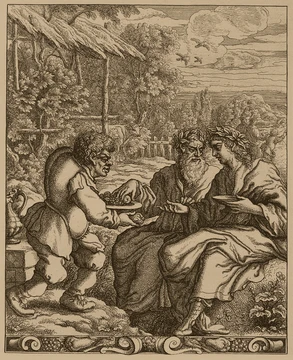
The Bear and the Travelers
A fable about trust and the danger of counting on future gains.
The Bear and the Travelers is a fable attributed to Aesop and is number 65 in the Perry Index. It was expanded and given a new meaning in mediaeval times.
Quick Facts
- Perry index number
- 65
- First recorded in
- Latin verse by Avianus
- Proverb
- Catch the bear before you sell his skin
Facts from the source article.
The Classical Fable
This fable, first put into Latin verse by Avianus, is often used by teachers to instill moral lessons in young children. It follows two friends traveling through rough terrain who are surprised by a bear. One friend climbs a tree to safety, while the other lies on the ground and plays dead. The bear approaches, sniffs him, and then leaves, as bears are said to avoid touching corpses. After the danger passes, the man in the tree climbs down and jokingly asks what the bear whispered to his companion. The friend replies that the bear gave him good advice: never trust a friend who abandons you in a crisis. The motif of pretending to be sick or dead appears in several other fables. In 1903, journalist Allen Kelly, who wrote for the San Francisco Examiner, discussed the tactic of playing dead to avoid harm from a bear and expressed his view that the fable contains some truth.
The origin of a European proverb
The late medieval writer Philippe de Commynes noted that in 1475, King Louis XI of France sent a delegation to Emperor Frederick III, suggesting they split the Burgundian lands. The emperor answered with a tale. Three friends get credit at an inn by vowing to catch a bear and sell its skin, but they end up fleeing. One friend trips, and the bear sniffs him but leaves him unharmed.
When his companions ask what the bear said, he replies, "She told me never again to sell the bear's skin before the beast is dead." This is one of the earliest known versions of a proverb now common across Europe: "Catch the bear before you sell his skin." The story's core comes from an Aesop fable, but it has been reshaped to teach the lesson of not counting one's chickens before they hatch. A different version appears in Laurentius Abstemius' 1490s collection of one hundred fables, titled "How a Tanner Bought a Bear's Skin from Hunters Before It Was Taken."
However, it was Jean de La Fontaine's fables that kept this variation popular, specifically his "L'ours et les deux compagnons" (Fables V.20). His version closely matches Commynes' account, except that only two men are involved, and one climbs a tree to escape, as in the original Aesop. Aesop himself had used the moral of not assuming success before it happens for his fable of "The Milkmaid and Her Pail."
Artistic interpretations
Thanks to its ties to La Fontaine, the fable appears most often in French works. Louis Lacombe included it in his Opus 72 from 1875. In 1920, producer Marius O'Gallop turned it into a nine-minute silent film. Francis Poulenc used it as the second part of his ballet suite Les Animaux modèles in 1941. Marc Chagall made it Plate 63 in his 1952 series of one hundred fables, using etchings with watercolour. Among artists working from Aesop, Scottish painter Martin Hill created a large oil version in 2009. Composer Edward Hughes set the fable to a poetic text by Peter Westmore in his 1965 collection Songs from Aesop's Fables. Anthony Plog also wrote a piece for narrator, horn, and piano in 2011.
More in Aesop's Fables
Spotted an error? Know more?
Reader corrections go straight into our review queue. Suggest an edit · How this site is sourced