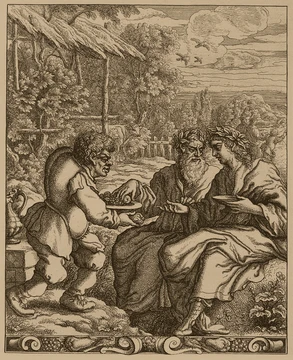
The Ass Carrying an Image
A fable against conceit, later used in Canon Law.
Aesop's fable numbered 182 in the Perry Index, The Ass Carrying an Image, criticizes human vanity. At one time, it also served to support a Canon Law argument that a priest's unworthiness does not invalidate a sacrament.
Quick Facts
- Perry index
- 182
- Latin title
- Asinus portans mysteria
Facts from the source article.
A jackass in office
In a Greek fable, a donkey carries a sacred statue and mistakes the crowd's reverence for the crowd's respect for him. Puffed up with pride, the ass refuses to move, so its handler beats it and says that the world has not grown so foolish that people bow to donkeys. The story's Latin name, Asinus portans mysteria, or its Greek equivalent, ονος αγων μυστήρια, became a proverb for human arrogance, recorded in Erasmus's Adagia.
During the Renaissance, Andrea Alciato brought the fable back in his Emblemata, giving it the heading Non tibi sed religioni, meaning not for your sake but religion's, and set it within the Egyptian worship of Isis. Within a few decades, three English translations of Alciato's Latin poem appeared. The most notable was by Geoffrey Whitney in his Choice of Emblemes, a paraphrase that focuses on the fable's lesson. It compares the donkey to religious pastors and also to secular ambassadors, both of whom serve as go-betweens for a higher authority.
None of these writers credited the tale to Aesop, but Christoph Murer, in his 1620 book of emblems XL emblemata miscella nova, referred to "Aesop's Ass" and compared it to people chasing ambition. Around the same time, the Neo-Latin poet Pantaleon Candidus used the story to describe "those who aspire to great honours." An English reference from about 1630, in The Conversations at Little Gidding, mentions "Aesops Asse interpreting the Prostrate Worship of the People that was offered to the Golden Image on his back as intended to his Beastliness."
This remark, however, was used to separate a person from their religious role. George Herbert, who may have joined those conversations, touched on the same idea in his poem "The Church Porch" (lines 265–268): "When baseness is exalted, do not bate / The place its honour for the person's sake. / The shrine is that which thou doest venerate, / And not the beast that bears it on his back."
More in Aesop's Fables
Spotted an error? Know more?
Reader corrections go straight into our review queue. Suggest an edit · How this site is sourced