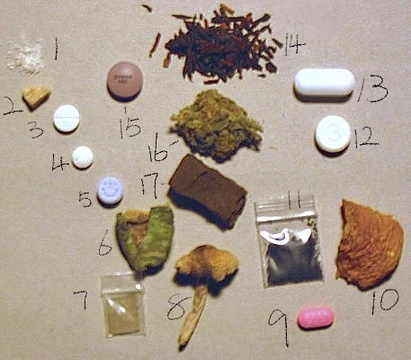
Hallucinogen
Last updated
The term hallucinogen derives from the word hallucination, which traces back to the Latin hallūcināri meaning "to wander in the mind".[1] A broad and diverse class of psychoactive drugs, hallucinogens can trigger altered states of consciousness marked by changes in perception, mood, cognition, and self-experience.[2]
Key facts and history
Leo Hollister gave five criteria for classifying a drug as hallucinogenic, and Richard Glennon added two more criteria to narrow the category to classical hallucinogens.[3][4] After World War II, interest in hallucinogenic drugs in psychiatry exploded, owing mainly to the invention of LSD.[5] LSD was banned in the United States in 1967 as a result of its growing popularity and association with the hippie subculture.[6] Albert Hofmann first identified the hallucinogenic effects of LSD in 1943, an event that made the wider availability of such drugs seem more likely.[7]
Medical journal publications about LSD numbered over 100 by 1951, and that figure had climbed to more than 1,000 by 1961.[5] During the early 1960s, prominent counterculture figures including Timothy Leary and Ken Kesey promoted the use of these drugs for their psychedelic properties.[6] Throughout history, hallucinogens have seen frequent application in religious and shamanic rituals, where they are termed entheogens.[8] Classical hallucinogens hold Schedule 1 status in the U.S., a classification that pharmacologist David E. Nichols contends was established for political, not scientific, motives.[9]
What the cited sources add
A review of ibogaine found that at dosages between 3 and 5 mg/kg it elicits an oneirogenic condition facilitating long-term memory retrieval and closure of unresolved emotional conflicts.[10] The word "oneirogen" is used rather than "hallucinogen" for ibogaine because it does not produce loss of consciousness or formal deterioration of thought.[10] The term "deliriants" was introduced by David F. Duncan and Robert S. Gold to distinguish these drugs from psychedelics and dissociatives due to their primary effect of causing delirium.[11]
References
- Wikipedia, "Hallucinogen" (CC BY-SA 4.0), which cites: "hallucinogen", Merriam-Webster; "Hallucinate", Dictionary.com (original not read by us) en.wikipedia.org
- Wikipedia, "Hallucinogen" (CC BY-SA 4.0), which cites: "Phenomenology, Structure, and Dynamic of Psychedelic States", Current Topics in Behavioral Neurosciences, 2018, p. 221–256; "Classification schemes of altered states of consciousness", Neuroscience & Biobehavioral Reviews, 2025; Walker, "Introduction to the chemistry and pharmacology of psychedelic drugs", Australian Journal of Chemistry, 5 July 2023, p. 236–257; Presti, "The Blackwell Companion to Consciousness", Wiley, 12 April 2017, p. 171–186; Vollenweider, "Brain mechanisms of hallucinogens and entactogens", Dialogues in Clinical Neu en.wikipedia.org
- Wikipedia, "Hallucinogen" (CC BY-SA 4.0), which cites: Glennon RA. Classical drugs: an introductory overview. In Lin GC and Glennon RA (eds). Hallucinogens: an update . National Institute on Drug Abuse: Rockville, M; "Arylalkylamine drugs of abuse: an overview of drug discrimination studies", Pharmacology Biochemistry and Behavior, October 1999, p. 251–6; "Arylalkylamine drugs of abuse: an overview of drug discrimination studies", Pharmacology Biochemistry and Behavior, October 1999, p. 251–6; "Arylalkylamine drugs of abuse: an overview of drug discrimination studies", Pharmacology Biochemistr en.wikipedia.org
- Wikipedia, "Hallucinogen" (CC BY-SA 4.0), which cites: "Arylalkylamine drugs of abuse: an overview of drug discrimination studies", Pharmacology Biochemistry and Behavior, October 1999, p. 251–6 (original not read by us) en.wikipedia.org
- Wikipedia, "Hallucinogen" (CC BY-SA 4.0), which cites: Dyck, "Flashback: Psychiatric Experimentation With LSD in Historical Perspective", The Canadian Journal of Psychiatry, 2005, p. 381–388 (original not read by us) en.wikipedia.org
- Wikipedia, "Hallucinogen" (CC BY-SA 4.0), which cites: Goffman, "Counterculture through the Ages: From Abraham to Acid House", Villard, 2004; Lindsey, "The Age of Abundance: How Prosperity Transformed America's Politics and Culture", Collins, 2007, p. 156; Goffman, "Counterculture through the Ages: From Abraham to Acid House", Villard, 2004, p. 266–267; "Determination of LSD in urine by capillary column gas chromatography and electron impact mass spectrometry", Journal of Analytical Toxicology, January–February 1988, p. 1–8 (we also read that source) en.wikipedia.org
- Wikipedia, "Hallucinogen" (CC BY-SA 4.0), which cites: Abraham, "The Psychopharmacology of Hallucinogens", Neuropsychopharmacology, 1996, p. 285–298 (original not read by us) en.wikipedia.org
- Wikipedia, "Hallucinogen" (CC BY-SA 4.0), which cites: Schultes, "Hallucinogenic Plants", Golden Press, 1976, p. 5, 7, 9, 102 (original not read by us) en.wikipedia.org
- Wikipedia, "Hallucinogen" (CC BY-SA 4.0), which cites: "Hallucinogens", Pharmacology & Therapeutics, February 2004, p. 131–81; "Hallucinogens", Pharmacology & Therapeutics, February 2004, p. 131–81; "Hallucinogens", Pharmacology & Therapeutics, February 2004, p. 131–81; Smith, "The Saturday Profile; Nearly 100, LSD's Father Ponders His 'Problem Child'", The New York Times, 7 January 2006 (original not read by us) en.wikipedia.org
- "Ibogaine: A Review of Contemporary Literature", Multidisciplinary Association for Psychedelic Studies – MAPS – Psychedelic Research for Psychological Healing. facts only, no text reused. maps.org
- Wikipedia, "Hallucinogen" (CC BY-SA 4.0), which cites: Duncan, "Drugs and the whole person", Wiley, 1982 (we also read that source) en.wikipedia.org
Each numbered sentence above was checked against the source it cites before publication. Sentences citing Wikipedia adapt text from the English Wikipedia article Hallucinogen (contributors), used under CC BY-SA 4.0; this entry is available under the same licence. Other sources were used for facts only; no text or images are copied from them.
More in Addictive Substances & Medications
Sources
Compiled from Wikipedia and the sources listed below. Text from Wikipedia is available under CC BY-SA 4.0; this entry is adapted from it.
- Wikipedia: Hallucinogen (CC BY-SA 4.0).
Spotted an error? Know more?
Reader corrections go straight into our review queue. Suggest an edit · How this site is sourced