
La Abadía del Crimen
Isometric adventure based on Umberto Eco's novel.

La Abadía del Crimen (The Abbey of Crime) is a 1987 video game written by Paco Menéndez with graphics by Juan Delcán, published by Opera Soft. Conceived as an adaptation of Umberto Eco's 1980 novel The Name of the Rose, it was released under a different title because the rights to the name could not be secured. The game is an isometric adventure in which a Franciscan friar, William of Occam, and his novice Adso investigate murders in a medieval Italian abbey.
Quick Facts
- Title
- La abadía del crimen
- Developer
- Opera Soft
- Designer
- Paco Menéndez
- Artist
- Juan Delcán
- Released
- 1987
- Genre
- Adventure
- Modes
- Single-player
- Platforms
- Amstrad CPC, MSX, MS-DOS, ZX Spectrum
Facts from the source article.
Lore & Background
The game was originally developed for the Amstrad CPC 6128 and later ported to ZX Spectrum 128, MSX, and MS-DOS. The Amstrad CPC 464 version had rooms and decoration removed to fit on 64K. The player controls Fra William and can also control novice Adso; if not controlled, Adso follows William. Characters move with programmed artificial intelligence, and dialogue appears as scrolling text. The abbey is mapped across many isometric screens, and the player must collect objects to complete the game. Action occurs over seven days subdivided into canonical hours, with time shown at the bottom left. The abbot sets rules: attend services, meals, stay in cell at night. Disobedience lowers the obsequium (obedience) level; reaching zero or missing a prayer office or being caught out at night ends the game.
Reader's Guide
La Abadía del Crimen had modest commercial success and was never officially released outside Spain, where it achieved a cult following. Retro Gamer considered it one of the perfect ten games for the Spectrum 128. The game was referenced on a Spanish postal stamp. Its music includes Bach's Minuet in G major and sonata for flute BWV 1033, and Crystal Palace by Gwendal; the PC version added Schubert's 'Ave Maria' in the church. Copy protection caused a voice to cry '¡Pirata!' ten times before crashing if an illegal copy was detected. The game's legacy includes numerous ports and remakes: a Windows version from the MS-DOS original with 256-color graphics, an MSX2 version with 16-color palette, an Amstrad PCW version, a Game Boy Advance version, a J2ME commercial version, and a complete disassembly and rewrite in C++ (Vigasoco project). Vigasoco has been ported to SDL for Linux, PS3, PS2, Windows, Mac OS X, Dreamcast, Google Native Client, WebAssembly, RG350, Android, and web browsers via Java/GWT. Other ports include Swift for iOS, JavaScript (with logic errors), VB.net, Java, and The Abbey of Crime Extensum (extended J2SE edition) available free on Steam.
Did You Know?
- The game's working title was the same as the novel's working title: 'The Abbey of the Crime'.
- The user manual mistakenly describes Fra William as a monk, though he is a Franciscan friar.
- If an illegal copy was detected, entering the church triggered a voice shouting '¡Pirata!' ten times before the game crashed.
- The game was never officially released outside Spain.
Origins and the Eco Connection
La Abadía del Crimen was born from an ambition to translate Umberto Eco's 1980 novel The Name of the Rose into interactive form. Writer Paco Menéndez and publisher Opera Soft set out to create a video game adaptation, but ran into a legal wall: they could not secure the rights to use the novel's title. The solution was both practical and revealing. "The Abbey of the Crime" had actually been the working title Eco used while drafting the book, so the team adopted that phrase in Spanish—La Abadía del Crimen—as their release name. The game launched in 1987 with graphics by Juan Delcán. The plot follows a Franciscan friar, here named William of Occam rather than the novel's William of Baskerville, alongside his young novice Adso, as they investigate a string of murders inside a medieval Italian abbey. The inability to use the original title ultimately gave the game its own identity, one that would sustain a devoted following in the Spanish-speaking world long after the source material's initial wave of popularity.
Monastic Simulation and Gameplay
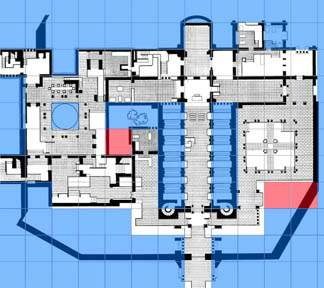
The gameplay wraps a classic isometric adventure inside a surprisingly detailed monastic simulation. The player steers Fra William through a sprawling abbey mapped across many screens rendered in 3D isometric perspective, while also having the option to independently control the novice Adso on the same screen; left alone, Adso simply trails his master. Other monks roam the abbey on programmed artificial-intelligence paths, offering written dialogue that scrolls along the bottom of the display. The action unfolds over seven days, each subdivided into Canonical hours, with the current day and hour displayed in the lower-left corner. The abbot's opening briefing sets strict rules: attend services, eat at the refectory, remain in one's cell at night. Adso nudges the player toward obligations, and the obsequium meter in the lower-right tracks obedience. Drop it to zero and the abbot ejects you. Miss a prayer or wander after dark and the game ends instantly. Collecting scattered objects across the abbey is the key to solving the murder mystery.
Technical Craft and Musical Identity
Originally built for the Amstrad CPC 6128 8-bit platform, the game was subsequently ported to the ZX Spectrum 128, MSX, and MS-DOS. The Amstrad CPC 464 edition had to shed several rooms and decorative elements to squeeze the code into 64K of memory, while the Spectrum version was exclusive to the 128K model. Musically, the game leaned on classical and choral pieces: Bach's Minuet in G major and the flute sonata BWV 1033, alongside Gwendal's Crystal Palace. The PC build added a short chorus recording of Schubert's "Ave Maria," piped through the speaker whenever the player entered the church. The developers also embedded a cheeky copy-protection gag: if a pirated copy was detected, the "Ave Maria" would be replaced by a voice shouting "¡Pirata!"—Spanish for "pirate"—ten times in descending pitch before the program crashed. These touches of personality, from the musical choices to the anti-piracy joke, gave the game a distinctive character beyond its genre conventions.
Cult Status and the Remake Ecosystem
Despite modest commercial sales and no official release outside Spain, La Abadía del Crimen carved out a devoted cult following in its home country. Its cultural footprint extended to a Spanish postal stamp bearing the game's image, and Retro Gamer later named it one of the ten perfect games for the Spectrum 128. The true legacy, however, is the extraordinary wave of community-driven remakes. Manuel Abadia disassembled the original Z80 code and rewrote it in C++ as the Vigasoco project, which was then ported via SDL to Linux, PlayStation 2 and 3, Windows, Mac OS X, Dreamcast, Google Native Client, and WebAssembly. Additional ports target the Anbernic RG350 and Android. Vigasoco was also translated to Java and GWT for browser play, adapted to Swift for iOS, and extended as The Abbey of Crime Extensum on Steam. Other efforts include a Game Boy Advance version, a J2ME commercial release, a Windows port with 256-colour graphics and translations, and an MSX2 build adding a 16-colour palette and disk load-save. The project has even seen unfinished Visual Basic and JavaScript attempts, testifying to how deeply the game grips its community.
Gallery
Frequently Asked Questions
What is La Abadía del Crimen?
It is a 1987 isometric adventure game written by Paco Menéndez with graphics by Juan Delcán, published by Opera Soft. Players follow a Franciscan friar and his novice as they track down a killer inside a medieval Italian abbey.
Why isn't the game called The Name of the Rose?
The developers originally conceived it as an adaptation of Umberto Eco's 1980 novel, but they were unable to obtain the rights to use that title. As a result, it shipped under the Spanish name La Abadía del Crimen, which translates to The Abbey of Crime.
Who created La Abadía del Crimen and on what platforms did it appear?
Paco Menéndez handled the writing and Juan Delcán produced the artwork, with Opera Soft publishing the finished product in 1987. Versions were released for the Amstrad CPC 6128, ZX Spectrum 128, MSX, and MS-DOS.
What is the gameplay like in La Abadía del Crimen?
You control William of Occam and his novice Adso, moving through the abbey's rooms in an isometric perspective to gather clues and solve puzzles surrounding a string of murders. The structure is a classic point-and-click-style investigation rather than a combat-heavy experience.
Why do Spanish retro-gaming fans still talk about La Abadía del Crimen?
Retro Gamer magazine gave it a perfect ten out of ten for the ZX Spectrum 128, a rare distinction that cemented its reputation as a benchmark adventure. It has kept a loyal cult following in Spain for decades and is frequently cited as one of the finest titles of the 8-bit era.
More in Action-adventure games 1-24
Spotted an error? Know more?
Reader corrections go straight into our review queue. Suggest an edit · How this site is sourced