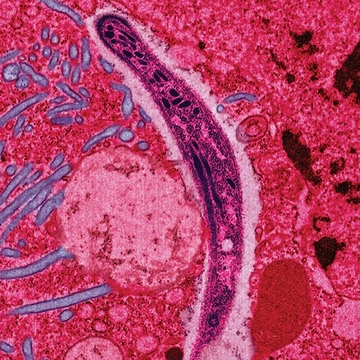
Mammomonogamus
A rare parasitic nematode causing respiratory infection in humans.
Mammomonogamus is a genus of parasitic nematodes in the family Syngamidae that primarily infects the respiratory tracts of cattle, sheep, goats, deer, cats, orangutans, and elephants. The disease caused in humans, mammomonogamiasis, is very rare, with about 100 reported cases worldwide, and is considered accidental. The most common species found in humans is M. laryngeus, which inhabits the upper respiratory region and can cause chronic coughing and asthma-like symptoms.
Quick Facts
- Most common human-infecting species
- M. laryngeus
- Incubation period
- 6 to 11 days
- Male worm length
- 3–6.3 mm / 0.01–0.021 ft
- Female worm length
- 8.7–23.5 mm / 0.029–0.077 ft
- Egg size
- about 40 x 80 μm
Facts from the source article.
Did You Know?
- The first reported human infection was diagnosed by Dr. King in a woman from St. Lucia, Antilles.
- Adult M. laryngeus worms are red to reddish-brown due to their hemophagous nature.
Taxonomic classification
Mammomonogamus belongs to the family Syngamidae, within the superfamily Strongyloidae and order Strongylata, making it a relative of hookworms. The genus name combines Latin mamma ('breast') with Greek monos ('single') and gamos ('marriage'), referring to the permanent copulation of male and female worms. Species include M. laryngeus, M. nasicola, M. gangguiensis, and M. auris, but only M. laryngeus is known to infect humans. Originally classified as Syngamus laryngeus and Syngamus kingi due to resemblance to bird gapeworms, the taxonomy was revised in 1948 by Ryzhikov. The human disease is also called mammomonogamosis, syngamosis, or syngamiasis.
Life cycle
The complete lifecycle of M. laryngeus is not fully known, but two hypotheses exist. The first proposes that infection begins by ingesting adult worms in food, water, or intermediate hosts; the adults migrate to the larynx or trachea, attach to mucosal walls, and reproduce, with eggs expelled in sputum or feces. The second hypothesis suggests that embryonated eggs or infective larvae are ingested, releasing larvae in the intestine that burrow through intestinal walls, travel via mesenteric veins to the alveoli, undergo a pulmonary cycle, and develop into adults in about seven days. Adults then migrate upward to the trachea, larynx, or bronchi, where sexual reproduction occurs, with egg production starting about three weeks later. Eggs are coughed up or excreted. Larvae may hatch from embryonated eggs outside the host. A recent case found adult worms in the duodenum, possibly from being coughed up and reswallowed. Intermediate hosts may include earthworms, snails, or arthropods, but no other vectors are known.
Pathogenesis
Little is known about how M. laryngeus causes disease. Symptoms appear only after worms reach adulthood and obstruct bronchial airways, leading to asthma-like symptoms and coughing. Bronchial inflammation or hemoptysis may occur from worms attaching to mucosal walls and ingesting red blood cells. The incubation period of six to 11 days supports the hypothesis of a pulmonary cycle. Eosinophilia is not a reliable indicator of infection severity, as levels vary widely between cases. Simple removal of worms from the upper respiratory area usually resolves symptoms, with or without antihelmintics, and no lasting tissue damage has been reported. No reinfection mechanism has been proposed; all adult worms found in a human result from ingested eggs, larvae, or adults. Most cases involve a single pair of worms, though multiple pairs may occur.
Epidemiology
Mammomonogamiasis is an uncommon infection in people but a frequent one in animals, with around 100 human cases documented. The parasite's main reservoirs are tropical livestock like cattle, along with cats, orangutans, and other hoofed mammals. Humans catch it accidentally, usually through close contact with cows or cats. The parasite likely spreads via the oral-fecal route, meaning people ingest contaminated food or water containing eggs, larvae, or possible intermediate hosts such as earthworms, snails, or arthropods. Endemic regions include parts of the Caribbean, South America, India, tropical Africa, and several Asian countries.
More in Zoonotic Parasitic Diseases
Spotted an error? Know more?
Reader corrections go straight into our review queue. Suggest an edit · How this site is sourced