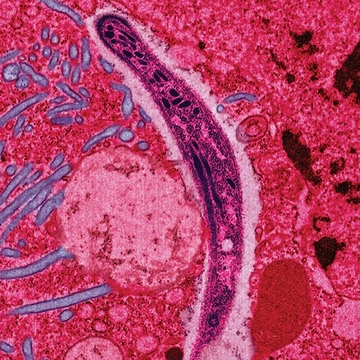
Coenurosis in humans
A rare parasitic infection from dog tapeworm larvae forming cysts.
Coenurosis is a parasitic infection caused by the ingestion of eggs from certain dog tapeworm species, including Taenia multiceps, T. serialis, T. brauni, and T. glomerata. Unlike intestinal tapeworm infections, humans serve as intermediate hosts, where the eggs develop into larvae that form fluid-filled cysts in tissues such as the central nervous system, muscles, and subcutaneous areas. The disease is notable for its rarity in humans and its potential to cause severe neurological damage.
Quick Facts
- Specialty
- Infectious diseases
Facts from the source article.
Did You Know?
- Definitive hosts for these Taenia species are canids such as dogs, wolves, foxes, and coyotes.
- No vaccination exists for coenurosis.
Symptoms and signs
Symptoms depend on the location of the cyst. In the brain, growing cysts can increase intracranial pressure or press on brain structures, leading to headaches, seizures, vomiting, ataxia, hemiplegia, monoplegia, and loss of muscle coordination. Spinal cord cysts may cause severe pain, inflammation, and arachnoiditis. Ocular cysts result in decreased vision and headaches. In muscles and subcutaneous tissues, cysts form disfiguring, painful nodules that can protrude and impair muscle function. Cysts of T. multiceps are usually 2 to 6 cm in diameter, most often in the CNS, and may contain from a few to over a hundred larvae. T. serialis and T. glomerata cysts occur in the CNS, muscles, or subcutaneous tissue, while T. brauni cysts more frequently involve the eye.
Diagnosis
Because coenurosis is very rare, diagnostic methods are limited. CT or MRI scans are the most common way to visualize cysts. Additional clinical findings include papilledemas, hypoglycorrhacia, and high intracranial pressure from ventricular obstruction. Serological and microscopic tests can confirm Taenia larvae after surgical removal of a cyst for biopsy. The disease may be misdiagnosed as neurocysticercosis or echinococcosis. A patient's exposure history is important: those living in areas with poor sanitation, high wild dog populations, or endemic tapeworm are at higher risk. Children are more often affected than adults due to greater contact with canid feces.
Management
Surgical removal of cysts is the most common treatment. Surgery is more complicated when cysts form in the central nervous system than in muscles or subcutaneous tissues. Alternative treatments include anthelmintics and glucocorticoids. Praziquantel alters cell membrane permeability, causing paralysis and disintegration of the parasite. Niclosamide uncouples oxidative phosphorylation and inhibits glucose uptake. Albendazole binds to β-tubulin, preventing microtubule polymerization and reducing glucose absorption, leading to ATP depletion and parasite death. Dexamethasone, a glucocorticoid, inhibits pro-inflammatory signals, promotes anti-inflammatory signals, reduces capillary vasodilation, and inhibits neutrophil apoptosis to manage inflammatory symptoms.
History
Human coenurosis took time to be recognized, and species differentiation remains difficult. The first diagnosed case of T. multiceps occurred in 1913 in a Paris man with CNS degeneration, convulsions, and speech difficulties; autopsy revealed two coenuri in his brain. T. glomerata was first diagnosed in 1919 in Nigeria and may cause coenurosis in parts of Africa. In 1933, a French woman had a subcutaneous cyst extracted and fed to a dog, which developed a T. serialis tapeworm infection. T. brauni was first diagnosed in 1956 in Africa and is endemic only there. Human cases have been recorded in Uganda, Kenya, Ghana, South Africa, Rwanda, Nigeria, Italy, Israel, Mexico, Canada, and the United States. In 1983, a 4-year-old girl in the USA presented with progressive muscle weakness, inability to walk, rash, abdominal pain, and neurological decline; CT showed brain cysts, and surgery revealed coenuri, but chemotherapy with praziquantel could not prevent her death. The most recent North American case was in 1994 in Los Angeles, where a 39-year-old man had an enlarging back mass; fine needle aspiration confirmed muscular coenurosis, and praziquantel successfully killed the larvae.
More in Zoonotic Parasitic Diseases
Spotted an error? Know more?
Reader corrections go straight into our review queue. Suggest an edit · How this site is sourced