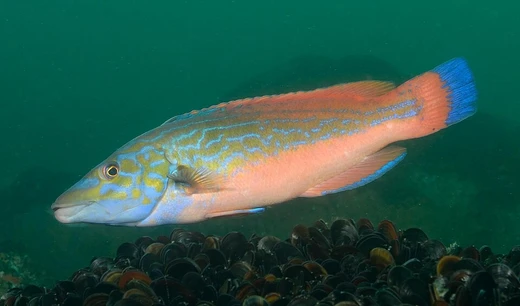
Moon wrasse
Last updated
The moon wrasse, also called the crescent or lyretail wrasse, lives in the Indian Ocean and western Pacific Ocean. It is found on coral reefs and nearby areas, from 1 to 20 meters deep.
This carnivorous fish eats fish eggs and small invertebrates living on the sea floor. It can grow up to 45 centimeters long. While not a major target for local fisheries, it does appear in the aquarium trade.
Description
Young moon wrasses have a blue lower body, a black spot in the middle of the dorsal fin, and a black blotch at the base of the tail fin. As they mature, that spot becomes a yellow crescent, which gives the fish its common name. The body is green with clearly marked scales, and the head ranges from blue to magenta with a broken checkerboard pattern.
Biology
These fish are active and territorial, spending all day moving and chasing or nipping at others that get in their way. They are diurnal, with strong vision and a decent sense of smell. At night, they rest in crevices, often under rocks, and may dig out a space by swimming through it repeatedly until they fit. Moon wrasses are protogynous hermaphrodites: all start as females and can change to males in just ten days.
Some live in groups with a dominant male and a harem of about a dozen others, including both females and males. The alpha male is more brightly colored and, at every low tide, turns from green to blue and puts on a display of attacking and nipping the others. During breeding season, just before high tide, he turns completely blue, gathers all the females, and a spawning frenzy begins.
In the aquarium
In captivity, moon wrasses can live up to ten years, though their lifespan is shorter in the wild. They are popular in the aquarium trade for their hardiness, bright colors, and active behavior. They tolerate spikes in nitrite well and eat bristle worms, which can be pests in tanks.
Scientific classification
- KingdomAnimalia
- PhylumChordata
- ClassActinopterygii
- DivisionTeleostei
- OrderLabriformes
- FamilyLabridae
- GenusThalassoma
- SpeciesThalassoma lunare
Named by (Linnaeus, 1758)
Close relatives
Other species of Thalassoma with a Codexery entry.
- Fivestripe wrasse Thalassoma quinquevittatum
- Black-barred wrasse Thalassoma nigrofasciatum
- Christmas wrasse Thalassoma trilobatum
- Jansen's wrasse Thalassoma jansenii
- Ornate wrasse Thalassoma pavo
- Saddle wrasse Thalassoma duperrey
- Sixbar wrasse Thalassoma hardwicke
- Surge wrasse Thalassoma purpureum
Sources: Wikipedia taxobox: Moon wrasse (CC BY-SA 4.0) · differs from this box at order: WoRMS AphiaID 212209 (CC BY 4.0)
Conservation status
Least Concern (LC)
- LC▲ this species
- NT
- VU
- EN
- CR
- EW
- EX
Source: IUCN Red List assessment · GBIF copy of the Red List category
How big is it?
Largest length in the source, 0.45 m, next to a 1.8 m person.
Diagram: drawn by Codexery, schematic shapes to scale (not a likeness). Length: Wikipedia: Moon wrasse
Where the moon wrasse has been recorded
Each dot is a place where the species has been observed and reported (14,423 records, half-degree grid) — not a modelled range. 40 inland records left out (institution coordinates). 2 isolated far-off records not drawn.
Map: drawn by Codexery. Data: GBIF occurrence search (records CC0 / CC BY) · Natural Earth basemap (public domain) · place coordinates: Wikipedia (CC BY-SA 4.0)
More in Wrasses
Sources
Compiled from Wikipedia and the sources listed below. Text from Wikipedia is available under CC BY-SA 4.0; this entry is adapted from it.
- Wikipedia: Moon wrasse (CC BY-SA 4.0).
- Classification: the source article's taxobox; compare WoRMS, the World Register of Marine Species (CC BY 4.0).
- Conservation status: IUCN Red List assessment.
- Occurrence records: GBIF (CC0 / CC BY). Basemap: Natural Earth (public domain).
- Word definitions: the Codexery glossary, each quoted from its Wikipedia article.
Spotted an error? Know more?
Reader corrections go straight into our review queue. Suggest an edit · How this site is sourced