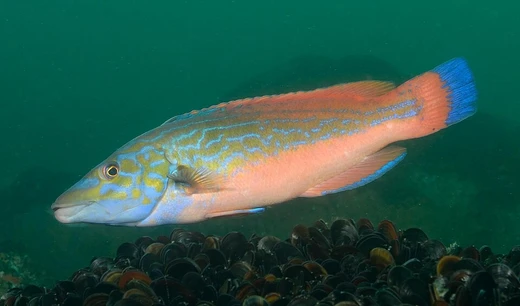
Belted wrasse
Last updated
The belted wrasse (Stethojulis balteata) is a reef fish found only in the Hawaiian Islands. First described in 1824 as Stethojulis axillaris by Quoy and Gaimard, it belongs to the wrasse family Labridae. In Hawaiian, it is called ʻOmaka, though it can also be referred to generally as hīnālea or alea for wrasse.
Its bright coloring makes it easy to spot: a light green body crossed by parallel blue lines, with a thicker orange stripe running from the pectoral fin to the tail, and an orange spiny dorsal fin. Fully grown, it reaches about 6 inches (15 centimeters) long. Like many wrasses, it is a sequential hermaphrodite, capable of changing sex during its life.
This species lives in the shallow reefs of Hawaii and also around Johnston Atoll, about 825 miles from Honolulu. It is benthopelagic, staying near the seafloor among corals and algae beds, and can be found in outer reefs up to 50 feet (15 meters) deep. At night, it buries itself in sand, a common wrasse behavior. Its diet consists of small invertebrates such as bivalves, polychaetes, sipuncula, and gastropods, and it may also eat organic waste from dead crustaceans and fish.
While the ʻOmaka can be kept in aquariums, it is not recommended because wrasses are skittish and may jump out of an uncovered tank. It is not considered a food fish today, but it may have been eaten by Native Hawaiians before missionaries arrived.
Traditional fishing methods included melomelo, where sticks coated in charred oil were submerged to attract the fish, making them easy to catch. Another technique used hinaʻi hoʻoluʻuluʻu, baskets woven from the native ʻāwikiwiki plant to trap fish. Hīnālea were also commonly offered to the gods in ceremonies, though it is uncertain whether the ʻomaka specifically was used in this way.
Scientific classification
- KingdomAnimalia
- PhylumChordata
- ClassActinopterygii
- DivisionTeleostei
- OrderLabriformes
- FamilyLabridae
- GenusStethojulis
- SpeciesStethojulis balteata
Named by (Quoy & Gaimard, 1824)
Sources: Wikipedia taxobox: Belted wrasse (CC BY-SA 4.0) · differs from this box at order: WoRMS AphiaID 219060 (CC BY 4.0)
Conservation status
Least Concern (LC)
- LC▲ this species
- NT
- VU
- EN
- CR
- EW
- EX
Source: IUCN Red List assessment · GBIF copy of the Red List category
Where the belted wrasse has been recorded
Each dot is a place where the species has been observed and reported (9,813 records, half-degree grid) — not a modelled range. 12 inland records left out (institution coordinates).
Map: drawn by Codexery. Data: GBIF occurrence search (records CC0 / CC BY) · Natural Earth basemap (public domain) · place coordinates: Wikipedia (CC BY-SA 4.0)
Physical Identity and Biological Quirks
The belted wrasse stands out in any reef community thanks to its striking and unmistakable coloration. Its body carries a pale green base tone, overlaid with a series of parallel blue lines that stretch across its flanks. Cutting between those blue stripes is a bolder orange band that extends from the pectoral fin all the way to the tail, while the spiny dorsal fin glows in a vivid orange. Together, these markings make the fish instantly recognizable among the more subdued residents of Hawaiian coral gardens.
In terms of size, it remains modest, topping out at roughly six inches, or about fifteen centimeters, when fully grown. One of the most fascinating biological traits shared by wrasses in general is sequential hermaphroditism: an individual can shift its sex at some point during its life, meaning the population contains fish that were born one sex and later function as the other. This capacity for sexual transition adds a layer of complexity to how the species reproduces and organizes its social groups on the reef.
Range, Habitat, and Daily Rhythms
Although the belted wrasse is considered endemic to the Hawaiian archipelago, its range extends slightly beyond those waters, with sightings recorded on the reefs surrounding Johnston Atoll, a remote outlying feature roughly 825 miles from Honolulu. Within its preferred environment, the species gravitates toward shallow reef structures, though it is not restricted to the very surface; individuals can be encountered on outer reef slopes descending to about fifty feet, or fifteen meters, below the waterline.
Ecologically, the ʻOmaka is classified as benthopelagic, meaning it spends much of its active hours hovering near the seafloor among coral formations and dense algae beds. Each night, it follows a behavior common to many wrasse species: it buries itself into the sandy substrate, effectively disappearing from view until dawn. Its diet consists primarily of small invertebrates, including bivalves, polychaete worms, sipunculan eelworms, and various gastropods.
On occasion, it will also scavenge organic matter left behind by dead crustaceans and fish, supplementing its invertebrate-focused foraging with whatever detritus the reef provides.
Taxonomic History and Hawaiian Nomenclature
The scientific identity of this species carries a small historical footnote. When Quoy and Gaimard first described the fish in 1824, they assigned it the name Stethojulis axillaris. Over time, the accepted binomial shifted to Stethojulis balteata, placing it firmly within the family Labridae, the large and diverse group of wrasses found across tropical and subtropical waters worldwide. The belted wrasse is one of the few Labridae members whose entire natural range is confined to a single island chain, making it a true endemic of the Hawaiian Islands.
In the local Hawaiian language, the fish goes by the name ʻOmaka, a term that carries cultural weight beyond mere taxonomy. It is also occasionally called hīnālea or alea, both of which serve as broader Hawaiian words for wrasse in general. These indigenous names reflect centuries of close observation by the people who lived alongside these reefs long before Western naturalists pressed the species into a Latin classification system. The dual naming tradition—scientific and vernacular—highlights how the same small, colorful fish has been understood through two very different lenses of knowledge.
Cultural Role and Human Encounters
The relationship between the ʻOmaka and human communities in Hawaiʻi stretches back to pre-contact times, though it was never a major food fish in the modern sense. Before missionaries arrived, Native Hawaiians likely did consume hīnālea, and they developed clever, low-impact techniques to catch them. One method, called melomelo, involved submerging sticks coated in charred oil into the water; the scent or residue would attract the curious fish, making them easy to scoop up.
Another approach, known as hinaʻi hoʻoluʻuluʻu, employed woven baskets crafted from ʻāwikiwiki, a native plant, designed to funnel and trap wrasse as they swam through. Beyond sustenance, hīnālea held a ceremonial role, appearing as offerings presented to the gods during religious observances, though it remains uncertain whether the ʻomaka specifically was the wrasse used in those rites. In the modern era, the species occasionally ends up in home aquariums, yet experts strongly discourage this.
Wrasses are naturally skittish and prone to leaping; an uncovered tank can easily lose its small, bright occupant to the floor.
Frequently Asked Questions
What does the Belted Wrasse look like?
Its body is a light green crossed by parallel blue lines, with a bold orange stripe running from the pectoral fin to the tail and an orange spiny dorsal fin. That vivid, high-contrast coloration makes it one of the easier wrasses to spot on a reef.
Where can you find the Belted Wrasse?
This species is native to the Hawaiian Islands and Johnston Atoll, where it inhabits reef environments at depths up to roughly 50 feet (15 meters). It does not occur outside that Pacific region.
More in Wrasses
Sources
Compiled from Wikipedia and the sources listed below. Text from Wikipedia is available under CC BY-SA 4.0; this entry is adapted from it.
- Wikipedia: Belted wrasse (CC BY-SA 4.0).
- Classification: the source article's taxobox; compare WoRMS, the World Register of Marine Species (CC BY 4.0).
- Conservation status: IUCN Red List assessment.
- Occurrence records: GBIF (CC0 / CC BY). Basemap: Natural Earth (public domain).
- Word definitions: the Codexery glossary, each quoted from its Wikipedia article.
Spotted an error? Know more?
Reader corrections go straight into our review queue. Suggest an edit · How this site is sourced