El Wad
Epipalaeolithic cave and terrace site in Mount Carmel, Israel.
Last updated
Where it is
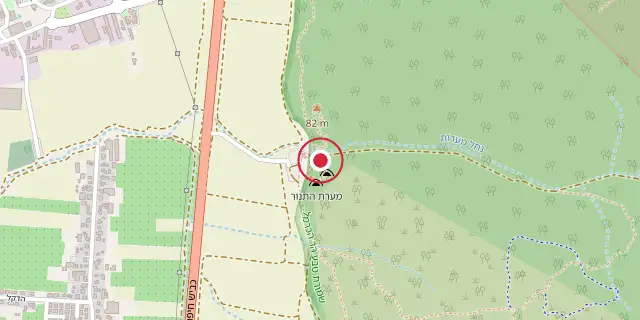
Coordinates: 32°40′16″N 34°57′58″E (32.6710, 34.9660) · Open in OpenStreetMap
Coordinates and connected clubs: the infobox of Wikipedia: El Wad (CC BY-SA 4.0). Map: drawn by Codexery from OpenStreetMap tiles.
El Wad is an Epipalaeolithic site in Mount Carmel, Israel, consisting of El Wad Cave (also called Mughārat al-Wād or HaNahal Cave) and the El Wad Terrace just outside it. Along with Tabun Cave, Jamal Cave, and Skhul Cave, it belongs to the Nahal Me'arot Nature Reserve, which is both a national park and a UNESCO World Heritage Site.
In the 1920s, the prehistory of the region was poorly understood, and quarrying for the Port of Haifa threatened the caves. In 1928, British archaeologist Charles Lambert carried out a trial excavation for the Department of Antiquities of Mandatory Palestine to evaluate the site's archaeological value. His finds included a carved bone animal head—a handle described as "sensational" and "the first prehistoric work of art recorded from the Near East"—which proved the caves' scientific importance and saved them from destruction.
The next year, the Department of Antiquities asked Dorothy Garrod to pause her work at Shuqba Cave and urgently investigate the el-Mughara caves. Garrod led large-scale excavations at El Wad for six years.
She noticed that the stone tools there resembled those from Shuqba, and she named this new industry the Natufian, after Wadi en-Natuf near Shuqba. She tentatively linked it to the European Mesolithic because both used microlithic technology. Garrod expanded Lambert's soundings to cover most of the cave interior and the exterior terrace.
In 1980–1981, François Valla and Ofer Bar-Yosef briefly excavated the terrace to re-examine Garrod's stratigraphy. In 1988–1989, Mina Weinstein-Evron dug a small untouched area at the back of the cave. Large-scale terrace excavations resumed in 1994, directed by Weinstein-Evron, Daniel Kaufman, and Reuven Yeshurun of the Zinman Institute of Archaeology, and continue to the present.
Lore & Background
Later excavations include those by François Valla and Ofer Bar-Yosef in 1980–1981 on the terrace to re-examine Garrod's stratigraphy, and by Mina Weinstein-Evron in 1988–1989 at the back of the cave. Large-scale excavations of the terrace resumed in 1994, directed by Weinstein-Evron, Daniel Kaufman, and Reuven Yeshurun of the Zinman Institute of Archaeology, and are ongoing.
Reader's Guide
El Wad holds a central place in the prehistory of the Levant as the type site for the Natufian culture, a key Epipalaeolithic industry that represents a transitional phase between mobile hunter-gatherer societies and early sedentary agricultural communities. The site's significance was first recognized through Charles Lambert's 1928 discovery of a carved bone handle, the earliest known prehistoric art from the Near East, which galvanized efforts to protect the caves from quarrying.
Dorothy Garrod's subsequent large-scale excavations from 1929 to 1934 not only defined the Natufian culture but also established a stratigraphic sequence that remains foundational for understanding the Epipalaeolithic period. The ongoing excavations since 1994 continue to refine knowledge of the site's occupation and environmental context. As part of the Nahal Me'arot Nature Reserve and a UNESCO World Heritage Site, El Wad contributes to the broader understanding of human evolution and cultural development in the Near East, and its research history illustrates the interplay between salvage archaeology, academic inquiry, and heritage preservation.
More in World Heritage Sites in Israel
Sources
Compiled from Wikipedia and the sources listed below. Text from Wikipedia is available under CC BY-SA 4.0; this entry is adapted from it.
- Wikipedia: El Wad (CC BY-SA 4.0).
Spotted an error? Know more?
Reader corrections go straight into our review queue. Suggest an edit · How this site is sourced