
Joggins
Coastal community with world-famous Carboniferous fossil cliffs.
Last updated
Where it is
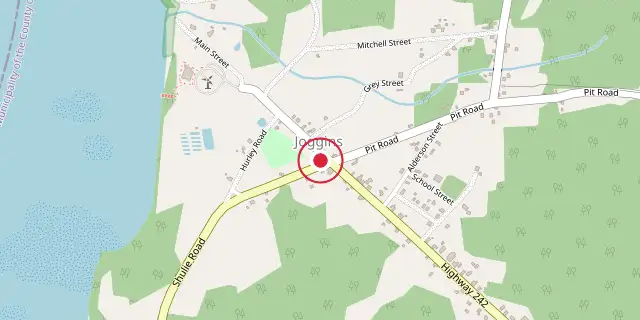
Coordinates: 45°41′31″N 64°26′38″W (45.6920, -64.4440) · Open in OpenStreetMap
Coordinates and connected clubs: the infobox of Wikipedia: Joggins (CC BY-SA 4.0). Map: drawn by Codexery from OpenStreetMap tiles.
Joggins is a rural community in western Cumberland County, Nova Scotia, Canada, known for the Joggins Fossil Cliffs, a UNESCO World Heritage Site inscribed on July 7, 2008. The area was originally called 'Chegoggins' by the Mi'kmaq, meaning 'place of the large fish weir,' and later became a long-established coal mining center with seams exploited as early as 1686 by Acadian settlers and 1715 by the British garrison at Annapolis Royal.
Lore & Background
The Joggins area was known to the Mi'kmaq as 'Chegoggins,' a name modified by French and English settlers. Coal mining began commercially in 1731 with Major Henry Cope's mine, which was abandoned due to financial difficulties and conflicts, not destroyed by the Mi'kmaq in 1732 as sometimes claimed. Later, Samuel McCully opened a mine in 1819 that shipped coal to Saint John, New Brunswick, but it closed in 1821 after mining less than 600 tons.
Large-scale industrialization came under the General Mining Association, starting in 1847, with production increasing after the Intercolonial Railway in the 1870s and the Joggins Railway in 1887. Joggins was never incorporated as a town; it remained an unincorporated community within Cumberland County. Mines closed after the 1958 Springhill Mining Disaster, and rail service ended in the early 1960s.
The Joggins Fossil Cliffs have been famous since the early 19th century for fossils in exposed Pennsylvanian coal seams. Geologists Abraham Gesner, Richard Brown, Thomas Jackson, and Francis Alger made early observations. Charles Lyell visited in 1842 and 1852, calling the exposure 'the finest example in the world.' In 1852, Lyell and Sir William Dawson discovered tetrapod fossils in an upright tree; Dawson later found Hylonomus lyelli, the earliest known sauropsid, and Protoclepsydrops, an early synapsid. The Joggins fossils were discussed by Charles Darwin in later correspondence and played a role in the 1860 Great Oxford Debate, though they are not mentioned in his On the Origin of Species.
Reader's Guide
Joggins is significant for its unparalleled record of a Pennsylvanian rainforest ecosystem, approximately 310 million years old, preserved in the Joggins Fossil Cliffs. The site's fossils include early tetrapods, the earliest known sauropsid (Hylonomus lyelli), and the early synapsid Protoclepsydrops, as well as plants like Sigillaria and trackways of the giant arthropod Arthropleura. The cliffs are continually eroded by the Bay of Fundy's high tides, exposing fresh fossils. The site was designated a UNESCO natural heritage site in 2008.
The Joggins Fossil Centre displays the geological history and the impact of coal mining on the community. The area also has a history of coal mining, shipbuilding, and more recently tourism, wild blueberry cultivation, and agricultural food processing. The fossil record contributed to debates on evolution, including the Great Oxford Debate of 1860. Recent work has been coordinated by Martin Gibling of Dalhousie University, and amateur collectors like Don Reid have donated significant collections.
Did You Know?
- Charles Lyell proclaimed the Joggins exposure 'the finest example in the world' of Coal Age rocks and fossils.
More in World Heritage Sites in Canada
Sources
Compiled from Wikipedia and the sources listed below. Text from Wikipedia is available under CC BY-SA 4.0; this entry is adapted from it.
- Wikipedia: Joggins (CC BY-SA 4.0).
- Word definitions: the Codexery glossary, each quoted from its Wikipedia article.
Spotted an error? Know more?
Reader corrections go straight into our review queue. Suggest an edit · How this site is sourced