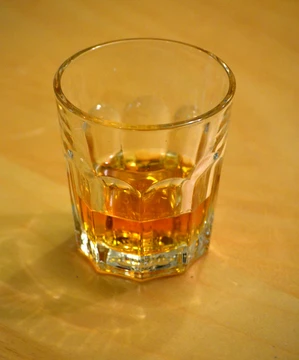
Maker's Mark
It tastes expensive ... and is.

Maker's Mark is a small-batch bourbon whisky made in Loretto, Kentucky, by Suntory Global Spirits. It comes in a squarish bottle with a red wax seal, is bottled at 90 U.S. proof (45% alcohol by volume), and is part of both the American Whiskey Trail and the Kentucky Bourbon Trail, with the distillery itself open for tours.
The brand got its start when T. William "Bill" Samuels Sr. bought the Burks' Distillery in Loretto for $35,000 on October 1, 1953. Production kicked off the following year, and the first batch was bottled in 1958, already featuring the signature dipped red wax seal. During the 1960s and 1970s, the tagline "It tastes expensive ... and is" was widely used in marketing. The distillery was added to the National Register of Historic Places on December 31, 1974, and became a National Historic Landmark on December 16, 1980, under the name "Burks' Distillery"—the first active distillery in America to receive such recognition.
Ownership changed hands several times. Hiram Walker & Sons bought Maker's Mark in 1981, then Seagram acquired it in 1987. After Seagram's collapse in 2001, Allied-Domecq took over. When Pernod Ricard bought Allied-Domecq in 2005, the brand was sold to Fortune Brands, based in Deerfield, Illinois. Fortune Brands split in 2011, and its alcohol business became Beam Inc. In January 2014, Beam Inc. was sold to Suntory, forming Beam Suntory, the third-largest distilled spirits company globally. Executives at the time promised the product's taste and historic purity standards would remain unchanged. In May 2024, Beam Suntory was rebranded as Suntory Global Spirits, complete with a new website and visual identity.
Bill Samuels Sr. created the brand, and his son Bill Samuels Jr. oversaw production until retiring as president and CEO in April 2011 at age 70. His son Rob Samuels then took over. In February 2013, the company announced via mass email a plan to lower the whiskey's proof from 90 to 84 (42% ABV) to stretch inventory by about 6%, citing supply issues. The company's tasting panel reported no taste difference, and industry analysts said the change would be subtle, especially for those who mix the bourbon or serve it on ice. Neil Irwin of *The Washington Post*'s Wonkblog suggested the move was driven by Beam's desire to keep Maker's Mark competitive as a premium bourbon in mid-range bars and a well drink in high-end bars. After a strong negative customer reaction, the company reversed course on February 17, 2013, keeping the original proof. Some overseas markets, like Australia, continued to sell at 40% ABV.
In 2014, Maker's Mark released a Cask Strength Bourbon in limited quantities, initially only at the distillery gift shop, with proof varying between 53% and 58% ABV per batch; it went global in July 2016. A major distillery expansion was announced in November 2015. In November 2018, master distiller Dave Pickerell, often called the "Johnny Appleseed of American Whiskey," died at age 62. In June 2019, the company began selling Maker's Mark 101 (101 proof) at the distillery, after introducing it at duty-free airport shops in 2018.
The bourbon itself is unusual because its mash bill uses no rye. Instead, it contains 70% corn, 16% red winter wheat, and 14% malted barley. During planning, Samuels allegedly developed seven candidate mash bills. Short on time to distill and age each, he baked a loaf of bread from each recipe, and the rye-free one won on taste. He also got considerable help and recipes from Pappy Van Winkle of Stitzel-Weller, which produced wheated bourbons like Old Fitzgerald and W. L. Weller. Aging takes about six years, with bottling happening when the company's tasters agree it's ready. Maker's Mark is one of the few distillers that rotates barrels from upper to lower warehouse levels during aging to even out temperature differences, ensuring consistent quality and taste.
The brand is marketed as a small-batch bourbon, with the producer defining the term as "a bourbon produced/distilled in small quantities of approximately 1,000 gallons or less (20 barrels) from a mash bill of around 200 bushels of grain." The squarish bottle and red wax seal were the ideas of T. William Samuels' wife, Marjorie "Margie" Samuels, who also named the whiskey and drew its label. It hit the market in 1959. Three varieties are sold: the original at 90 proof; a seasonal mint julep flavor with green wax on the neck, released in limited amounts; and Maker's 46 (47% ABV), a flavored variant.
- field
- Bourbon whisky distilling
- nationality
- American
- known_for
- Wheated bourbon, red wax seal, squarish bottle
- founded
- 1953
- founder
- T. William 'Bill' Samuels Sr.
- headquarters
- Loretto, Kentucky
Verified Timeline
Lore & Background
Maker's Mark's origin began when T. William 'Bill' Samuels Sr. purchased the Burks' Distillery in Loretto, Kentucky, for $35,000 on October 1, 1953. Production began in 1954, and the first run was bottled in 1958 under the brand's dipped red wax seal (U.S. trademark serial number 73526578). T. William Samuels' wife, Marjorie 'Margie' Samuels, gave the whiskey its name, drew its label, and thought up the wax dipping that gives the bottle its distinctive look. It was introduced to the market in 1959. The distillery was listed on the National Register of Historic Places on December 31, 1974, and designated a National Historic Landmark on December 16, 1980, listed as 'Burks' Distillery', the first distillery in America to be recognized while the landmark buildings were in active production. In the 1960s and 1970s, Maker's Mark was widely marketed with the tag line, 'It tastes expensive ... and is.'
Reader's Guide
Maker's Mark is significant as a pioneering wheated bourbon, using red winter wheat (16%) instead of rye in its mash bill of 70% corn, 16% wheat, and 14% malted barley. During planning, Samuels allegedly developed seven candidate mash bills and made a loaf of bread from each recipe; the one with no rye was judged the best tasting. Samuels also received considerable assistance and recipes from Stitzel-Weller owner Pappy Van Winkle. Maker's Mark is aged for around six years, with barrels rotated from upper to lower levels of aging warehouses to even out temperature variations. The brand was sold multiple times: to Hiram Walker & Sons in 1981, then to Seagram in 1987, Allied-Domecq in 2001, Fortune Brands in 2005, and finally to Suntory in 2014, becoming part of Beam Suntory (later Suntory Global Spirits). On February 9, 2013, the company announced a plan to reduce proof from 90 to 84, citing supply issues, but reversed the decision on February 17 after a strong negative reaction from customers. The brand has released variations including Cask Strength (2014, proof fluctuating between 53% and 58% abv), Maker's 46 (47% alcohol by volume, flavored by seared French oak staves), and Maker's Mark 101 (bottled at 101 U.S. proof, introduced at duty-free shops in 2018 and at the distillery in June 2019). It is one of a handful of American-made whiskies that uses the Scottish spelling 'whisky'. The distillery is part of the American Whiskey Trail and the Kentucky Bourbon Trail, and its Bourbon House & Lounge opened in Louisville in late 2004/early 2005.
Did You Know?
- Maker's Mark uses the Scottish spelling 'whisky' rather than the predominant American 'whiskey', along with George Dickel and Old Forester.
- The distillery was the first in America to be recognized as a National Historic Landmark while its landmark buildings were in active production, designated on December 16, 1980.
- During the 2013 proof-reduction controversy, the company reversed its decision after just eight days due to a strong negative reaction from customers.
- Marjorie 'Margie' Samuels named the whiskey, drew its label, and came up with the distinctive red wax dipping.
- Maker's Mark rotates barrels from upper to lower levels of aging warehouses during aging to even out temperature differences.
Common Misconceptions (Editorial)
- Some people mistakenly believe that Maker’s Mark uses the American spelling “whiskey,” but the brand actually uses the Scottish spelling “whisky,” as stated in the facts. - It is a common misconception that the wax seal originated solely as a marketing gimmick or practical innovation by the distillery itself, but in fact, Marjorie “Margie” Samuels came up with the wax dipping and gave the bottle its distinctive look. - Some may assume that when the company proposed lowering the proof in 2013, it stood by the change, but the facts show the company reversed its decision after just eight days due to a strong negative customer reaction.
Why It Matters (Editorial)
Maker’s Mark endures as an icon of American bourbon craftsmanship, distinguished by its wheated recipe, unique bottle design, and the family-driven innovation that gave the brand its name and signature wax seal. Its recognition as a National Historic Landmark while remaining in active production underscores how tradition and continuity can coexist, making the distillery not just a producer of whisky but a living piece of Kentucky’s cultural heritage.
Frequently Asked Questions
What is Maker's Mark and where does it come from?
It is a small-batch wheated bourbon distilled in Loretto, Kentucky, and currently produced under Suntory Global Spirits. The brand is instantly recognizable by its squarish bottle finished with a hand-dipped red wax seal.
Who founded Maker's Mark and when did production begin?
T. William 'Bill' Samuels Sr. bought the old Burks' Distillery on October 1, 1953, for $35,000, and the first run was finally bottled in 1958. That original red-wax dip has remained a signature of every bottle since.
What sets Maker's Mark apart from other bourbons?
Instead of rye, the mash bill uses wheat, which gives the spirit a noticeably softer, sweeter character. Combined with the 90 U.S. proof (45% ABV) bottling and the hand-applied wax seal, it reads as a premium, approachable bourbon.
What does Maker's Mark actually taste like?
Fans describe a rich, honeyed sweetness with prominent vanilla and caramel notes that feel well above the price tag. The wheated profile keeps the finish smooth rather than spicy, which is why many call it the easiest 'expensive' bourbon to recommend.
Can you tour the Maker's Mark distillery?
Yes—the Loretto, Kentucky site welcomes visitors for guided tours and tastings. It is a designated stop on both the Kentucky Bourbon Trail and the wider American Whiskey Trail, making it a common destination for bourbon pilgrims.
More in World of Whisky 1-20
Spotted an error? Know more?
This is a living reference — every entry is fact-audited, and reader corrections feed straight into our audit queue. Suggest an edit · See this site's audit record