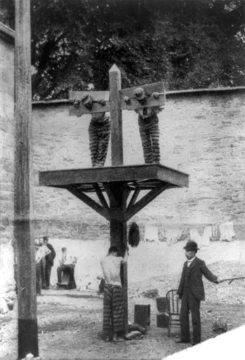
Knout
A Russian whip used for cattle prodding and corporal punishment.
Last updated
The knout is a Russian whip made from a rawhide strap or rope fixed to a long wooden handle. While often used to urge on horses or cattle, it also served as a tool for flogging in Russia’s history of corporal punishment. The English term comes from a French spelling of the Russian word кнут, which simply means “whip.”
Quick Facts
- Handle length
- about half arshin (35 cm)
- Braided rawhide piece length
- one arshin (70 cm)
- Rawhide belt length
- one arshin
- Abolished by
- Emperor Nicholas I
- Year of abolition
- 1845
- Replaced with
- pleti
Facts from the source article.
For corporal punishment
A typical knout used by Russian executioners had a wooden handle about half arshin (35 cm) long, to which a thick braided rawhide piece of one arshin (70 cm) was attached. This piece ended in a metal ring holding a wide rawhide belt of the same length, with a stiffened beak-like end.
Knouts were employed for flogging criminals and political offenders, who were tied to a post or wooden triangle and stripped, receiving strokes on the back. A sentence of 100 or 120 lashes was equivalent to a death sentence. Emperor Nicholas I abolished punishment by knout in 1845, replacing it with the pleti, a lighter whip commonly with three tails.
Did You Know?
- The word may be derived from the Swedish knutpiska, a kind of whip with knots.
- The stem knut is of generic Germanic origin, related to German Knute, Dutch knoet, Old Norse knutr, Anglo-Saxon cnotta, and English knot.
More in Whipping
Sources
Compiled from Wikipedia and the sources listed below. Text from Wikipedia is available under CC BY-SA 4.0; this entry is adapted from it.
- Wikipedia: Knout (CC BY-SA 4.0).
Spotted an error? Know more?
Reader corrections go straight into our review queue. Suggest an edit · How this site is sourced