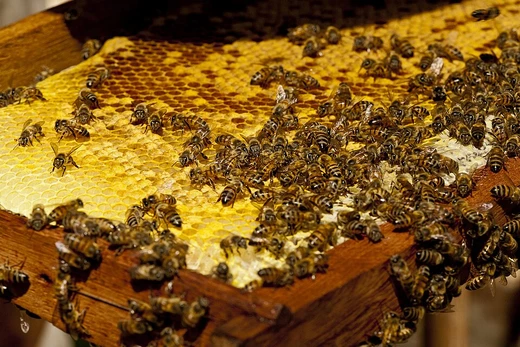
Italian bee
A commercially widespread honey bee from Italy.
The Italian bee (Apis mellifera ligustica) is a subspecies of the western honey bee. It is endemic to continental Italy south of the Alps, where it survived the last ice age. This bee is likely the most commercially distributed of all honey bees.
Quick Facts
- Genus
- Apis
- Species
- mellifera
- Subspecies
- ligustica
Facts from the source article.
Did You Know?
- Among different strains of Italian bees, there are three different colors: Leather; bright yellow (golden); and very pale yellow (Cordovan).
- Their bodies are smaller and their overhairs are shorter than those of the darker honeybee races.
- Jas. Carroll received a hive of Italian bees in Brisbane, Queensland, in 1877 when Angus Mackay accompanied a hive aboard the City of New York, packaged by Harbison in California.
Origin
The Italian honey bee is native to mainland Italy below the Alps, having endured the last ice age there. The Sicilian subspecies is Apis mellifera siciliana. Those from the Ligurian Alps in northern Italy are known as Ligurian bees, and are said to exist only on Kangaroo Island. Because they evolved in the central Mediterranean’s warmth, they struggle with harsh winters and damp, cool springs in higher latitudes. Their winter clusters are looser, leading to greater heat loss and higher food consumption. Raising brood late in autumn further increases their food needs. In 1859, beekeeper Thomas White Woodbury brought the Italian bee to Britain, considering it far better than the native Old British Black bee.
Worldwide distribution
The Italian bee was introduced to Germany in 1853, to Poland in 1854 by Dr. Jan Dzierżon, to the United Kingdom and the United States in 1859, and to Australia on 9 December 1862 into Victoria aboard the steam ship Alhambra. There is strong evidence that subsequent Italian virgin queens hybridised with the English 'black' bee previously imported. Wilhelm Abram brought several queens from Italy to Sydney in December 1880, but they probably reached New South Wales earlier through other hands. The bee was introduced to the Russian Empire in 1866, to New Zealand in 1880, and to Kangaroo Island in South Australia at Easter 1884, sourced from Brisbane where they had been imported in 1880 from Italy by Chas. Fullwood. The government of South Australia passed legislation in 1885 intended to encourage the culture of Ligurian Bees on Kangaroo Island. Honey from Kangaroo Island is marketed as being from the only pure Ligurian bees in the world.
More in Western Honey Bee Breeds
Spotted an error? Know more?
Reader corrections go straight into our review queue. Suggest an edit · How this site is sourced