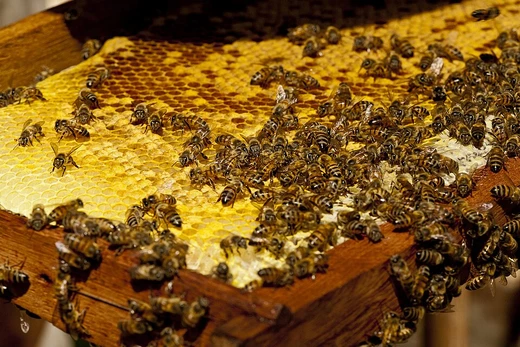
Buckfast bee
A cross-breed honey bee developed at Buckfast Abbey.
The Buckfast bee is a breed of honey bee developed by Brother Adam (born Karl Kehrle in 1898 in Germany) at Buckfast Abbey in Devon, United Kingdom, starting in 1919. It is a cross of many subspecies and their strains, created after only 16 colonies survived at the abbey in 1916, all of which were Ligurian or Ligurian queens mated with the English black bee. Breeding of the Buckfast bee is now regulated by the Federation of European Buckfast Beekeepers (G.D.E.B.) across Europe.
Quick Facts
- Developer
- Brother Adam (born Karl Kehrle)
- Location of development
- Buckfast Abbey, Devon, United Kingdom
- Year breeding began
- 1919
- Governing organization
- Federation of European Buckfast Beekeepers (G.D.E.B.)
- Countries with breeders
- over twenty six
Facts from the source article.
Origin and Heritage
The British native honeybee, a local strain of Apis mellifera mellifera, vanished from the area around Buckfast Abbey in 1915 due to the Isle of Wight disease. By 1916, only bees descended from the Italian Ligurian strain of Apis mellifera ligustica remained. Brother Adam raised a queen in 1919, later called B-1, which he considered the perfect blend of the Ligurian and native bees. All Buckfast bees trace their lineage to this single queen. Mating was uncontrolled until an isolated station was set up on Dartmoor in June 1925. Over time, Brother Adam tested many subspecies and strains for his breeding program, though not all were kept. These included the Ligurian strain of A. m. ligustica; the Gale's French, Brown Provence, Swedish, and Finnish strains of A. m. mellifera; as well as A. m. cypria, A. m. carnica, A. m. cecropia, A. m. meda (from Iraq and Iran), A. m. sahariensis, A. m. anatoliaca (Turkish and Armenian strains), A. m. caucasica, A. m. lamarckii, A. m. monticola (from Mount Elgon), A. m. adami, and A. m. macedonica (from Mount Athos). Other beekeepers joined the program in 1971, using their own isolated mating stations and instrumental insemination. Today, the Federation of European Buckfast Beekeepers (G.D.E.B.) oversees the breeding of pedigree Buckfast bees across more than twenty-six countries.
History
Brother Adam was inspired by the survival of Italian (A. m. ligustica) × dark bee (A. m. mellifera) crosses when the Isle of Wight disease, later identified as Acarine, reached Buckfast Abbey. To control matings, he used an isolated valley in Dartmoor, maintaining genetic integrity and developing desirable traits. He investigated various honey bee subspecies, making long journeys in Europe, Africa, and the Middle East, and had queens imported for his breeding program. The book In Search of the Best Strains of Bee recounts his travels. Each new bee subspecies or strain was first crossed with existing Buckfast bees; desired qualities were passed on and stabilized with further breeding, each crossing taking about 10 years. Over 70 years, Brother Adam developed a vigorous, healthy, and fecund honey bee named the Buckfast bee. It is popular among beekeepers and available from breeders in Germany, Ireland, the United Kingdom, France, and other places. Brother Adam wrote that in 1920 they obtained an average of no less than 192 lbs surplus per colony, with individual yields exceeding 336 lbs. In the 1986 BBC documentary The Monk and the Honey Bee, more than 400 pounds of honey were reported from a single Buckfast colony.
Buckfast breeding programme
The qualities desired in Buckfast bee breeding are divided into primary, secondary, and tertiary groups. Primary aims of economic importance are industry (a boundless capacity for foraging work), fecundity (the queen must fill at least eight or nine Dadant combs with brood at a certain point relative to the nectar flow), resistance to disease, and disinclination to swarm. Secondary qualities contribute to intensifying honey gathering ability: longevity (prolonging bee lifespan increases effective foraging force), wing-power (ability to forage further), keen sense of smell (linked with wing-power), instinct of defense (effective against robbing, not aggression toward the beekeeper), hardiness and wintering ability (ability to winter on inferior stores without a cleansing flight), spring development (must not occur prematurely without artificial stimulation), thrift or frugality (connected with seasonal colony development), instinct of self provisioning (seasonally appropriate brood chamber storage for overwintering), comb building (increases zest for economic activity), and gathering of pollen (positively affects longevity). Tertiary qualities reduce time and effort for seasonal care: good temper (non-aggression, docility being a characteristic of the C Lineage such as A. m. ligustica, to which the Buckfast bee is most closely related), calm behavior during manipulation, and disinclination to propolize (excess propolis increases beekeeper work).
Characteristics
Brother Adam observed that the Buckfast bee, compared to A. m. ligustica (from which it is directly descended and most closely related), was more industrious, more thrifty, less disposed to swarm, and more resistant to disease, especially Acarine (tracheal mites). Compared to most bee subspecies, the Buckfast bee collects less propolis, keeps restful in winter, builds up rapidly at the appropriate time in spring in England/northern Europe, and maintains maximum effective colony strength throughout summer, enabling full advantage of honey flow. It is unusually docile and tolerates handling in unfavourable weather. A pure Buckfast bee will swarm but is little disposed to do so, and has a reputation for unusual honey-gathering ability. In a Polish study from 2009 to 2010 comparing pure Buckfast bees with a hybrid cross of A. m. mellifera and A. m. caucasia, the Buckfast bee had a larger brood area, greater increase and strength in spring build-up, and stronger colonies at the last inspection; honey extracted during spring and summer was 34.45% greater, with less variation between hives. In another Polish study comparing foraging and hoarding abilities, the Buckfast colony collected 2.1% less syrup than a hybrid A. m. caucasia x A. m. carnica but stored 24.8% more, showing greater efficiency; it collected and stored 38.2% more syrup than a hybrid A. m. mellifera x A. m. caucasia.
More in Western Honey Bee Breeds
Spotted an error? Know more?
Reader corrections go straight into our review queue. Suggest an edit · How this site is sourced