Qing invasion of Joseon
Qing victory forced Joseon into tributary status and severed Ming ties.
Last updated
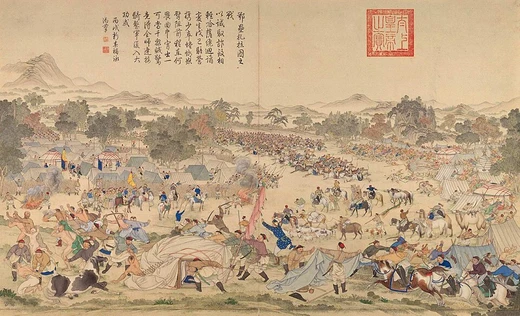
The Qing invasion of Joseon in the winter of 1636 was a military campaign by the newly established Manchu-led Qing Empire against the Joseon Kingdom. It established Qing hegemony in the Imperial Chinese tributary system and formally severed Joseon's relationship with the Ming dynasty. The invasion followed an earlier Later Jin invasion in 1627 and resulted in a Qing victory.
Background
After the 1627 Jin invasion, Joseon remained ambivalent toward the Qing. The Later Jin accused Joseon of harboring fugitives and supplying grain to the Ming army, and Joseon refused to recognize Hong Taiji's newly declared dynasty. Manchu delegates Inggūldai and Mafuta received a cold reception in Hanseong; King Injo would not meet them or send a letter, and a warlike message to Pyongan Province was seized by Inggūldai.
Qing princes proposed immediate invasion, but Hong Taiji first raided Ming, reaching the Marco Polo Bridge near Beijing. After that successful operation, he turned toward Joseon in December 1636. Prior to the invasion, Hong Taiji sent Abatai, Jirgalang, and Ajige to secure coastal approaches, preventing Ming reinforcements.
War
On 9 December 1636, Hong Taiji led Manchu, Mongol, and Han Chinese Banners in a three-pronged attack on Joseon, with Chinese support in artillery and naval contingents. Im Gyeong-eop held Baengma fortress in Uiju with 3,000 men against Dodo's 30,000-strong western division, which bypassed the fortress. Dorgon and Hooge led a Mongol vanguard straight to Hanseong, defeating its garrisons on 14 December. King Injo and 13,800 soldiers took refuge at Namhansanseong, which lacked sufficient provisions.
Hong Taiji's 70,000-strong main division laid siege. Provincial forces moved to relieve the fortress; on 28 January, Joseon forces under Hong Myeong-gu and Yu Lim engaged 6,000 Manchus. Manchu cavalry was turned back by musket fire but later ambushed Hong's troops from the rear. Yu's forces fared better, decimating Manchu attacks.
The defenders successfully countered siegeworks and blew up an artillery battery's powder magazine, killing its commander. Dorgon occupied Ganghwa Island on 27 January, capturing the king's second son and consorts. King Injo surrendered the next day.
Aftermath
Many Korean women were kidnapped and raped by Qing forces; those ransomed and released were often not welcomed by families, and divorce demands rose, but the government rejected them, stating repatriated women should not be regarded as disgraced. In 1648 Joseon was forced to provide royal princesses as concubines to Qing regent Prince Dorgon, who married Princess Uisun in 1650 after she was adopted by King Hyojong. Koreans privately harbored defiant attitudes toward the Qing, with scholars secretly using Ming-era names and some believing Joseon should have succeeded the Ming.
Despite a peace treaty forbidding fortress construction, fortresses were built around Hanseong and in the north. The future King Hyojong, held hostage for seven years in Mukden, planned an invasion of Qing called Bukbeol, but the plan died with him. From 1639 to 1894, Joseon trained a corps of Korean-Manchu translators; Shin Gye-am adapted Jurchen textbooks into Manchu script in 1639, used for yeokgwa examinations until 1684. The examination's title changed from 'Jurchen' to 'Manchu' in 1667.
Popular culture
The novel Namhansanseong by Kim Hoon, based on the invasion, was adapted into the 2017 film The Fortress. A 2009 musical of the same name, starring Yesung of Super Junior, focused on common people's survival. The 2011 film War of the Arrows, the 2015 drama Splendid Politics, the 2023 series My Dearest, and the 2024 series Captivating the King all depict events of the invasion or its aftermath.
Did You Know?
- In Korean, the invasion is called 'Byeongja Horan', where 1636 is a 'Byeongja' year in the sexagenary cycle and 'Horan' means a disturbance caused by northern or western foreigners.
- The defector Kong Youde, ennobled as Prince Gongshun, joined the attacks at Ganghwa Island and Ka Island.
More in Wars Involving Imperial China
Sources
Compiled from Wikipedia and the sources listed below. Text from Wikipedia is available under CC BY-SA 4.0; this entry is adapted from it.
- Wikipedia: Qing invasion of Joseon (CC BY-SA 4.0).
Spotted an error? Know more?
Reader corrections go straight into our review queue. Suggest an edit · How this site is sourced