Croatian–Venetian wars
Centuries-long Adriatic conflicts between Venice and Croatia.
The Croatian–Venetian wars, also known as the Croatian-Hungarian-Venetian wars, were a series of intermittent conflicts between Venice and Croatia (later in personal union with Hungary) over control of the Adriatic Sea and its eastern coast. Spanning from the 600s CE to 1420, these engagements involved naval and land battles among multiple belligerents, including polities in Zachlumia and Istria. The wars are notable for their duration and for shaping the political landscape of Dalmatia and the Croatian Littoral.
Quick Facts
- Date
- 7th century – 15th century
- Location
- Dalmatia, Croatian Littoral, Istria
- Territory
- Establishment of Venetian Dalmatia
Facts from the source article.
Historical Overview
The two polities emerged in the 7th and 8th centuries and clashed almost immediately as rival Adriatic powers. Conflicts intensified in the 9th century, lessened in the 10th, and reignited in the early 11th century. In 1000, Venetian forces began subjugating coastal towns of the Byzantine Theme of Dalmatia, territory ceded from the Byzantine Emperor to the Croatian King. Croatian kings Stephen I and Peter Krešimir IV regained much of this territory in the 1030s, but Venice re-conquered and annexed the Croatian Littoral in 1085.
After Croatia entered a personal union with Hungary in the 12th century, Croato-Hungarian kings Coloman and Béla II reclaimed large swathes of Dalmatia, though conflicts with Venice continued. Later wars became theaters of the wider Hungarian–Venetian Wars. King Louis the Great launched a campaign in 1356–1358, forcing Venice to withdraw from Dalmatia via the Zadar Peace Treaty. In 1409, Venice bought Dalmatia for 100,000 ducats from Ladislaus of Naples, establishing Venetian Dalmatia after the Battle of Motta.
The Croatian Littoral and eastern Istria remained parts of Croatia, and Croats fought Venice in later conflicts like the War of the Holy League and the Uskok War. By the early 16th century, the wars were subsumed into Ottoman–Venetian and Habsburg–Venetian wars.
Warfare until 887
Conflicts between Venetians and Croats, as well as other Slavic groups like the Narentines, began in the 7th and 8th centuries over Venetian demands for free passage without paying taxes. Doge Giovanni I Participazio fought the Narentines, concluding a peace treaty in 830. Further warfare led to another treaty in 839 among Doge Pietro Tradonico, Duke Mislav of Croatia, and Prince Družak of the Narentines. Hostilities resumed under Duke Domagoj (ruled 864–876), whom Venetian chronicler John the Deacon called the worst Duke of Slavs due to his wars against Venice and the Arabs.
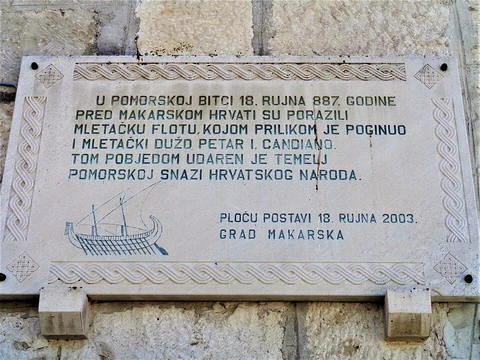
Doge Orso I Participazio attacked Croatian territory in 865, resulting in a peace agreement securing safe passage for Venetian ships. A new naval-commercial war broke out in 871 or 872, ending after Domagoj's death. On 18 September 887, the Narentines crushed a Venetian fleet led by Doge Pietro I Candiano at Makarska, killing him.
Warfare after 1000
The Venetian fleet under Orseolo took over coastal towns from Rab to Dubrovnik, including Vis, Lastovo, and Korčula, through force or surrender. The bloodiest conflict was the Battle of Lastovo in 1000, where the town was destroyed and survivors displaced. Venetian suzerainty lasted until the 1030s, when Croatian King Stjepan I took control of Zadar; he and his son Petar Krešimir IV reclaimed other coastal towns. After the Byzantine–Venetian Treaty of 1082, Venice conquered much of the Croatian coast by 1085. Doge Domenico Michele captured Split and Trogir in 1125, but King Béla II liberated them in 1133. King Béla III freed Zadar and the area between the Krka and Neretva rivers in 1180. A war between Venice and Zadar, supported by the king, lasted twenty years (1183–1203), ending with the Crusaders' capture of Zadar as payment for transport.
Period between 1203 and 1358
During periodic Venetian rule in Zadar in the 13th and early 14th centuries, citizens rebelled several times with Croato-Hungarian support, notably in 1242, 1247, 1311, and 1345–1346. Venice forced Dubrovnik to accept its governor after Rector Damjan Juda refused and committed suicide in 1205, taking control of the southernmost Croatian lands. In the north, Venice ruled western and southern Istria after military interventions in towns such as Pula (1148, 1243, 1267, 1331, 1397), Rovinj (1283), Poreč (1354), Novigrad (1270, 1358), and Umag (1269, 1370).
Venice sought central and eastern Istria but never gained permanent control over the Pazin area, despite clashes with German feudal owners holding the title of Margraves of Istria. King Louis the Angevin, who became Croato-Hungarian king in 1342, made pushing Venice from the northeastern Adriatic a key goal. He failed to aid Zadar during the Venetian siege in 1346 but strengthened his position by taking the fortress of Ostrovica in 1347. In summer 1356, he launched a large campaign, entering Zadar, Split, Trogir, Šibenik, and other towns within a year and a half.
The Treaty of Zadar on 18 February 1358 forced Venice to renounce all Dalmatian towns and islands between the Gulf of Kvarner and Drač/Durazzo in favor of the king.
More in Venetian Period in the History of Croatia
Spotted an error? Know more?
Reader corrections go straight into our review queue. Suggest an edit · How this site is sourced