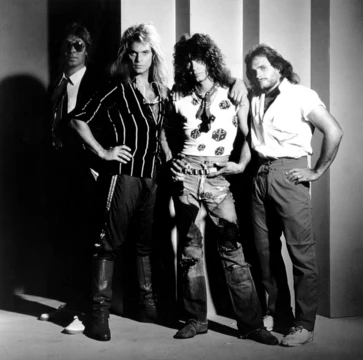
1995: Balance Released
A hard rock balancing act of light and shadow.
Released in 1995, Balance is the tenth studio album by Van Halen and the fourth and final to feature vocalist Sammy Hagar. It finds the band in a darker, more introspective mood, swapping some of their usual party-rock swagger for brooding riffs and personal lyrics. The title isn't just a word—it's a theme that runs through every track, exploring the tightrope walk between triumph and turmoil, love and loss. This album marks a pivotal moment before Hagar's departure, a last flash of brilliance from a lineup that was starting to crack.
Quick Facts
- Album
- Balance
- Artist
- Van Halen
- Release year
- 1995
- Lead vocalist
- Sammy Hagar
- Producer
- Bruce Fairbairn
- Role
- Final studio album with Sammy Hagar
Lore & Background
By 1995, Van Halen had weathered years of massive success and internal friction. Balance emerged from sessions with producer Bruce Fairbairn, known for his work with Aerosmith, which gave the album a polished yet gritty edge. The band members were at a crossroads: Eddie Van Halen's struggles with personal demons and the band's creative tensions seeped into the music, resulting in a record that felt both heavy and vulnerable. Songs like 'The Seventh Seal' and 'Don't Tell Me (What Love Can Do)' grapple with existential questions, while 'Can't Stop Lovin' You' offered a radio-friendly counterpoint.
Reader's Guide
The album's creation was marked by a shift in dynamics. Eddie Van Halen's health issues and the band's growing creative differences led to a more somber tone. Bruce Fairbairn pushed for a cohesive sound, emphasizing melody and depth. The lead single, 'The Seventh Seal,' opened with a brooding riff, while 'Don't Tell Me (What Love Can Do)' tackled social issues. 'Amsterdam' and 'Not Enough' showcased the band's range, from party anthems to ballads. The tour that followed was successful but strained, and by 1996, Hagar would leave the band, making Balance the end of an era. Its impact is felt as a fan favorite that captures the band at a crossroads, both creatively and personally.
Did You Know?
- The album's cover art features a stylized scale, symbolizing the theme of balance.
- Eddie Van Halen used a new guitar, the 'Wolfgang' prototype, on several tracks.
- The song 'Amsterdam' was inspired by the band's experiences touring in Europe.
More in Story & Timeline
Elsewhere in Van Halen
Spotted an error? Know more?
Reader corrections go straight into our review queue. Suggest an edit · How this site is sourced