Virginia
First permanent English colony in the New World.

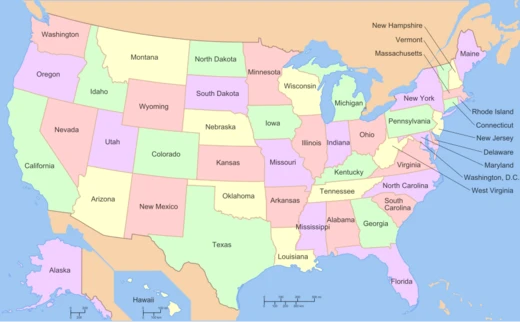
Virginia, whose official name is the Commonwealth of Virginia, sits between the Atlantic Coast and the Appalachian Mountains in the Southeastern and Mid-Atlantic United States. It shares borders with West Virginia to the west and northwest, Kentucky along a short line at the far southwest corner, Tennessee to the southwest, North Carolina to the south, and Maryland to the north. The capital is Richmond, while Virginia Beach holds the title of most populous city. With roughly 8.8 million residents, it ranks as the 12th most populous state and the 15th most densely populated. Over a third of those people live in Northern Virginia, home to Fairfax County, the state’s most populous jurisdiction. Eastern Virginia lies on the Atlantic Plain, and the Middle Peninsula forms the mouth of the Chesapeake Bay. Central Virginia sits mostly in the Piedmont, the foothills of the Blue Ridge Mountains, which cross the western and southwestern parts of the state. The fertile Shenandoah Valley supports the most productive agricultural counties, while Northern Virginia’s economy relies on tech companies and federal government agencies. Hampton Roads hosts the region’s main seaport and Naval Station Norfolk, the largest naval base in the world.
Virginia’s history starts with Indigenous groups such as the Powhatan. In 1607, the London Company founded the Colony of Virginia, the first permanent English colony in the New World, which earned the state its nickname, the Old Dominion. The colony’s economy grew on the backs of enslaved Africans and land taken from displaced native tribes, sparking conflicts both within and beyond the colony. Virginians fought for independence during the American Revolution and helped shape the new national government. During the Civil War, the state government in Richmond joined the Confederacy, while many northwestern counties stayed loyal to the Union, leading to West Virginia’s separation in 1863. After Reconstruction, the state saw nearly a century of one-party rule, but since the repeal of racial segregation laws in the 1960s and 1970s, both major political parties have competed for power. Virginia’s state legislature, the Virginia General Assembly, was established in July 1619, making it the oldest continuously operating law-making body in North America.
Quick Facts
- Official Name
- Commonwealth of Virginia
- Anthem
- "Our Great Virginia"
- Flag Alt
- Navy blue flag with the circular Seal of Virginia centered on it.
- Flag Link
- Flag of Virginia
- Seal Link
- Seal of Virginia
- Nicknames
- Old Dominion, Mother of Presidents
- Motto
- la · Sic semper tyrannis / (English: Thus Always to Tyrants)
- Officiallang
- English
- Languages
- English 86% / Spanish 6% / Other 8%
- Population Demonym
- Virginian
- Seat
- Richmond
- Largestcity
- Virginia Beach
Facts from the source article.
Lore & Background
During the American Revolution, Virginians fought for independence and helped establish the new national government. In the American Civil War, the state government in Richmond joined the Confederacy, while many northwestern counties remained loyal to the Union, leading to the separation of West Virginia in 1863. After the Reconstruction era, the state was under one-party rule for nearly a century until the repeal of racial segregation laws in the 1960s and 1970s made both major political parties competitive.
Reader's Guide
Virginia's significance lies in its role as the birthplace of English colonization in North America and as a central stage for the development of representative government, slavery, and the conflicts that shaped the United States. The Virginia General Assembly, established in 1619, is the oldest continuous law-making body in North America, reflecting early colonial demands for local control. The state's economy has evolved from a plantation-based system fueled by enslaved labor to a modern one driven by technology companies and federal government agencies in Northern Virginia, while Hampton Roads hosts the world's largest naval base. Virginia's history of Indigenous displacement, colonial expansion, and the Civil War division that created West Virginia illustrates the complex interplay of power, land, and labor that defined American history. The state's competitive two-party politics since the 1960s and 1970s mark a shift from its post-Reconstruction one-party rule.
More in U.S. States 1-24
Spotted an error? Know more?
Reader corrections go straight into our review queue. Suggest an edit · How this site is sourced