Turanoceratops
A transitional ceratopsian from the Turonian of Uzbekistan.
Last updated
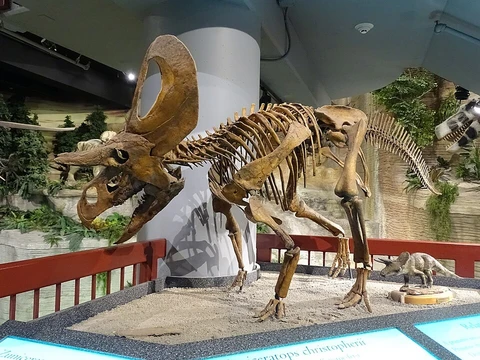
Turanoceratops is a genus of herbivorous ceratopsian dinosaur from the late Cretaceous Bissekty Formation of Uzbekistan, dating to the mid-late Turonian stage about 90 million years ago. Its skull bore a pair of long brow horns similar to those of Ceratopsidae, but the animal appears to have been transitional between earlier ceratopsians and ceratopsids rather than a true ceratopsid itself.
Scientific classification
- KingdomAnimalia
- PhylumChordata
- ClassReptilia
- CladeDinosauria
- Clade
- Clade†Ceratopsia
- Genus†Turanoceratops
- SpeciesTuranoceratops tardabilis
Named by Nesov et al., 1989
Sources: Wikipedia taxobox: Turanoceratops (CC BY-SA 4.0)
How big is it?
Largest length in the source, 2 m, next to a 1.8 m person.
Diagram: drawn by Codexery, schematic shapes to scale (not a likeness). Length: Wikipedia: Turanoceratops
Quick Facts
- Name meaning
- Turan horned face
- Type species
- Turanoceratops tardabilis
- Described by
- Lev Aleksandrovich Nesov
- L.F. Kaznysjkina
- Gennady Olegovich Cherepanov
- Year of valid description
- 1989
- Holotype
- CCMGE No. 251/12457
- Estimated length
- 2 m / 6 ft 7 in
- Estimated weight
- 175 kg / 386 lb
Facts from the source article.
Discovery and naming
Fragmentary fossils discovered near Dzharakuduk in Navoi Viloyat from the 1920s onward led Soviet scientists to suspect the presence of a ceratopsid. In 1988, Lev Aleksandrovich Nesov published the name Turanoceratops tardabilis but provided no description, leaving it a nomen nudum. The following year, Nesov, L.F. Kaznysjkina, and Gennady Olegovich Cherepanov validly named the type species. The generic name combines Turan, an old Persian term for Turkestan, with ~ceratops, meaning horned face.
The specific name tardabilis, Latin for retarding, refers to the protracted research. The holotype is a damaged left maxilla. Other referred fossils later proved to belong to other dinosaur types, including a braincase identified as sauropod. In 2004, Peter Dodson considered it a nomen dubium, but Hans-Dieter Sues and Alexander Averianov concluded in 2009 that it is a valid taxon.
Description
Turanoceratops was relatively small, with Gregory S. Paul in 2010 estimating a length of 2 m and a weight of 175 kg. Sues and Averianov in 2009 identified both basal and derived traits.
Basal features include variably developed secondary ridges on tooth crowns and only two or three teeth per tooth position. Derived traits relative to Zuniceratops include an increase to two or three teeth and teeth with two roots. More general derived traits are the exclusion of the frontal bone from the upper eye socket rim and incipient cavities in the skull roof.
Classification
Turanoceratops belongs to Ceratopsia, a group of herbivorous dinosaurs with parrot-like beaks that lived in North America and Asia during the Cretaceous and became extinct at its end. Andrew Farke and colleagues disagreed, running an independent phylogenetic analysis that placed it as the immediate sister group to Ceratopsidae rather than within it. Sues and Alexander Averianov criticized that analysis, arguing mis-coded characteristics. The describers of Sinoceratops, the only known Asian ceratopsid, conducted a phylogenetic analysis and found Turanoceratops more derived than Zuniceratops but outside Ceratopsidae, lacking several important synapomorphies of the group.
More in Turonian Dinosaurs
Sources
Compiled from Wikipedia and the sources listed below. Text from Wikipedia is available under CC BY-SA 4.0; this entry is adapted from it.
- Wikipedia: Turanoceratops (CC BY-SA 4.0).
- Word definitions: the , each quoted from its Wikipedia article.
Spotted an error? Know more?
Reader corrections go straight into our review queue. Suggest an edit · How this site is sourced