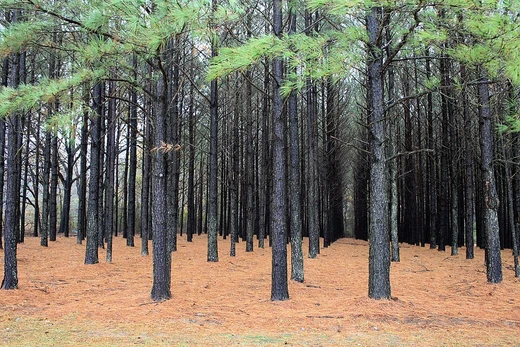
Quercus alba
Its name comes from the pale color of the leaf undersides, not the bark, which is usually light gray.[1] One of the most important hardwood trees in eastern and central North America is Quercus alba, commonly called the white oak.[2] There are records of white oak individuals that have lived for more than 450 years.[3]
Quick Facts
- Species
- alba
Facts from the source article.
Biology and range
Quercus alba is fairly tolerant of a variety of habitats, including ridges, valleys, dry and moist sites, and moderately acid and alkaline soils.[4] Although it typically grows in lowland areas, in the Appalachian Mountains it can be found at elevations up to 1,600 m.[4] Within oak-heath forests, this species frequently forms part of the upper canopy layer.[4] Oak forests, including Q. alba, were historically kept from spreading into the Midwest by the frequent fires that occurred in the Central Plains.[5][6]
After Europeans settled the region, the reduced frequency of fires allowed oak forests to rapidly expand into the Great Plains.[5][6] New leaves that emerge in spring are soft, silvery pink, and coated with a fine downy fuzz.[7] The tree first reaches sexual maturity at roughly 20 years of age, but substantial acorn production does not start until it is about 50 years old.[8] Once acorns ripen, they spoil rapidly; seeds that are six months old have only a 10% chance of germinating.[8]
What the specialist sources record
The Mingo Oak, felled in 1938, was reportedly the largest white oak in the world at 145 feet tall with a limb spread of 96 feet.[9] Phenolic compounds found in Q. alba include grandinin/roburin E, castalagin/vescalagin, gallic acid, and ellagic acid.[10][11]
References
- Wikipedia, "Quercus alba" (CC BY-SA 4.0), which cites: Keeler, "Our Native Trees and How to Identify Them", Charles Scribner's Sons, 1900, p. 328–332 (we also read that source) en.wikipedia.org
- Wikipedia, "Quercus alba" (CC BY-SA 4.0), which cites: Kirkman, "Native Trees of the Southeast", Timber Press, 2007, p. 162-64 (original not read by us) en.wikipedia.org
- Wikipedia, "Quercus alba" (CC BY-SA 4.0), which cites: ; "Eastern OLDLIST: A database of maximum tree ages for Eastern North America" (original not read by us) en.wikipedia.org
- Wikipedia, "Quercus alba" (CC BY-SA 4.0), which cites: "The Natural Communities of Virginia Classification of Ecological Community Groups (Version 2.3), Virginia Department of Conservation and Recreation, 2010"; Schafale, M. P. and A. S. Weakley. 1990. Classification of the natural communities of North Carolina: third approximation. North Carolina Natural Heritage Progr (original not read by us) en.wikipedia.org
- Wikipedia, "Quercus alba" (CC BY-SA 4.0), which cites: Abrams, "Fire and the Development of Oak Forests", BioScience, May 1992, p. 346–353 (we also read that source) en.wikipedia.org
- Marc D. Abrams, "Fire and the Development of Oak Forests", BioScience (1992), doi:10.2307/1311781. OpenAlex metadata CC0; paper not read. doi.org
- Wikipedia, "Quercus alba" (CC BY-SA 4.0), which cites: Keeler, "Our Native Trees and How to Identify Them", Charles Scribner's Sons, 1900, p. 328–332; (we also read that source) en.wikipedia.org
- Wikipedia, "Quercus alba" (CC BY-SA 4.0) en.wikipedia.org
- Encyclopedia, "September 23, 1938: Cutting of the Mingo Oak", www.wvpublic.org. facts only, no text reused. wvpublic.org
- Wikipedia, "Quercus alba" (CC BY-SA 4.0), which cites: Analysis of oak tannins by liquid chromatography-electrospray ionisation mass spectrometry. Pirjo Mämmelä, Heikki Savolainen, Lasse Lindroos, Juhani Kangas and (we also read that source) en.wikipedia.org
- Pirjo Mämmelä, "Analysis of oak tannins by liquid chromatography-electrospray ionisation mass spectrometry", Journal of Chromatography A (2000), doi:10.1016/s0021-9673(00)00624-5. OpenAlex metadata CC0; paper not read. doi.org
Each numbered sentence above was checked against the source it cites before publication. Sentences citing Wikipedia adapt text from the English Wikipedia article Quercus alba (contributors), used under CC BY-SA 4.0; this entry is available under the same licence. Other sources were used for facts only; no text or images are copied from them.
More in Trees And Forest Species
Spotted an error? Know more?
Reader corrections go straight into our review queue. Suggest an edit · How this site is sourced