Pando (tree)

United States Forest Service · Public domain
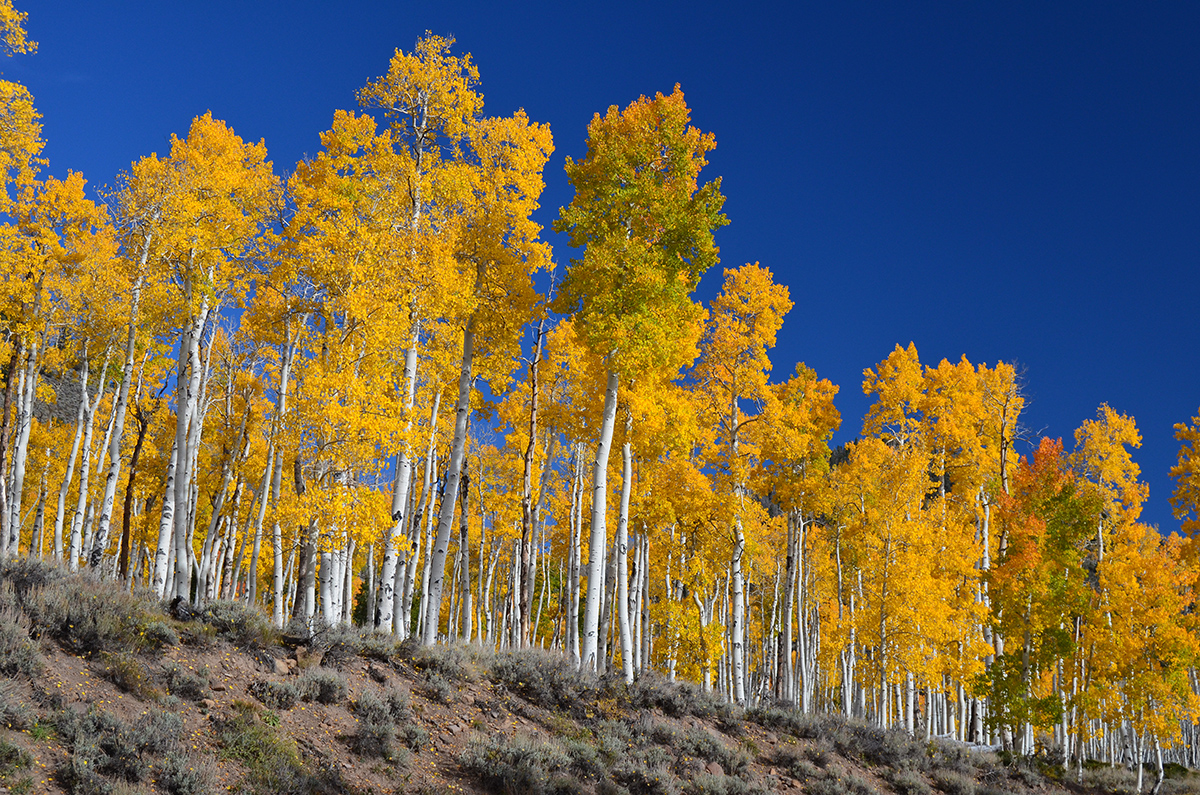
It consists of about 47,000 genetically identical stems connected by a single root system spanning 42.8 hectares.[1] Pando is considered the world's largest tree by weight and landmass.[1] Within the Fishlake National Forest in Sevier County, Utah, there exists a male clonal organism of the species Populus tremuloides, known as Pando.[2][1]
Quick Facts
- County
- Sevier County, Utah
- Country
- United States
- Elevation
- 2,700 m / 8,858 ft
- Area
- 43.6 ha / 0.168 sq mi
- Species
- Populus tremuloides
Facts from the source article.
Biology and range
Pando's stems, called ramets, appear as individual trees but are all part of one organism connected by a shared root system.[1] A 2008 genetic study by Jennifer DeWoody and colleagues confirmed the clone's size and scale.[3] Pando is surrounded by 700 square miles of de facto wildlife preserve.[4] Based on habitat modeling, the root system's maximum possible age is estimated at 14,000 to 16,000 years, though it is generally thought to be several thousand years old.[5]
The lifespan of individual stems rarely exceeds 100 to 130 years.[5] Pando occupies 42.89 hectares of land and has an estimated mass of 6,000 metric tons.[5] Along a steep basin wall, the clone's elevation ranges from 2,700 meters up to roughly 2,773 meters above sea level.[6] Jerry Kemperman and Burton V. Barnes were the ones who first identified Pando in 1976.[7]
What the specialist sources record
A 2022 paper by Jan Novák and colleagues, published in Forest Ecology and Management, indicates Pando has survived fires that would have leveled the tree, regenerating from its root system.[8][9] The U.S. Forest Service's Fire Effects Information System summarizes findings that aspen seedling establishment can be abundant on sites exposed by wildfire.[10][11] According to the same study, cattle grazing on a small southeastern portion of Pando was allowed for 10 days each October until it was halted in 2024.[8][9] In a 2018 PLOS ONE paper, Paul Rogers and Darren McAvoy emphasized that lowering herbivory from mule deer and elk is essential for Pando's conservation.[12][13]
A 2024 preprint by Rozenn M. Pineau and colleagues, posted on bioRxiv, used somatic mutation modeling to propose an age for Pando between 16,000 and 80,000 years; however, this work has not undergone peer review.[14][15]
Gallery
References
- Wikipedia, "Pando (tree)" (CC BY-SA 4.0), which cites: DeWoody, ""Pando" Lives: Molecular Genetic Evidence of a Giant Aspen Clone in Central Utah", Western North American Naturalist, 2008, p. 493–497 (original not read by us) en.wikipedia.org
- Wikipedia, "Pando (tree)" (CC BY-SA 4.0), which cites: Grant, "The Trembling Giant", October 1993, p. 82–89 (original not read by us) en.wikipedia.org
- Wikipedia, "Pando (tree)" (CC BY-SA 4.0), which cites: Grant, "The Trembling Giant", Discover Magazine, November 11, 2019; DeWoody, "Pando lives: molecular genetic evidence of a giant aspen clone in central Utah", Western North American Naturalist, 2008-01-01, p. 493–497 (original not read by us) en.wikipedia.org
- Wikipedia, "Pando (tree)" (CC BY-SA 4.0), which cites: "Pando Clone Recovery", Grand Canyon Trust, 2020-03-05 (original not read by us) en.wikipedia.org
- Wikipedia, "Pando (tree)" (CC BY-SA 4.0), which cites: DeWoody, ""Pando" Lives: Molecular Genetic Evidence of a Giant Aspen Clone in Central Utah", Western North American Naturalist, 2008, p. 493–497; "Pando", USDA Forest Service; Mock, "Clonal dynamics in western North American aspen ( Populus tremuloides )", Molecular Ecology, November 2008, p. 4827–4844; Ding, "Post-glacial biogeography of trembling aspen inferred from habitat models and genetic variance in quantitative traits", Scientific Reports, 2017-07-05, p. 4672; Pineau, "Mosaic of Somatic Mutations in Earth's Oldest Living Organism, en.wikipedia.org
- Wikipedia, "Pando (tree)" (CC BY-SA 4.0), which cites: Google earth (original not read by us) en.wikipedia.org
- Wikipedia, "Pando (tree)" (CC BY-SA 4.0), which cites: Kemperman, "Clone size in American aspens", Canadian Journal of Botany, 1976-11-15, p. 2603–2607; Mock, "Clonal dynamics in western North American aspen (Populus tremuloides)", Molecular Ecology, 2008, p. 4827–4844; Dick, "Burton v. Barnes as a Forest Botanist", The Michigan Botanist, p. 46–52 (original not read by us) en.wikipedia.org
- Wikipedia, "Pando (tree)" (CC BY-SA 4.0), which cites: Novák, "Soil macrocharcoals reveal millennial-scale stability at the Pando aspen clonal colony, Utah, USA", Forest Ecology and Management, 2022-10-01 (we also read that source) en.wikipedia.org
- Jan Novák, "Soil macrocharcoals reveal millennial-scale stability at the Pando aspen clonal colony, Utah, USA", Forest Ecology and Management (2022), doi:10.1016/j.foreco.2022.120436. OpenAlex metadata CC0; paper not read. doi.org
- Wikipedia, "Pando (tree)" (CC BY-SA 4.0), which cites: Mitton, "Genetic Variation and the Natural History of Quaking Aspen", BioScience, 1996, p. 25–31; Kay, "Aspen seedlings in recently burned areas of Grand Teton and Yellowstone National Parks", Northwest Science, 1993, p. 94–104; Howard, "Populus tremuloides", Fire Effects Information System, 1996 (we also read that source) en.wikipedia.org
- Jeffry B. Mitton, "Genetic Variation and the Natural History of Quaking Aspen", BioScience (1996), doi:10.2307/1312652. OpenAlex metadata CC0; paper not read. doi.org
- Wikipedia, "Pando (tree)" (CC BY-SA 4.0), which cites: Rogers, "Mule deer impede Pando's recovery: Implications for aspen resilience from a single-genotype forest", PLOS ONE, 2018-10-17; Rogers, "Past Management Spurs Differential Plant Communities within a Giant Single-Clone Aspen Forest", Forests, December 2019, p. 1118; "Once given a death sentence, Utah's Pando aspen grove has 'come a long way'", The Salt Lake Tribune (we also read that source) en.wikipedia.org
- Paul C. Rogers, "Mule deer impede Pando’s recovery: Implications for aspen resilience from a single-genotype forest", PLoS ONE (2018), doi:10.1371/journal.pone.0203619. OpenAlex metadata CC0; paper not read. doi.org
- Wikipedia, "Pando (tree)" (CC BY-SA 4.0), which cites: Ding, "Post-glacial biogeography of trembling aspen inferred from habitat models and genetic variance in quantitative traits", Scientific Reports, July 5, 2017 (original not read by us) en.wikipedia.org
- Rozenn M. Pineau, "Mosaic of somatic mutations in one of Earth’s largest organisms, Pando", bioRxiv (Cold Spring Harbor Laboratory) (2024), doi:10.1101/2024.10.19.619233. OpenAlex metadata CC0; paper not read. doi.org
Each numbered sentence above was checked against the source it cites before publication. Sentences citing Wikipedia adapt text from the English Wikipedia article Pando (tree) (contributors), used under CC BY-SA 4.0; this entry is available under the same licence. Other sources were used for facts only; no text or images are copied from them.
More in Trees And Forest Species
Spotted an error? Know more?
Reader corrections go straight into our review queue. Suggest an edit · How this site is sourced