Kepler-16b
Last updated

Jet Propulsion Laboratory (JPL) / NASA («Courtesy NASA/JPL-Caltech») · Public domain
It was the first confirmed circumbinary planet discovered, meaning it orbits two stars rather than one.[1] The planet orbits near the outer edge of the habitable zone but has surface temperatures around -100 to -70 °C.[2]
Key facts and history
Kepler-16b was discovered in 2011 using NASA's Kepler space observatory via the transit method.[3] The discovery team leader Laurance Doyle stated this was "the best-measured planet outside the Solar System"[3] The planet orbits its binary stars every 228 days at a distance of 0.704 AU.[4] Kepler-16b orbits a K-type and M-type binary star system whose stars orbit each other every 41 days.[5]
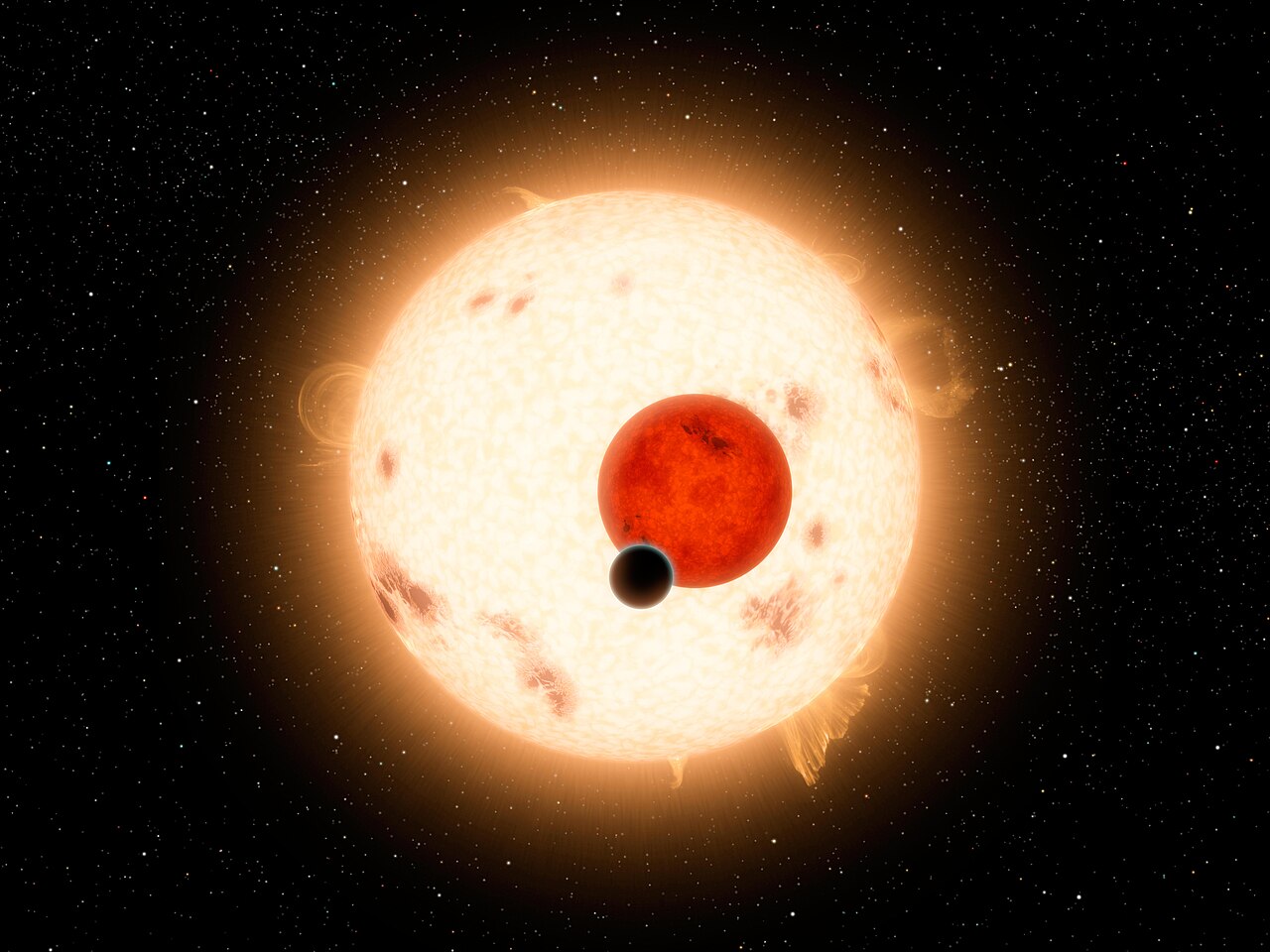
The planet likely migrated to its current orbit rather than forming there.[4] The planet was identified when astronomers observed a star dimming at a time when the other star in the binary system was not blocking its light.[3] By September 2011, the precision of Kepler-16b's radius measurement, at 0.3%, exceeded that of all other known exoplanets at the time.[3] Kepler-16b's orbit lies at a distance from the stars that is less than the previously assumed minimum distance for a planet to form around a binary star.[6]
What the research research sources say
The binary system has a 41.0781 day period with two K or M components.[7] Star A has a temperature of 4450 ± 150 K and radius 0.6489 ± 0.0013 solar radii.[7] Star B has a mass of 0.20255 ± 0.00065 solar masses and radius 0.22623 ± 0.00059 solar radii.[7] The binary system's orbital inclination is 90.3401 ± 0.0019 degrees.[7]
A moon around a gas giant must sustain an atmosphere for billions of years, with mass, radiation, solar flux, and magnetic effects all affecting atmosphere retention.[8]
References
- Wikipedia, "Kepler-16b" (CC BY-SA 4.0), which cites: Drake, "On Kepler-16b, shadows come in pairs", Science News; Doyle, "Kepler-16: A Transiting Circumbinary Planet", Science, 2011, p. 1602–6; "From Star Wars to science fact: Tatooine-like planet discovered", Smithsonian Science (original not read by us) en.wikipedia.org
- Wikipedia, "Kepler-16b" (CC BY-SA 4.0), which cites: "Exoplanets Continuously Within the Habitable Zone - Planetary Habitability Laboratory @ UPR Arecibo", sites.google.com (original not read by us) en.wikipedia.org
- Wikipedia, "Kepler-16b" (CC BY-SA 4.0), which cites: Gold, "Scientists find planet orbiting two suns like in 'Star Wars'", Los Angeles Times, 2011-09-15; Gold, "Scientists find planet orbiting two suns like in 'Star Wars'", Los Angeles Times, 2011-09-15; Overbye, "NASA Detects Planet Dancing With a Pair of Stars", The New York Times, 2011-09-15; Overbye, "NASA Detects Planet Dancing With a Pair of Stars", The New York Times, 2011-09-15; Winn, "Spin-orbit alignment for the circumbinary planet host Kepler-16 A", The Astrophysical Journal, 2011, p. L1 (original not read by us) en.wikipedia.org
- Wikipedia, "Kepler-16b" (CC BY-SA 4.0), which cites: Pierens, "Migration and gas accretion scenarios for the Kepler 16, 34, and 35 circumbinary planets", Astronomy & Astrophysics, 2013, p. A134 (original not read by us) en.wikipedia.org
- Wikipedia, "Kepler-16b" (CC BY-SA 4.0), which cites: Fraser Cain, "How Old is the Sun?", Universe Today, 16 September 2008; Fraser Cain, "Temperature of the Sun", Universe Today, September 15, 2008 (original not read by us) en.wikipedia.org
- Wikipedia, "Kepler-16b" (CC BY-SA 4.0), which cites: Overbye, "NASA Detects Planet Dancing With a Pair of Stars", The New York Times, 2011-09-15; Overbye, "NASA Detects Planet Dancing With a Pair of Stars", The New York Times, 2011-09-15; Overbye, "NASA Detects Planet Dancing With a Pair of Stars", The New York Times, 2011-09-15 (original not read by us) en.wikipedia.org
- Jean Schneider, "Notes for Planet Kepler-16 (AB) b", 2011. facts only, no text reused. exoplanet.eu
- "In Search Of Habitable Moons", Pennsylvania State University. facts only, no text reused. xs4all.nl
Each numbered sentence above was checked against the source it cites before publication. Sentences citing Wikipedia adapt text from the English Wikipedia article Kepler-16b (contributors), used under CC BY-SA 4.0; this entry is available under the same licence. Other sources were used for facts only; no text or images are copied from them.
More in Transiting Exoplanets
Sources
Compiled from Wikipedia and the sources listed below. Text from Wikipedia is available under CC BY-SA 4.0; this entry is adapted from it.
- Wikipedia: Kepler-16b (CC BY-SA 4.0).
- Word definitions: the Codexery glossary, each quoted from its Wikipedia article.
Spotted an error? Know more?
Reader corrections go straight into our review queue. Suggest an edit · How this site is sourced