GJ 1214 b
Last updated

ESO/L. Calçada · CC BY 4.0
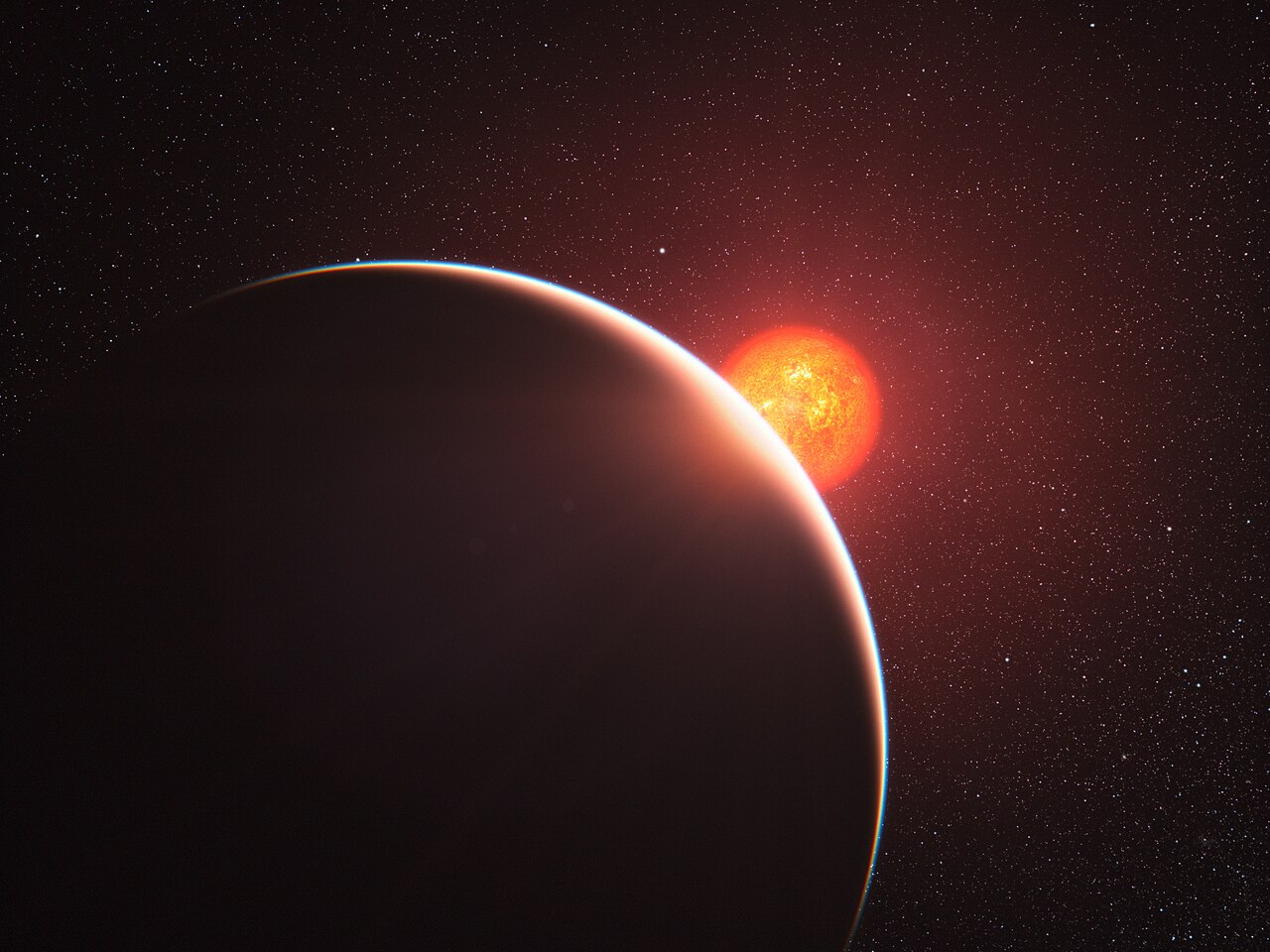
GJ 1214 b, also called Enaiposha since 2023, is a sub-Neptune exoplanet orbiting the star GJ 1214 in Ophiuchus, 48 light-years from the Sun.[1][2][3] It was the second planet between Earth and Neptune in mass to have both its mass and radius measured.[3] Its equilibrium temperature is believed to range from 393 to 555 K.[4]
Key facts and history
The planet was discovered in December 2009.[1] Its radius is 2.733 Earth radii and its mass is 8.41 Earth masses.[5] That study ruled out a thick, cloud-free hydrogen-rich atmosphere.[6] Upon its discovery, GJ 1214 b was regarded as the best candidate for an ocean planet, a type frequently described as a "waterworld" by researchers at that time.[2]
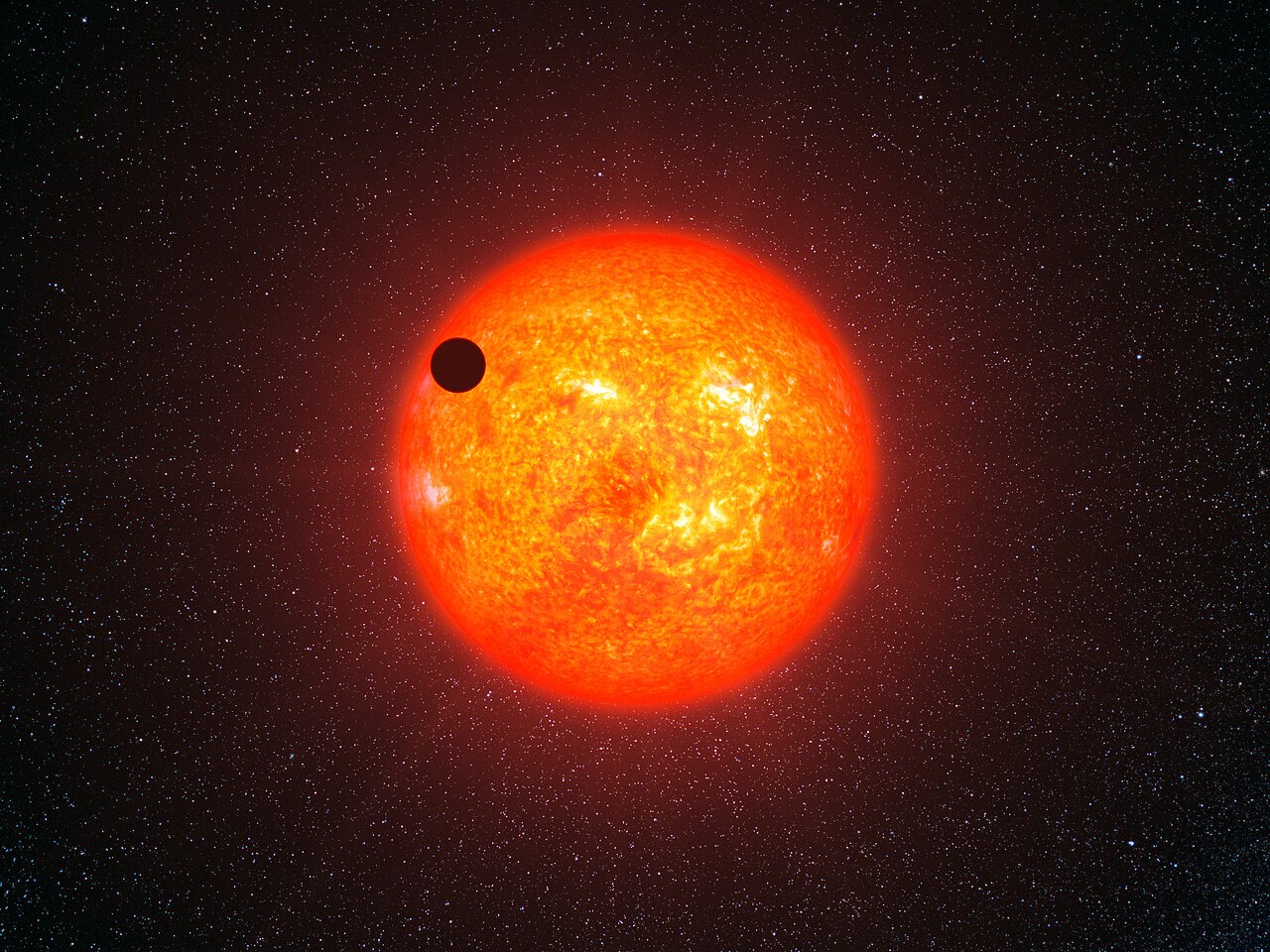
In June 2023, the name Enaiposha—derived from the Maa term for a large body of water—was officially approved for this planet.[7][8] Research published in December 2010 indicated that the planet's transmission spectrum lacked significant features across the 750–1000 nm wavelength range.[6] A NASA announcement from December 2013 stated that evidence for clouds in the atmosphere of GJ 1214 b had possibly been found.[9] According to a 2024 study, the atmosphere of GJ 1214 b might be rich in carbon dioxide, giving it a composition similar to that of Venus.[9]
What the research sources say
A University of Arizona news article states that an international team used the James Webb Space Telescope to unveil the nature of GJ 1214 b's atmosphere for the first time.[10] The same article reports that theoretical models confirmed the atmosphere is likely carbon-dominated, like a "super-Venus"[10] A NASA press release from 2013 states that Hubble spectra ruled out cloud-free compositions of water vapor, methane, nitrogen, carbon monoxide, or carbon dioxide for the first time.[11] That release also notes that earlier spectra indicated GJ 1214 b’s atmosphere was dominated by water vapor or hydrogen, with high-altitude clouds.[11]
References
- Wikipedia, "GJ 1214 b" (CC BY-SA 4.0), which cites: Rein, Hanno, "Open Exoplanet Catalogue –", Open Exoplanet Catalogue; "2022 Approved Names", nameexoworlds.iau.org (we also read that source) en.wikipedia.org
- Wikipedia, "GJ 1214 b" (CC BY-SA 4.0), which cites: Kuchner, "Mass–radius relationships for solid exoplanets", The Astrophysical Journal, 2007, p. 1279–1297; "10 real planets that are stranger than science fiction", iflscience.com, 3 June 2015; "New Insights into the Internal Structure of informed by JWST", The Astrophysical Journal Letters, 2024, p. L28 (original not read by us) en.wikipedia.org
- Wikipedia, "GJ 1214 b" (CC BY-SA 4.0), which cites: "Three possible origins for the gas layer on", The Astrophysical Journal, 2010, p. 1208–1216 (original not read by us) en.wikipedia.org
- Wikipedia, "GJ 1214 b" (CC BY-SA 4.0), which cites: Aguilar, David A., "Astronomers find super-Earth using amateur, off-the-shelf technology", Harvard-Smithsonian Center for Astrophysics, 2009-12-16 (original not read by us) en.wikipedia.org
- Wikipedia, "GJ 1214 b" (CC BY-SA 4.0), which cites: Mahajan, "Using JWST Transits and Occultations to Determine ∼1% Stellar Radii and Temperatures of Low-mass Stars", The Astrophysical Journal Letters, 2024-03-01, p. L37; Mahajan, "Using JWST Transits and Occultations to Determine ∼1% Stellar Radii and Temperatures of Low-mass Stars", The Astrophysical Journal Letters, 2024-03-01, p. L37 (original not read by us) en.wikipedia.org
- Wikipedia, "GJ 1214 b" (CC BY-SA 4.0), which cites: Bean, "A ground-based transmission spectrum of the super-Earth exoplanet", Nature, 2010, p. 669–672; Kasper, "Nondetection of helium in the upper atmospheres of three sub-Neptune exoplanets", The Astronomical Journal, 2020, p. 258; Orell-Miquel, "A tentative detection of He I in the atmosphere of", Astronomy & Astrophysics, 2022, p. A55 (original not read by us) en.wikipedia.org
- Wikipedia, "GJ 1214 b" (CC BY-SA 4.0), which cites: "List of ExoWorlds 2022", nameexoworlds.iau.org, 8 August 2022 (original not read by us) en.wikipedia.org
- Wikipedia, "GJ 1214 b" (CC BY-SA 4.0), which cites: "2022 Approved Names", nameexoworlds.iau.org (original not read by us) en.wikipedia.org
- Wikipedia, "GJ 1214 b" (CC BY-SA 4.0), which cites: Harrington, "Release 13-383 – NASA's Hubble Sees Cloudy Super-Worlds With Chance for More Clouds", NASA, December 31, 2013; Moses, "Extrasolar planets: Cloudy with a chance of dustballs", Nature, January 1, 2014, p. 31–32; Knutson, Heather, "A featureless transmission spectrum for the Neptune-mass exoplanet GJ 436b", Nature, January 1, 2014, p. 66–68; Kreidberg, Laura, "Clouds in the atmosphere of the super-Earth exoplanet", Nature, January 1, 2014, p. 69–72; Schlawin, "Possible Carbon Dioxide Above the Thick Aerosols of GJ 1214 b", The Astro en.wikipedia.org
- "Spectra from a carbon dioxide world: Astronomers unlock the atmospheric secrets of a 'new class of planet' University of Arizona News", news.arizona.edu. facts only, no text reused. news.arizona.edu
- Harrington, "Release 13-383 – NASA's Hubble Sees Cloudy Super-Worlds With Chance for More Clouds", NASA, December 31, 2013. facts only, no text reused. nasa.gov
Each numbered sentence above was checked against the source it cites before publication. Sentences citing Wikipedia adapt text from the English Wikipedia article GJ 1214 b (contributors), used under CC BY-SA 4.0; this entry is available under the same licence. Other sources were used for facts only; no text or images are copied from them.
More in Transiting Exoplanets
Sources
Compiled from Wikipedia and the sources listed below. Text from Wikipedia is available under CC BY-SA 4.0; this entry is adapted from it.
- Wikipedia: GJ 1214 b (CC BY-SA 4.0).
- Word definitions: the Codexery glossary, each quoted from its Wikipedia article.
Spotted an error? Know more?
Reader corrections go straight into our review queue. Suggest an edit · How this site is sourced