Octave Callandreau
French astronomer who advanced celestial mechanics and studied the transit of Venus.
Last updated

via Wikipedia: Octave Callandreau · see source
Pierre Jean Octave Callandreau, a French astronomer born on 18 September 1852 in Angoulême, France, made his mark in celestial mechanics by calculating orbits and applying perturbation theory. He became a professor of astronomy at the École Polytechnique in 1893, and his career included a key role in the 1882 French mission to Haiti to observe the transit of Venus.
Life and work
Callandreau entered the École Polytechnique in 1874, then worked as an assistant to Le Verrier at the Paris Observatory. He studied celestial mechanics under Victor Puiseux at the Sorbonne and became adjoint astronomer in 1881. In 1879 he translated Hugo Gyldén's Swedish work on perturbation theory. His tasks included checking Lalande's star catalogue and developing a method for computing Laplace's coefficients in planetary theory.
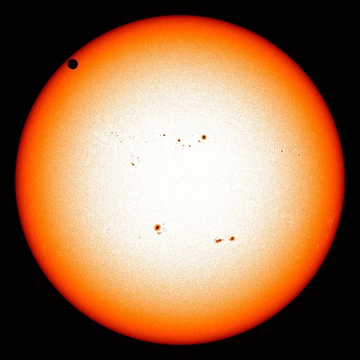
For his doctoral thesis at the Faculty of Sciences in Paris, he applied Gyldén's method to the perturbations of minor planets. Elected to the Académie des Sciences in 1892, he became a professor of astronomy at the École Polytechnique the next year. As president of the Société Astronomique de France in 1899, he began a large-scale study of shooting stars. He traveled with the French mission to Haiti in 1882 to observe the transit of Venus.
From 1884 he was a founding member and editor of the Astronomical Bulletin. He married Sophie de Luynes in 1882, and they had seven children.
More in Transit of Venus
Sources
Compiled from Wikipedia and the sources listed below. Text from Wikipedia is available under CC BY-SA 4.0; this entry is adapted from it.
- Wikipedia: Octave Callandreau (CC BY-SA 4.0).
Spotted an error? Know more?
Reader corrections go straight into our review queue. Suggest an edit · How this site is sourced