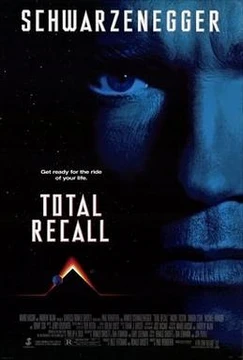
Special effects of Total Recall (1990 film)
Practical effects dominated in an early CGI era.
The 1990 action film Total Recall relied almost entirely on practical effects, with over 100 visual effects produced at a time when computer-generated imagery was a new and rarely used technique. The visual effects were developed by Dream Quest Images, with contributions from Stetson Visual Services, Metrolight Studios, and Industrial Light & Magic. The film's special effects included miniatures, bluescreen effects, and extensive creature effects.
Quick Facts
- Film
- Total Recall (1990)
- Visual effects supervisor
- Eric Brevig
- Special effects photographer
- Alex Funke
- Special effects supervisor
- Thomas L. Fisher
- Creature effects
- Rob Bottin
- Production designer
- William Sandell
- Effects producer
- Mary Siceloff
Facts from the source article.
Did You Know?
- Visual-effects plates were in VistaVision for the largest negative possible.
- Bottin had been asked to work on the film while it was being developed by De Laurentiis, but chose to work on The Thing (1982).
Creature effects and prosthetics
Rob Bottin, who previously collaborated with Verhoeven on RoboCop, handled the creature effects. To sidestep the backlash over RoboCop's violence, Verhoeven and Bottin chose to emphasize distorted, stretched flesh rather than blood, though the film still used more than 3,000 blood packs. Many intricate makeup effects were finished in post-production. For the Martian decompression scenes, Bottin created face molds of Schwarzenegger, Ticotin, and Cox by applying latex as they made exaggerated expressions. These molds became masks with small air pockets that could be inflated to further warp features. Bottin thought through how the eyes, tongue, and neck would behave during such distortions.
Visual effects
Verhoeven did not want the hologram effects to appear slick. For the low-tech tennis instructor hologram, the actress was filmed against a bluescreen; the footage was loaded into the camera alongside a blank film reel and a second take created a raster effect. Footage outside the raster area was double-exposed to make it brighter. When Lori does not match the instructor, it flashes red via a five-frame red filtered exposure of a black-and-white version. Ripple glass distorted the footage when Schwarzenegger walks through it. For high-tech holograms, linescreens and ripple glass were added only when disturbed. For the holographic watch scene, Schwarzenegger was filmed with a camera dolly on the left using a motion-control track; footage was played back in sync as he repeated movements on the right. When the hologram dissolves, he was filmed against a bluescreen and a line pattern and ripple-glass effect were used to de-rez him. The train-station X-ray scanner effect, led by Tim McGovern and his team, used a 24 ft–30 ft ramp with black tempered glass; Verhoeven believed the sequence was more effective if shown in an offhand manner.
Sets and vehicles
Set construction for Total Recall kicked off in January 1989, with thirty-five different sets spread across eight soundstages at Estudios Churubusco. As soon as filming wrapped on one set, it was dismantled to clear space for the next. Long tunnels linked these large sets, extending beyond the stages so futuristic vehicles could drive between them. Director Paul Verhoeven liked to shoot scenes in single, extended takes, which meant he could start filming on one set and track the cast straight into the next, sometimes with up to 400 people on hand. Cox noted that despite the scale, the production felt low-budget because so much money went into the sets. The reactor sequence with Schwarzenegger and Ticotin was shot on stages 7 and 8. The bridge, called "the plank," was mounted on scaffolding at one end, with the other end open and a 20-by-40-foot backlit bluescreen hanging in front. The actors were greased and sprayed with fake sweat, but this interfered with the bluescreen work, so they were dried off. Verhoeven sometimes played music to boost their emotions, while fluorescent green lights underneath provided a glow. To create the illusion of location shooting, a full-scale Martian landscape set about 15 by 100 feet was built, but it was too small for the vast exteriors Verhoeven wanted. It was reused for walking scenes, enhanced with matte paintings and forced-perspective miniatures from Stetson. Blending these effects required careful experimentation with details like sand grain size, contrast, and color. Like the main Mars set, the miniatures—such as canyon walls and mountains—were repeatedly reused and adapted to keep costs down.
Miniatures
The miniature work for the film was handled by Stetson in Los Angeles, with Mark Stetson and Robert Spurlock overseeing the team. To achieve a convincing depth of field, the miniatures were shot using long exposures; capturing just five seconds of footage could take hours. These models were built and filmed separately from the main live-action shooting, which took place in Mexico. Director Paul Verhoeven would frequently drop by Stetson’s facility after his own filming was done to suggest changes to the models. The sets used forced perspective to suggest an infinite landscape, but the resulting images were too crisp, which made blending them with a painted sky look unnatural. Funke described this as one of his toughest challenges, likening it to the notoriously troubled effects work on Damnation Alley. The fix involved shooting each scene twice: once with a bright matte sky against a dark horizon, and again with a thin layer of smoke that blurred the line between the sky and the model. Brevig’s team struggled to show a barren landscape because they couldn’t rely on usual tricks like smoke to hide imperfections. The terrain had to stay sharp and show clear depth from front to back to sell the scale. Most landscape miniatures were shaped like trapezoids, twenty to thirty-five feet deep, with the narrow end facing the camera. Some sets stretched sixty-five to seventy feet wide, built at roughly a 1/200 scale. The frames were made from chicken wire, covered with old carpet, and then dressed by model-maker George Trimmer with fine sand and red mortar dye. The canyon floor wasn’t meant to be seen but had to be deep, so the whole model was raised six feet off the ground.
More in Characters
Elsewhere in Total Recall
Spotted an error? Know more?
Reader corrections go straight into our review queue. Suggest an edit · How this site is sourced